
How to Tell If a Company Is Actually Good at Making Money
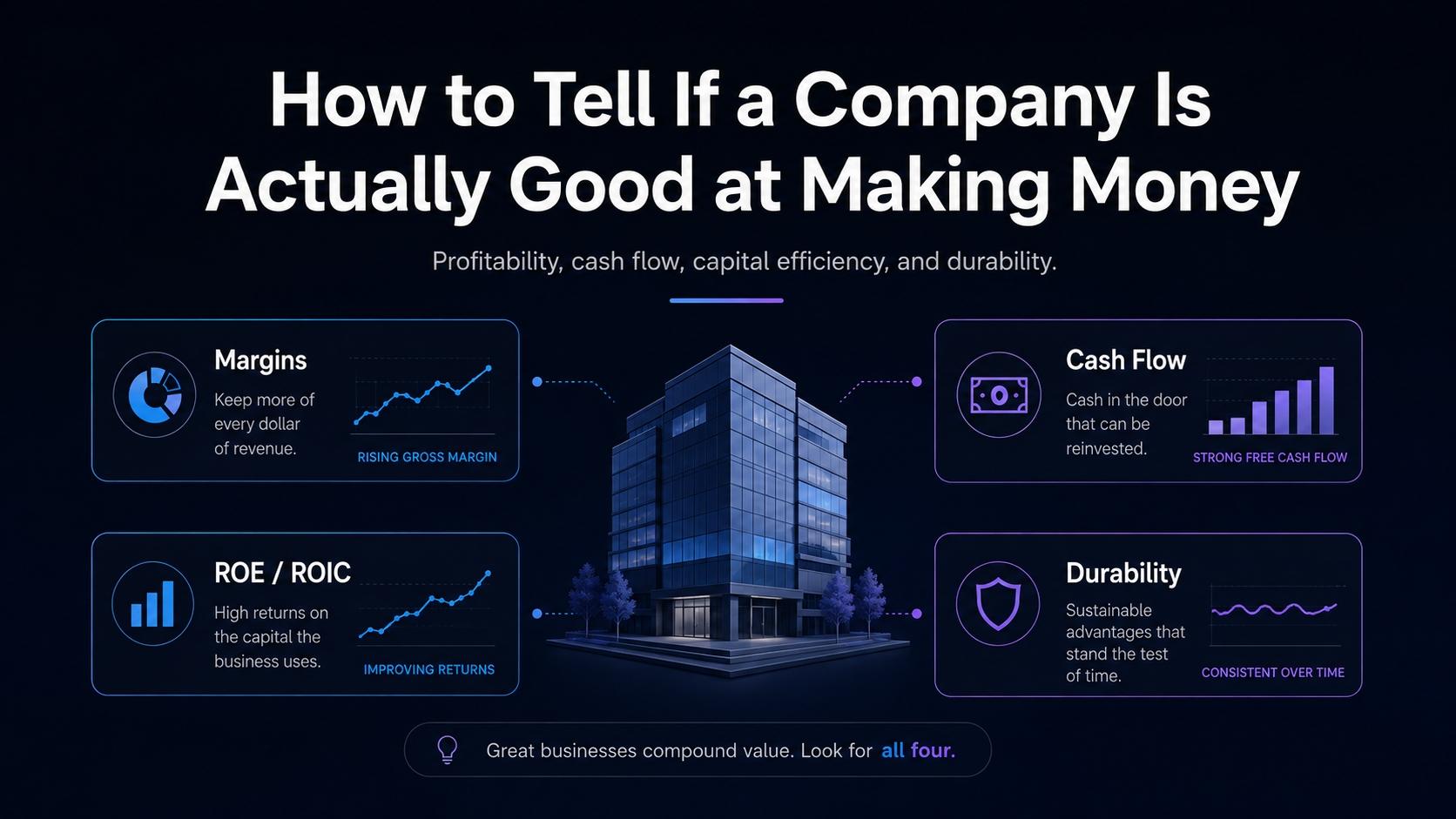
A company can grow sales while margins weaken, report higher earnings without generating comparable cash, or produce an impressive return on equity because it uses more debt. That is why one headline number rarely tells you whether the underlying business is strong.
A more useful approach is to look at a company through a few connected lenses: profitability, cash quality, capital efficiency, cost discipline, and durability.
1. Start with profitability
The income statement shows how revenue is converted into profit. The most useful way to read it is from top to bottom:
Gross margin
Gross margin shows how much revenue remains after the direct cost of producing or delivering a product or service. It can reveal pricing power, product economics, cost advantages, or pressure from competition.
There is no universal “good” gross margin. A software company and a supermarket operate with very different economics, so comparisons are most useful against the company’s own history and close peers.
Operating margin
Operating margin goes further by including the expenses needed to run the business, such as sales, administration, and research and development. A company can have excellent gross margins and still produce weak operating profits if those expenses consume most of its gross profit.
Net margin
Net margin shows how much of each dollar of revenue ultimately becomes profit after operating costs, interest, taxes, and other items. For investors, the trend is often more useful than the absolute number.
2. Check whether profits turn into cash
Net income and cash flow are not the same thing. Under accrual accounting, revenue and expenses can be recognized before or after cash actually changes hands. That makes cash flow an important check on reported earnings.
Operating cash flow
Operating cash flow measures cash generated by the company’s core operations. Over time, investors generally want to see cash generation support reported profits.
Free cash flow
Free cash flow estimates how much cash remains after the company funds capital investment in assets such as equipment, factories, stores, or data centers. That cash can then support reinvestment, debt repayment, dividends, share repurchases, or acquisitions.
3. Ask how much capital it took
Two companies can earn the same profit but require very different amounts of capital to get there. That difference is why return metrics matter.
Return on equity
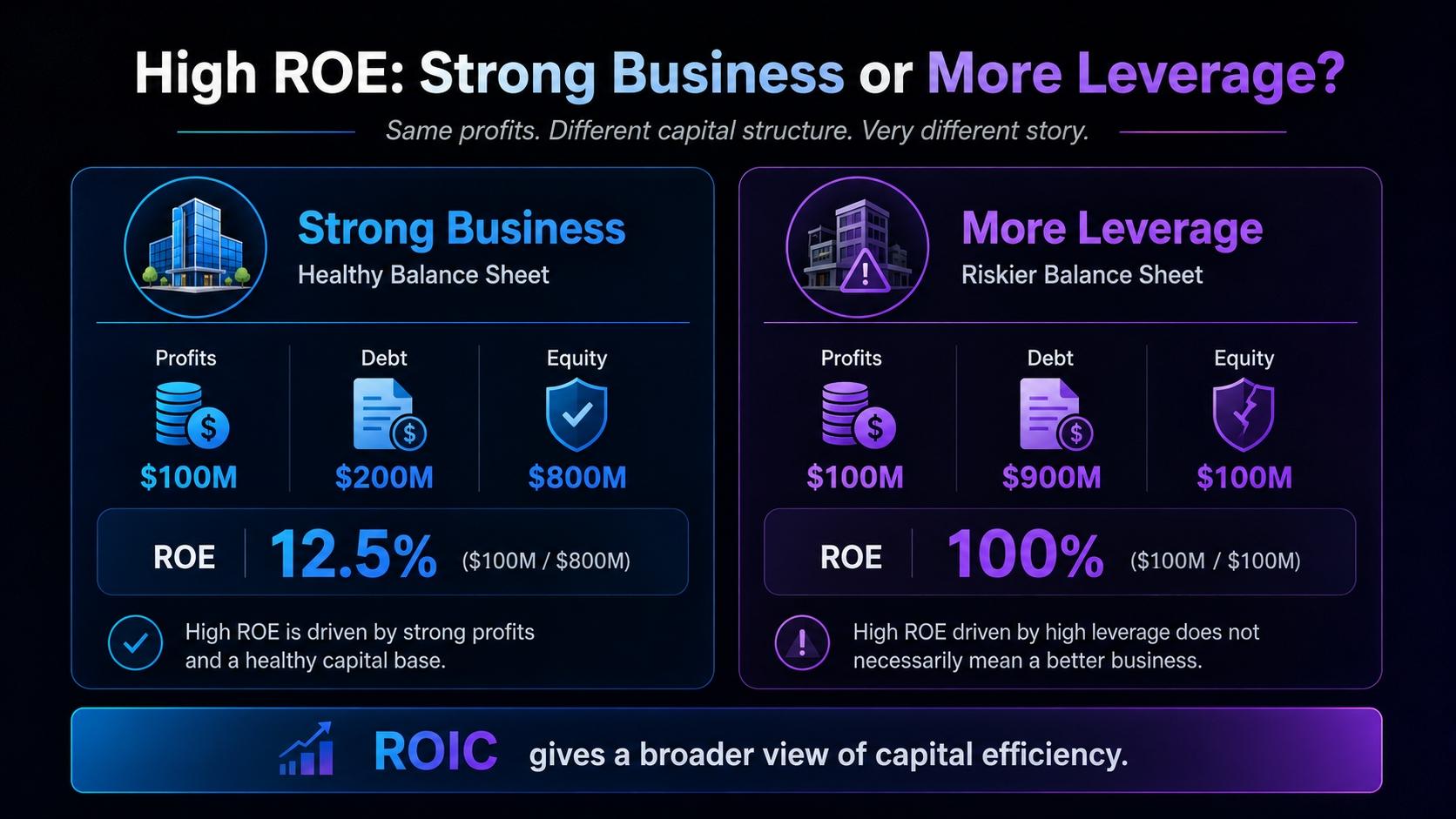
ROE measures the return generated on shareholders’ capital. A high ROE can be attractive, but it should not be read in isolation because leverage can mechanically increase it.
When ROE looks unusually high, ask what is driving it: strong margins, efficient use of assets, or a smaller equity base created by more debt.
Return on invested capital
ROIC takes a broader view by looking at the capital invested in the operating business — equity and debt together — rather than equity alone. NOPAT (net operating profit after tax) strips out the effect of financing choices, which is why ROIC is less distorted by leverage than ROE. Exact definitions of “invested capital” vary by source, but the underlying question is simple: how effectively does the business turn invested capital into operating profit?
ROIC means the most next to a benchmark: the company’s weighted average cost of capital (WACC), roughly what investors and lenders require to supply that capital. When ROIC comfortably exceeds WACC, the business is creating economic value as it grows; when ROIC sits below WACC, growth can erode value even while accounting profits still look positive.
4. Look for consistency, not just speed
Strong results matter more when they can be sustained. Review several years of revenue, margins, profit, cash flow, and returns on capital rather than relying on one exceptional quarter.
The goal is not perfectly smooth growth. Cyclical industries naturally produce more volatile results. What matters is understanding whether changes come from the normal industry cycle or from a deterioration in the company’s own economics.
5. Cost control is about efficiency, not simply spending less
Lower expenses do not automatically mean a better business. R&D, sales, infrastructure, and other spending can create future value. The better question is whether that spending produces enough growth and profit to justify itself.
Compare revenue growth with operating-expense growth and watch what happens to margins as the company scales. If revenue consistently grows faster than expenses, operating leverage can improve. If expenses rise much faster than revenue without a clear return, margins can come under pressure.
6. Finally, ask what protects the profits
Strong margins attract competition. The final question is not simply whether a company earns attractive profits today, but why competitors cannot easily take them away.
Common sources of durable competitive advantage include:
- Intangible assets: brands, patents, licenses, or proprietary technology.
- Switching costs: customers face real cost or disruption when leaving.
- Network effects: the product becomes more useful as more participants join.
- Cost advantages: scale, sourcing, technology, or operations support lower costs.
- Efficient scale: the market can economically support only a limited number of competitors.
A moat is not a financial ratio. Its effects usually appear over time through durable margins, strong returns on capital, recurring cash generation, and resilient competitive positioning.
A high-quality business does more than grow revenue. It converts revenue into profit, profit into cash, and invested capital into attractive returns — while maintaining competitive advantages that make those economics difficult to copy.
No single metric proves that a company is good at making money. The answer comes from how the pieces fit together.
For educational purposes only. Nothing in this article constitutes investment advice.
บทความเพิ่มเติม
Anchoring in Investing: How to Recognize and Overcome This Common Pitfall
Imagine you're at a yard sale, eyeing a vintage guitar. The seller mentions it was once worth $1,000, but now they're asking $300. Are you tempted? At this moment, you might fall into the trap of anchoring bias. That…
Asset Allocation: When It Fails and How to Prevent It
Asset allocation is a powerful tool for managing risk and growing wealth over time. The idea is simple: spread your investments across different asset classes—stocks, bonds, real estate, cash, and commodities—so that no…