
Hawkish Debut: Markets Fully Price In Fed Rate Hike by October as Policy Pivot Reverses

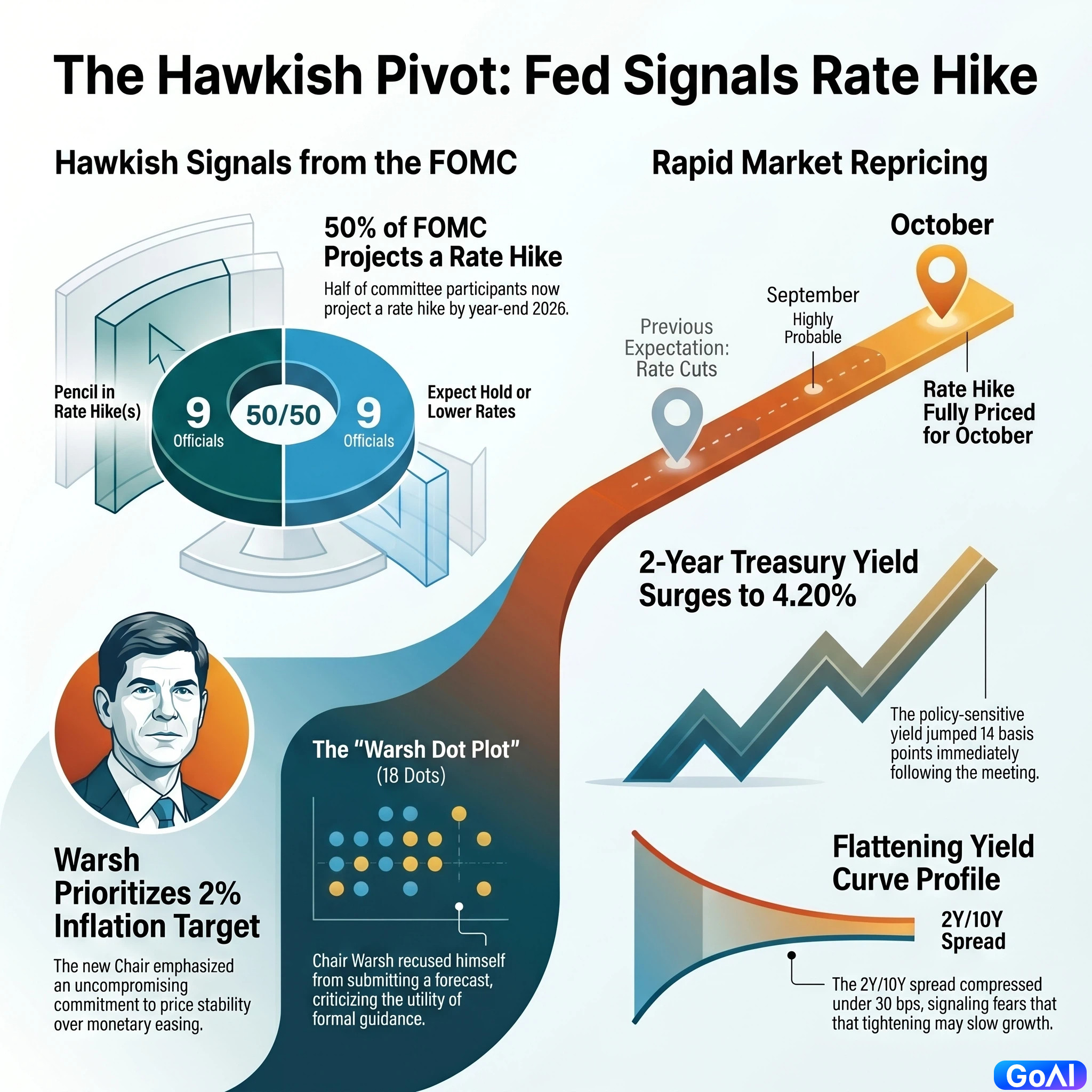
Traders have fully priced in a Federal Reserve rate hike by October after central bank officials signaled that tightening could materialize within the coming months, triggering a violent spike in short-duration Treasury yields.
Following Wednesday’s policy conclusion—marking Kevin Warsh’s inaugural meeting as Fed Chair—the policy-sensitive 2-year Treasury yield surged 14 basis points to touch 4.20%.
Concurrently, the US dollar caught a strong safety bid, strengthening aggressively across major currency pairs.
Money markets now view a September rate hike as a high-probability event, while an October tightening cycle is entirely locked in.
Short-term US interest rate futures indicate that the implied probability of a rate hike by September has officially eclipsed the probability of a pause.
While the FOMC expectedly held the federal funds target range steady at 3.50% to 3.75%, nearly half of the committee's participants now project a rate hike by year-end 2026 to combat persistent inflationary pressures.
The freshly published dot plot revealed that 9 officials pencil in at least one rate hike this year (with 6 modeling at least two hikes), while the remaining 9 expect rates to hold steady or drift lower.
Notably, Chair Warsh recused himself from submitting a personal rate forecast, stating that providing numerical projections is "not useful for the policymaking process."
Consequently, the dot plot comprised 18 dots instead of the traditional 19, aligning with Warsh's long-standing academic criticism of formal forward guidance.
"The fact that half of the committee expects to hike rates this year serves as an unambiguous warning shot to trading desks," noted Bob Michele, CIO and Global Head of Fixed Income at JPMorgan Asset Management. "In my view, they are explicitly laying the groundwork to hike."
The FOMC's revised policy statement stressed that "the Committee will achieve price stability," a mandate Warsh doubled down on during his press briefing by repeatedly emphasizing an uncompromising commitment to returning inflation to the 2% target.
Following the announcement, DoubleLine Capital CEO Jeffrey Gundlach noted that Warsh's tone landed significantly more hawkish than many institutional investors had modeled.
Gundlach observed that Warsh’s hyper-focus on price stability signals that the new leadership has zero structural appetite for monetary easing.
A Total Reversal in Macro Expectations
The hawkish pivot marks a complete breakdown of the macro thesis that dominated Wall Street at the start of the year.
When President Trump initially nominated Warsh to helm the central bank, macro desks heavily front-ran a sequence of 25-basis-point rate cuts throughout 2026.
However, the outbreak of the US-Iran conflict in late February triggered an aggressive spike in energy benchmarks, reigniting cost-push inflation fears.
Coupled with highly resilient domestic economic indicators, fixed-income allocators have been forced to systematically price in higher borrowing costs.
Reflecting this structural shift, the Bloomberg US Treasury Index has dropped roughly 1.5% since late February, while the benchmark 10-year yield has jumped nearly 50 basis points over the same horizon.
According to JPMorgan’s Treasury Client Survey released Tuesday, net long positions among active traders have collapsed to their lowest levels since May 18.
Wednesday's dot plot explicitly accelerated that bond rout.
The sudden leg higher in short-end yields compressed the 2-year/10-year Treasury spread to under 30 basis points, printing the flattest yield curve profile in over a year—a technical rotation typically indicative of market fears that aggressive Fed tightening will choke off long-term economic growth.
Dhiraj Narula, US Rates Strategist at HSBC, concluded that the Fed’s messaging and internal projections delivered "a decisively hawkish surprise relative to market consensus, cleanly justifying the rapid re-pricing at the short end of the curve."