
Global Highlights for This Week: US-Iran Negotiations Enter Second-Stage Posturing; Micron Earnings Take Center Stage

As market pricing around the "US-Iran Memorandum of Understanding" and the 60-day extension of the ceasefire runs its course, trading desks face a heavy slate of catalyst events this week.
Headlining the macro agenda is the formal commencement of the second phase of US-Iran negotiations.
According to the scheduled docket, senior officials from Washington and Tehran held technical-level talks in Switzerland last Sunday, with Pakistani and Qatari mediators in attendance.
Given Iran’s weekend announcement that it would re-impose a blockade on the Strait of Hormuz due to continued Israeli strikes against Hezbollah—a move US authorities subsequently disputed—this geopolitical chess match carries maximum intensity from the outset.

Because Iran's core demand hinges on Washington restraining Israel to secure a ceasefire on the Lebanese front, the dialogue heavily implicates US-Israeli coordination, particularly whether Prime Minister Benjamin Netanyahu will continue to align with President Trump’s strategic counsel.
UK politics also faces a critical juncture this week, with Prime Minister Keir Starmer approaching a decisive career milestone.
Should Starmer finalize his resignation early this week, the UK will navigate its sixth prime minister in nearly seven years.
Andy Burnham—the "King of the North" who officially returned to Westminster last week—currently stands as the front-runner to succeed him.
The broader systemic risk remains that if Burnham fails to arrest Labour's secular decline, right-wing populist Nigel Farage will move closer to the keys of Downing Street.

Across capital markets, corporate focus centers squarely on Q3 earnings from Micron Technology, one of the "Seven Memory Heavies" that notched fresh all-time closing highs last week.
Micron shares have surged 297% year-to-date ahead of its print and forward guidance scheduled for Wednesday after the closing bell.
According to FactSet data, consensus models project Micron’s adjusted quarterly EPS to hit $20.70 (compared to $1.71 in the prior-year period) on revenues of $35.56 billion (up from $9.3 billion a year ago).
However, given that Micron’s equity value has expanded ninefold over the past 12 months, simply meeting baseline consensus may not guarantee a positive post-earnings tape reaction.
Ahead of the Micron numbers, the Nasdaq 100 will introduce five new constituents at Monday's opening bell: Astera Labs (AI data center connectivity), CoreWeave (emerging cloud infrastructure), Nebius (emerging cloud infrastructure), Rocket Lab (commercial launch services), and Teradyne (semiconductor test equipment)—a clean sweep of AI-levered operators.
Data from Apollo Global Management indicates that while the S&P 500 has added over $5 trillion in market capitalization year-to-date in 2026, artificial intelligence proxies alone captured $6 trillion in incremental value, followed by a $200 billion expansion in the energy complex.
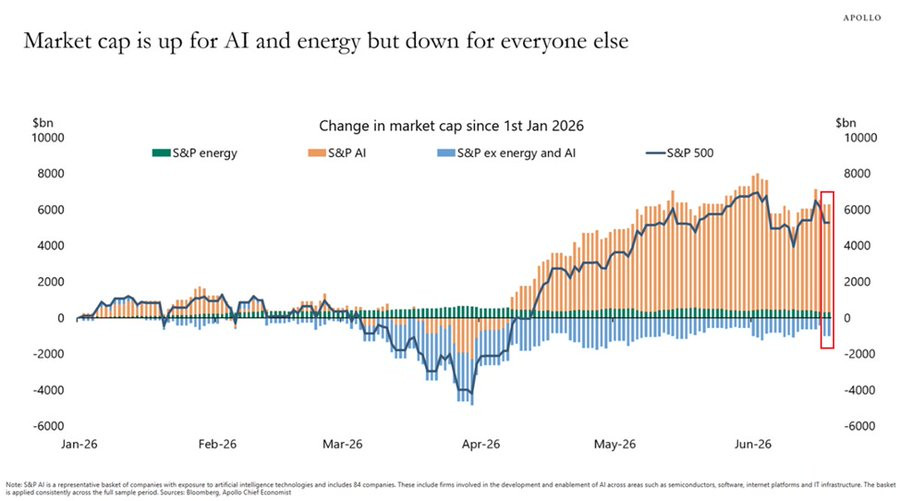
Concurrently, the remaining sectors of the index collectively erased $1 trillion in market value.
Against this backdrop of extreme concentration, Micron's financial print carries immense systemic weight for the broader tech ecosystem.
For investors with exposure to gold, silver, and commodities, the release of US May PCE inflation data this Thursday will also command close scrutiny, serving as the primary macro catalyst in an otherwise light data week.
While easing Middle East tensions have modestly softened crude benchmarks, US money markets have completely priced in a 25-basis-point rate hike by October.