
The First Landmine of H2: AI Compute Overcapacity?

Following an epic run in Q2 and the first half, the market hit its first speed bump of H2: Meta is reportedly entering the cloud business to sell off its excess AI compute resources.
The market panicked. Curiously, the sharpest drops were not among the Big Three cloud giants, but rather new cloud providers and hardware names. The former face being bypassed entirely as Meta enters the direct leasing market (given the choice between Meta or CoreWeave for identical GPUs, customers will choose Meta). The latter fell nearly as hard on fears of cooling capital expenditures.
Historically, Meta lacked its own cloud, relying on the Big Three while signing tens of billions of dollars in agreements with Nebius and CoreWeave. Mark Zuckerberg has long favored open-source infrastructure and internal compute consumption, steering clear of developing a public cloud like his peers.
Meta’s decision to sell surplus compute deals a direct blow to the core logic driving recent market gains, handing short-sellers ammunition. Rich Privorotsky, head of the 1-Delta trading desk at Goldman Sachs, warned that the market's previous core premise relied on compute scarcity. This shortage sustained firm pricing and justified the relentless capital spending of tech giants.
Privorotsky noted that if compute supply expands and leasing rates continue to fall, it will directly challenge the shortage narrative, with hardware taking the first negative hit. Recently, the ORNN H100 Index, which tracks compute leasing prices, has already shown signs of slipping.
Conversely, bulls argue that Meta's pivot is driven by company-specific bottlenecks—including the high costs of open-source LLMs and a relatively tight cash flow profile—forcing it to act as a landlord. Furthermore, if a GPU glut does materialize in the future, Meta’s approach outlines a clear path: GPU leasing.
Ultimately, it is not a bad thing for a company that lags materially in LLMs and lacks tangible results in other AI applications to streamline its spending. It can shift AI from chaotic spending toward an orderly stratification where everyone finds their place.
Logically, falling cloud costs and players exiting the AI race are a clear negative for new cloud providers. However, calling a top on hardware is premature; TSMC's capacity remains in short supply, and if orders are canceled, plenty of buyers stand ready to fill the gap.
Regardless, the upcoming quarterly reports' CSP Capex, FCF, and profit margins will be critical. Several companies might underperform; it will all come down to forward guidance and returns.
GoAI's deep dive
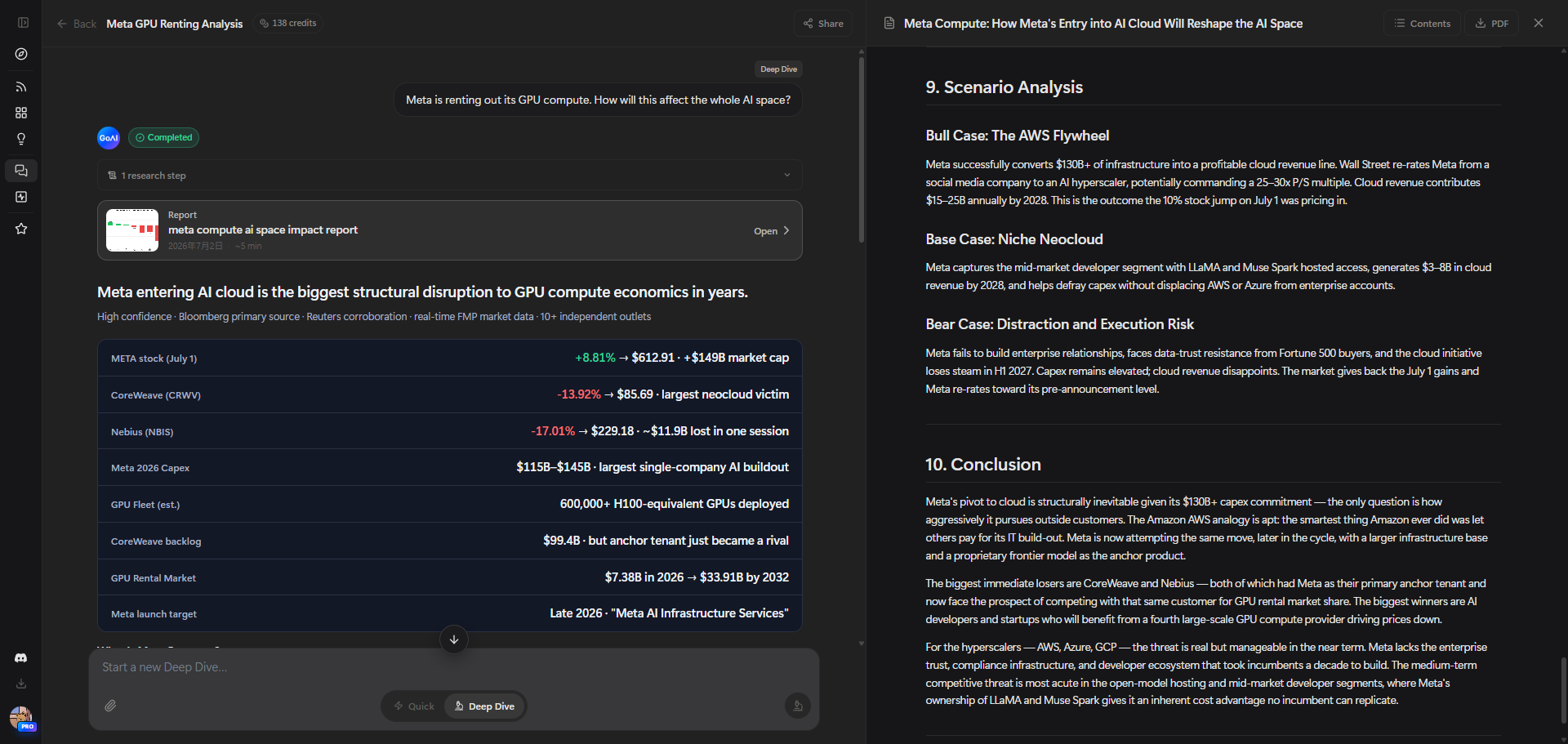
Meta's pivot to cloud is structurally inevitable given its $130B+ capex commitment — the only question is how aggressively it pursues outside customers.
The Amazon AWS analogy is apt: the smartest thing Amazon ever did was let others pay for its IT build-out. Meta is now attempting the same move, later in the cycle, with a larger infrastructure base and a proprietary frontier model as the anchor product.
The biggest immediate losers are CoreWeave and Nebius — both of which had Meta as their primary anchor tenant and now face the prospect of competing with that same customer for GPU rental market share. The biggest winners are AI developers and startups who will benefit from a fourth large-scale GPU compute provider driving prices down.
For the hyperscalers — AWS, Azure, GCP — the threat is real but manageable in the near term. Meta lacks the enterprise trust, compliance infrastructure, and developer ecosystem that took incumbents a decade to build.
The medium-term competitive threat is most acute in the open-model hosting and mid-market developer segments, where Meta's ownership of LLaMA and Muse Spark gives it an inherent cost advantage no incumbent can replicate.