
From Shampoo to Oreos: The AI Wave Drives Accelerated Innovation Across Consumer Goods

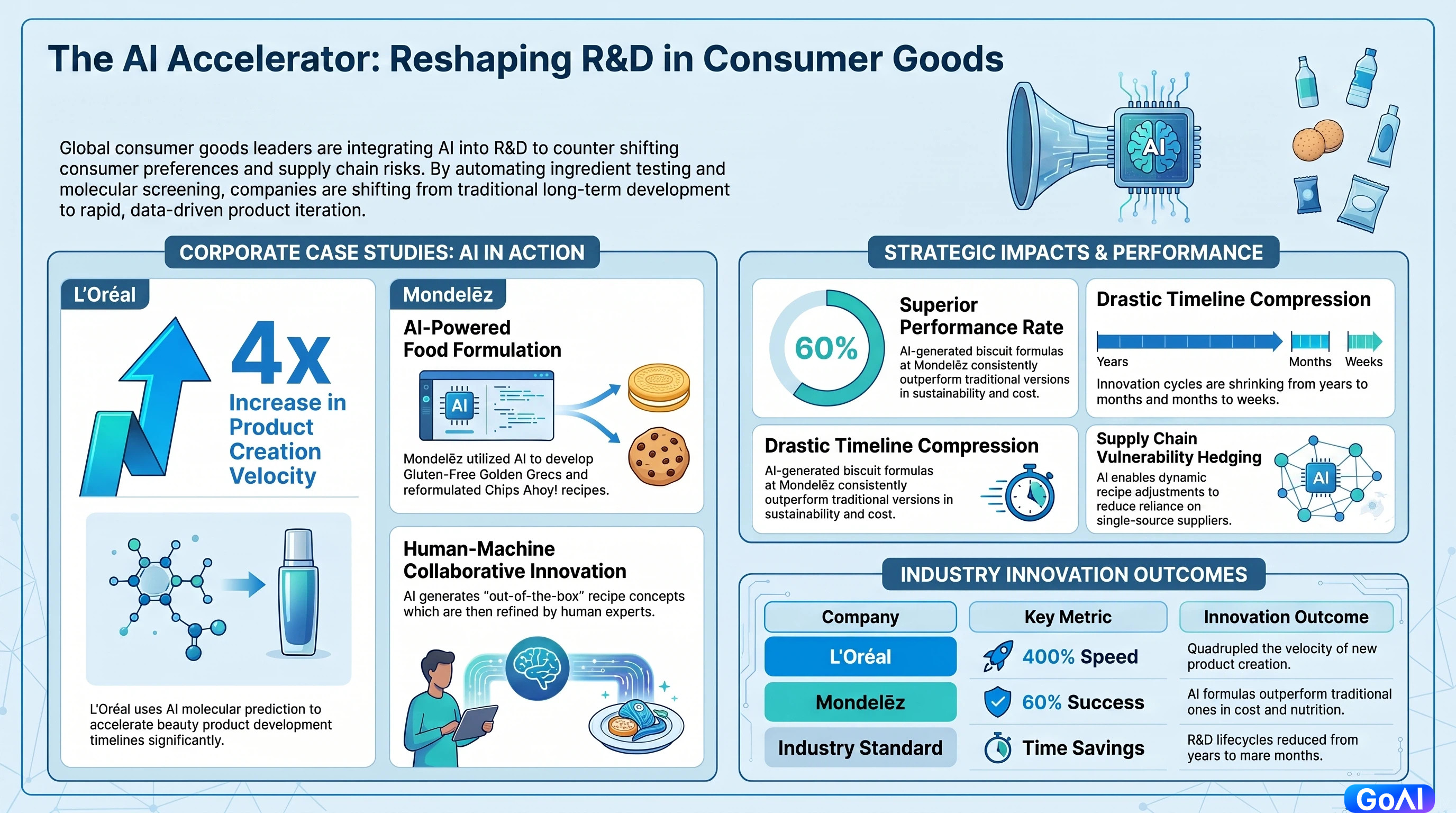
Global consumer goods giants are currently navigating external headwinds from shifting consumer preferences, triggering an urgent need to accelerate product innovation, reduce costs, and optimize efficiency. Against this backdrop, integrating artificial intelligence into the R&D workflow has emerged as a defining industry trend.
Industry experts note that consumer companies are utilizing AI to reshape portfolios spanning from shampoo to biscuits. Executives at Nestlé, Haleon (the parent company of Sensodyne), L’Oréal, and Mondelēz International have all confirmed that AI now plays a critical role in product innovation.
The technology not only enables faster ingredient testing and formula generation but also allows corporations to effectively hedge against supply chain vulnerabilities.
Compressing R&D Lifecycles
Fabrice Megarbane, President of L’Oréal’s Consumer Products Division, noted at the Consumer Goods Forum Global Summit in Vienna late last month that AI technology can dramatically compress product development timelines.
L’Oréal began integrating AI into its laboratories four years ago. Megarbane pointed out that by predicting how specific molecules interact with skin and hair, AI has successfully screened entirely new active ingredients for beauty products.
"By conceptualizing new molecular combinations and uncovering entirely new benefits, the pace of R&D can be significantly accelerated," Megarbane stated.
With AI assistance, L’Oréal's product creation velocity has quadrupled. One of its latest innovations involved repurposing a molecule traditionally used in skincare to develop a collagen-infused shampoo designed to add volume and fullness to hair.
AI has become a core mechanism for L’Oréal to accelerate product innovation. Last year, following the group's slowest sales growth in years, L’Oréal CEO Nicolas Hieronimus launched a "beauty stimulus initiative" aimed at revitalizing product innovation across the board.
Formulating the Future of Food
In the food and beverage sector, AI is demonstrating similarly disruptive potential. Filippo Catalano, Chief Information and Digital Officer (CIDO) at Mondelēz International—the parent company of Cadbury and Toblerone—told media that the AI-powered, human-machine collaborative innovation model is an industry "game-changer."
AI technology helps Mondelēz create product formulas and streamline business processes. The company stated that AI can generate "out-of-the-box" recipe concepts, which are subsequently evaluated by human experts.
"You can optimize the way you develop formulas," Catalano said. He further noted that this approach reduces reliance on single-source suppliers within the supply chain and enables the company to dynamically adjust recipes based on shifting consumer tastes.
Catalano revealed that Mondelēz’s proprietary AI tools are reducing the number of physical samples typically required in the innovation pipeline.
The company stated the technology has successfully aided the development of "Gluten-Free Golden Oreos" and an upgraded, reformulated version of "Chips Ahoy!."
Driving Broader Efficiency Gains
The practical application of AI has yielded measurable performance improvements. Mondelēz reported that within its biscuit category, 60% of AI-generated formulas outperformed traditional ones across multiple vectors, including nutrition, sustainability, and cost metrics.
"AI accelerates what you were already capable of doing," concluded Mondelēz CIDO Catalano. "But it compresses the timeline from months to weeks, or from years to months."
As consumer staples giants continue to scale their technology capital expenditures, the broader consumer market is poised for a cycle of rapid product iteration.