
Five Scenarios for Fed Decision: The Most Likely Outcome Is...

The Federal Reserve is set to announce its interest rate decision on Thursday, with Fed Chair Kevin Warsh scheduled to host the post-meeting press conference at 2:30 a.m.
Facing what market participants call one of the most unpredictable Fed decisions in recent history, JPMorgan's U.S. Market Intelligence desk expects the Fed to hold rates unchanged while drawing at least two hawkish dissents, likely from Beth Hammack and Lorie Logan.
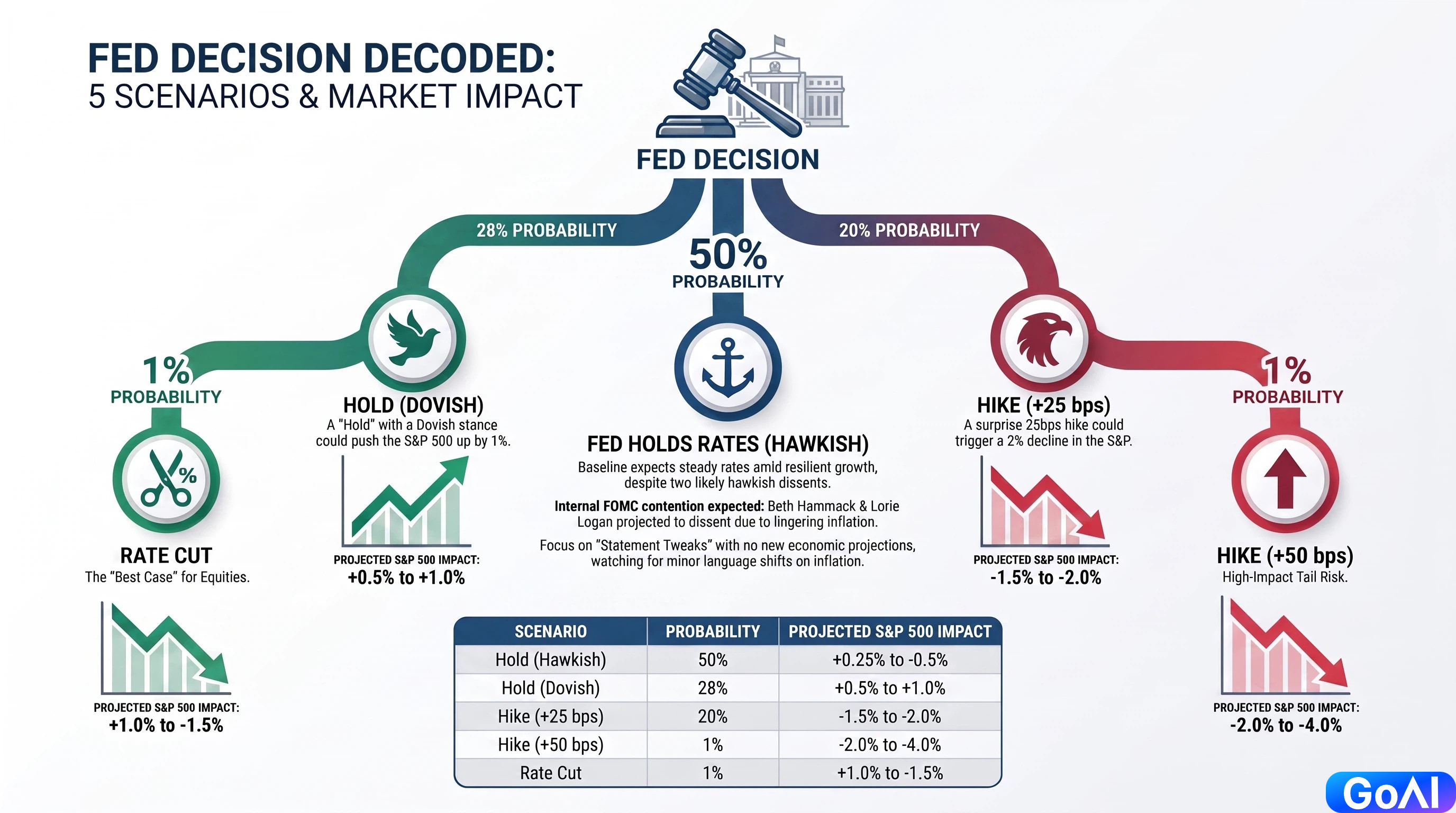
JPMorgan outlined five potential scenarios for the Fed decision along with projected S&P 500 price action (ordered from highest to lowest probability):
1. Fed Holds Rates Unchanged with a Hawkish Stance (50% Probability)
-
S&P 500 Impact: Range from +0.25% to -0.5%.
-
Context: This serves as JPMorgan's baseline scenario, where the Fed holds rates steady on resilient growth and labor metrics, while maintaining high alert on inflation as recent energy spikes hint at renewed price pressures.
2. Fed Holds Rates Unchanged with a Dovish Stance (28% Probability)
-
S&P 500 Impact: Expected gain of 0.5% to 1%.
-
Context: This represents the most favorable outcome for equities.
3. Fed Hikes Rates by 25 Basis Points (20% Probability)
-
S&P 500 Impact: Expected decline of 1.5% to 2%, with the Nasdaq 100 potentially doubling that loss.
-
Context: The Russell 2000 could relative outperform during this sell-off as investors rotate away from momentum and AI-related growth stocks.
4. Fed Hikes Rates by 50 Basis Points (1% Probability)
-
S&P 500 Impact: Expected decline of 2% to 4%.
-
Context: Losses could be capped if the Fed explicitly frames the move as a temporary measure to address legacy inflation metrics rather than the start of an extended rate-hiking cycle.
5. Fed Cuts Rates (1% Probability)
-
S&P 500 Impact: Range from +1% to -1.5%.
-
Context: Equities could react negatively if investors interpret a rate cut as a sign that the Fed has compromised its independence, leading to higher Treasury yields, wider breakeven inflation rates, elevated volatility, and lower stock prices.
Options Market Pricing and JPMorgan's Take
Based on July 28 pricing, options expiring July 29 imply a move of roughly 0.8% for U.S. equities, compared to typical CPI event-day implied moves of around 1.1%.
JPMorgan's market intelligence team believes the probability of an actual rate hike this week is lower than the ~30%+ implied probability currently priced into money markets.
Their reasoning rests on two main points: U.S. GDP growth remains near trend levels, and while inflation stays elevated, it shows little risk of accelerating out of control.
Furthermore, if the Fed intended to hike, June would have been a more logical time, given that CPI stood above the federal funds rate.
"We expect the FOMC to keep interest rates on hold at the conclusion of this week's meeting," the JPMorgan team noted. "However, we anticipate a contentious decision, as several committee members grow impatient with inflation lingering above target. We expect at least two hawkish dissents, likely from Hammack and Logan."
Because the Fed will not publish a Summary of Economic Projections (SEP) or dot plot at this meeting, market focus turns to statement tweaks.
Investors will watch whether the FOMC maintains its traditional approach of making minor incremental changes to statement language or adopts a substantial rewrite at each meeting.
JPMorgan expects minimal revisions under the traditional approach, as employment and inflation narratives have evolved only marginally since the last meeting.
Still, the committee may alter language to signal a willingness to act if necessary to demonstrate anti-inflation resolve.
Regarding Chair Warsh's press conference, JPMorgan sees a low probability of significant new guidance.
In his recent Congressional testimony, Warsh described his economic outlook using broad, high-level points. Subsequent disclosures regarding discount rate requests from regional banks may offer clearer insight into the views of non-voting FOMC members.