
Cashing Out and Calling It Quits: The U.S. Stock Market Wealth Effect Drives More Americans Aged 55+ Into Retirement

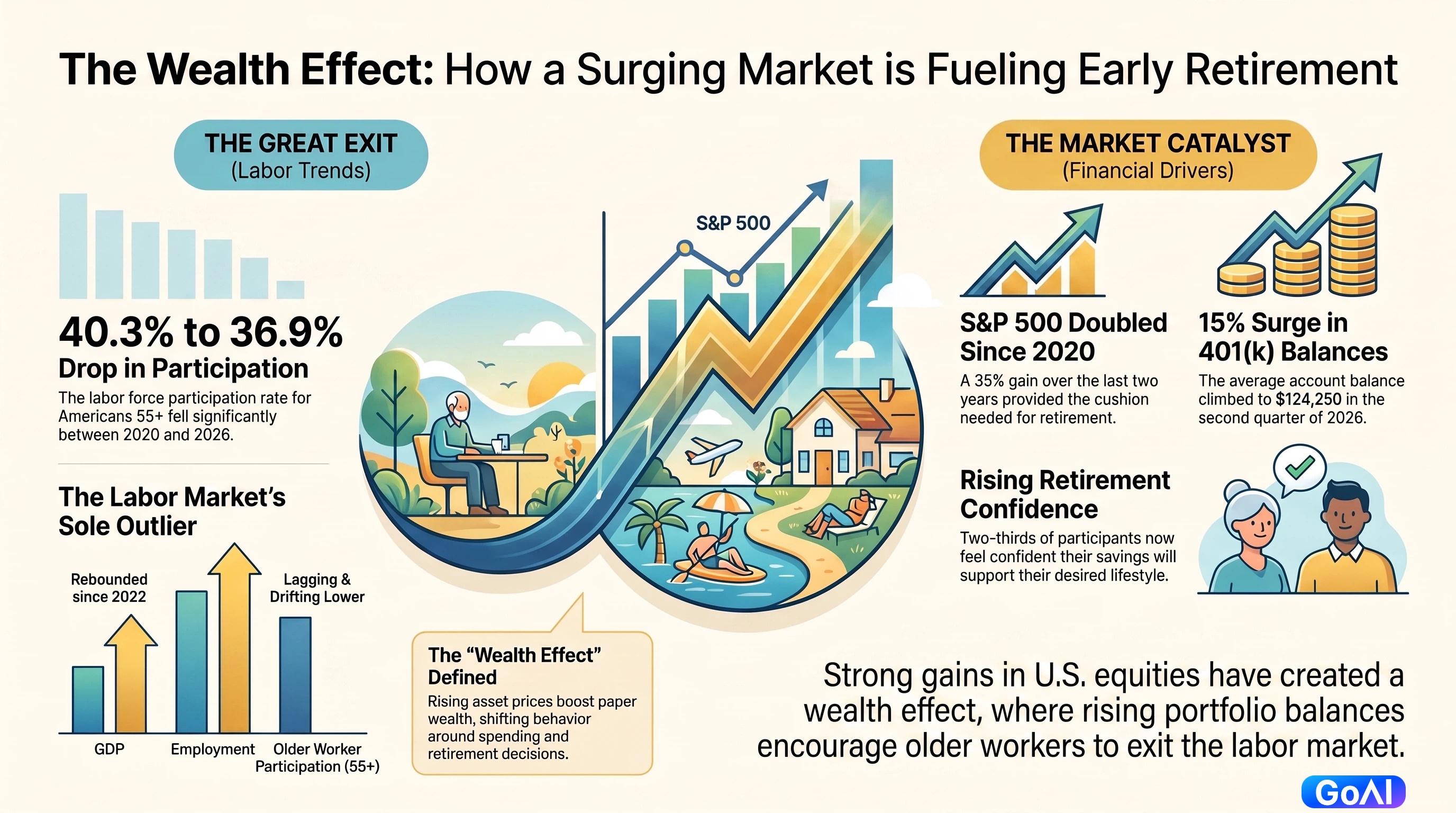
In recent years, the labor force participation rate among Americans aged 55 and older has drifted steadily lower.
A recent analysis by Bank of America points out that the sustained surge in U.S. equities has generated a strong wealth effect, with expanding portfolio balances prompting a growing number of older workers to step away from the workplace.
The "wealth effect" refers to an economic phenomenon where rising prices of assets held by households—such as equities—boost paper wealth, in turn shifting behavior around spending, employment, and retirement decisions.
Citing data from the Bureau of Labor Statistics, a recent research note from Bank of America highlighted that the labor force participation rate for Americans aged 55 and older stood at 40.3% in February 2020. By July 2026, that figure had dropped to 36.9%.
"We think this is tied to the S&P 500's cumulative gain of more than 35% over the past two years," said Aditya Bhave, Managing Director and U.S. Economist at BofA Global Research.
In his view, the powerful market run has made the decision to retire much easier for those who were previously on the fence about when to exit the labor market.
"There has been a persistent puzzle in the labor market data," Bhave noted.
"Looking across the broader U.S. economy, the vast majority of indicators rebounded robustly after 2022—far faster than expected. The sole outlier has been the participation rate among older workers, which has lagged behind and even drifted lower in recent months."
While Bhave does not attribute the phenomenon entirely to the stock market, he noted:
"No single factor can fully explain this trend. But it is clear that the stock market's stellar performance over the past two years—and a more than doubling of the S&P 500 since 2020—has built up enough wealth to nudge people toward retirement. They simply feel, 'I don't need to keep working anymore.'"
"That wealth growth gives people a solid cushion to comfortably step away, giving even relatively conservative investors a substantial financial buffer."
Addressing potential downside risks in the market, Bhave added: "In my view, this demographic currently holds a sufficient safety margin. Their mindset is that while a market pullback could happen, as long as it isn't a catastrophic crash, their accumulated wealth remains significant enough to support a comfortable retirement."
Industry Insights Corroborate Analysis
Financial advisors who work with clients nearing retirement reinforce these findings.
"The wealth effect is very real," said Cary Carbonaro, a Certified Financial Planner and author of Women & Wealth.
"The broad market delivered double-digit gains in 2023, 2024, and 2025, and that momentum looks poised to continue into 2026. These investment returns are giving my clients the financial flexibility to retire outright and explore new options."
Tyson Sprick, another financial planner, has observed similar dynamics among his client base.
"Portfolio balances are sitting at all-time highs, and that has given several clients the push they needed to finally pull the trigger on retirement."
"At the same time, some clients ask how long this run can last, and whether their lifestyle remains secure if the market takes a dive," Sprick added.
"We incorporate forward-looking assumptions into our planning based on current conditions. We can't predict the future, but we know these outsized returns won't go on forever."
Those not yet ready to retire are also riding the market's tailwinds. According to BofA's latest data, the average 401(k) account balance climbed to $124,250 in the second quarter of 2026, marking a 15% year-over-year surge.
The 401(k) is an employer-sponsored retirement savings and investment plan widely used across the U.S.
Data shows that roughly two-thirds of active 401(k) participants feel confident their savings will be sufficient to achieve their target retirement age and desired standard of living—a 6-percentage-point gain from last year.