
Moderna's Cancer Vaccine Breakthrough: Is the Historic Surge Just the Beginning?

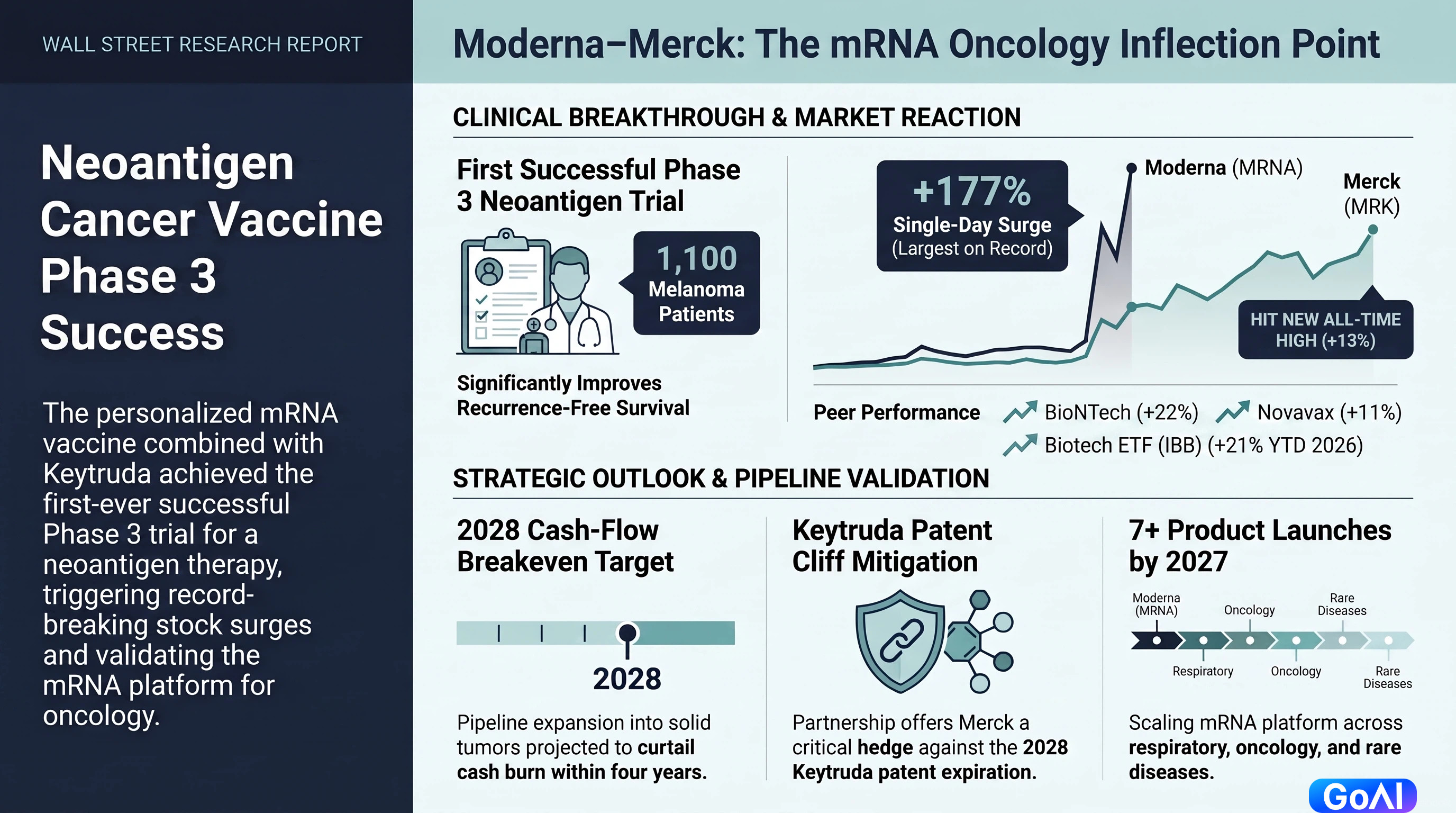
Moderna’s stock has surged this year, driven by rising optimism over its individualized neoantigen therapy.
The vaccine is seen as having the potential to reshape oncology and help the biotech move beyond its pandemic-era identity—a milestone that now appears within reach.
Moderna and Merck & Co. announced Wednesday that Moderna’s personalized cancer vaccine, intismeran, administered in combination with Merck’s blockbuster immunotherapy Keytruda (pembrolizumab), proved significantly more effective at preventing skin cancer recurrence than Keytruda monotherapy.
A Phase 3 clinical trial of 1,100 patients demonstrated that the combination therapy enabled patients to remain cancer-free for a longer duration following complete surgical resection of melanoma compared to standard-of-care treatment.
This represents the first successful Phase 3 trial for a neoantigen cancer vaccine, clearing the way for Moderna and Merck to submit regulatory filings for commercial approval.
Shares of Moderna surged 177% on Wednesday, marking its largest single-day percentage gain on record, following an initial 112% jump during pre-market trading.
Merck shares advanced nearly 13% to record a fresh all-time closing high—its strongest single-day rally since March 2009, according to Dow Jones Market Data.
The breakthrough lifted peer vaccine makers as well, with Novavax (NVAX) and BioNTech (BNTX) gaining 11% and 22%, respectively.
For Moderna, the magnitude of the rally reflects its ongoing efforts to shed the label of being strictly a "COVID and flu vaccine maker."
The company rose to prominence during the pandemic with the second FDA-authorized COVID-19 vaccine.
While related revenues have declined, the Spikevax COVID-19 vaccine remains a foundation of Moderna's portfolio, alongside recurring contributions from its respiratory pipeline.
However, investors have looked for a transformative catalyst capable of driving the stock back toward its 2021 highs.
Attention turned toward intismeran.
In June, Moderna and Merck reported positive five-year follow-up data from a Phase 2 trial, which demonstrated that the vaccine-Keytruda combination reduced the risk of cancer recurrence or death by half, triggering an earlier rally in Moderna shares.
Heading into Wednesday's session, Moderna shares had gained nearly 114% year-to-date in 2026, outpacing the broader market and outperforming the iShares Biotechnology ETF (IBB), which has risen 21% over the same period.
Much of Moderna's momentum has been anchored to expectations for its customized cancer vaccine, with investors interpreting the clinical data as a structural inflection point for the company's valuation.
mRNA Platform Validation and Pipeline Momentum
The Phase 3 success validates the therapeutic viability of Moderna’s proprietary mRNA platform.
The win comes amid intense regulatory scrutiny surrounding mRNA technology, including skepticism voiced by Department of Health and Human Services (HHS) Secretary Robert F. Kennedy Jr.
In August 2025, Kennedy canceled approximately $500 million in federal vaccine contracts, citing unverified claims regarding mutations, following prior public statements asserting that mRNA risks outweighed benefits.
Moderna also navigated regulatory friction over its recently approved senior influenza vaccine, mFlusiva, which received FDA clearance only after months of engagement following an initial Refusal to File letter in February.
While intismeran has yet to enter formal regulatory review, the Phase 3 data offers clear clinical evidence that Moderna’s mRNA technology can be deployed across broader therapeutic indications.
Prior studies indicated that the Keytruda combination demonstrated a manageable safety and tolerability profile.
Jefferies analyst Andrew Tsai noted that the trial results substantiate the underlying strength of Moderna's mRNA platform, raising Wall Street expectations for the company's oncology pipeline across multiple solid tumor trials.
Tsai highlighted that the trial achieved statistical significance across both Recurrence-Free Survival (RFS, the primary endpoint) and Distant Metastasis-Free Survival (DMFS, a key secondary endpoint).
These endpoints track how long patients remain free of disease following resection and the time before cancer spreads to distant organs, respectively.
Looking ahead, Tsai expects Moderna to launch more than seven commercial products across respiratory, oncology, and rare disease indications by 2027.
This pipeline expansion is projected to "curtail annual cash burn and position the company to achieve cash-flow breakeven by 2028," with intismeran serving as a core growth pillar.
Navigating the Patent Cliff and Next-Gen Oncology
The clinical win is equally vital for Merck as it works to insulate its top line against the 2028 patent cliff on Keytruda—the world's top-selling prescription drug last year—when primary patent expirations will open the market to biosimilar competition.
Leveraging its oncology footprint, Merck has entered into development agreements with outside biotechs, including China’s Sichuan Kelun-Biotech Biopharmaceutical, to advance multiple preclinical and clinical candidates.
In May, Kelun-Biotech reported positive clinical data for its antibody-drug conjugate (ADC) candidate, Sacituzumab Tirumotecan, which demonstrated improved progression-free survival in combination with Keytruda for advanced non-small cell lung cancer compared to Keytruda monotherapy.
The Moderna-Merck Phase 3 results address a longstanding clinical bottleneck in immunotherapy.
For decades, oncologists have attempted to develop therapeutic vaccines that effectively prime the immune system against malignancies, with limited clinical success.
For Moderna, intismeran represents an expansion beyond prophylactic respiratory vaccines into next-generation individualized therapeutics.
Beyond melanoma, Moderna is evaluating the platform across lung, bladder, renal, gastric, and pancreatic cancers.
Unlike conventional systemic therapies, intismeran is positioned for early adjuvant intervention.
As scientists from Merck and Moderna recently explained to Barron's, administering intismeran post-surgery targets residual cancer cells when the host immune system is most robust.
If approved, intismeran would introduce an unprecedented "one patient, one drug" commercial paradigm.
Leveraging mRNA manufacturing, each vaccine is tailored to target dozens of patient-specific neoantigens, diverging from the standardized, off-the-shelf therapies historically commercialized by both companies.
While personalized cell and gene therapies can cost millions of dollars per dose, Moderna has automated its end-to-end synthesis and manufacturing process, enabling production to scale to support multi-billion-dollar commercial demand.
Wall Street Focuses on Data Granularity
Despite the Phase 3 success, institutional investors are looking for further data granularity.
While the primary endpoints met statistical significance, the companies did not immediately disclose hazard ratios (HR) or confidence intervals, which will clarify the precise magnitude of clinical benefit.
Citi analyst Geoff Meacham raised questions regarding whether the efficacy profile observed in melanoma will translate across other solid tumor indications.
Detailed data will be presented at an upcoming medical conference.
Barclays analyst Eliana Merle noted that the trial cleared a high efficacy hurdle, providing a constructive read-through for label expansions into other solid tumors.
Merle assigns a 60% probability of success (PoS) for intismeran to clear full regulatory approval and commercial launch, modeling peak annual sales of $3 billion by 2035.
"Melanoma success will help validate read-through into other indications, which we view as driving substantial total addressable market (TAM) expansion," Merle wrote.
Moderna and Merck plan to submit the Phase 3 data to regulatory authorities globally to seek market authorization.
For Moderna, this milestone provides substantial proof-of-concept for its broader mRNA oncology franchise.