
Trillion-Yen Impairment Shock Rattles Markets: Global Precision Motor Giant Nidec Hits Daily Limit-Down as Write-Down Threatens Ten Years of Profit

Embattled global precision motor manufacturer Nidec Corp. suffered another devastating blow on Monday as its protracted accounting and corporate governance crisis deepened.
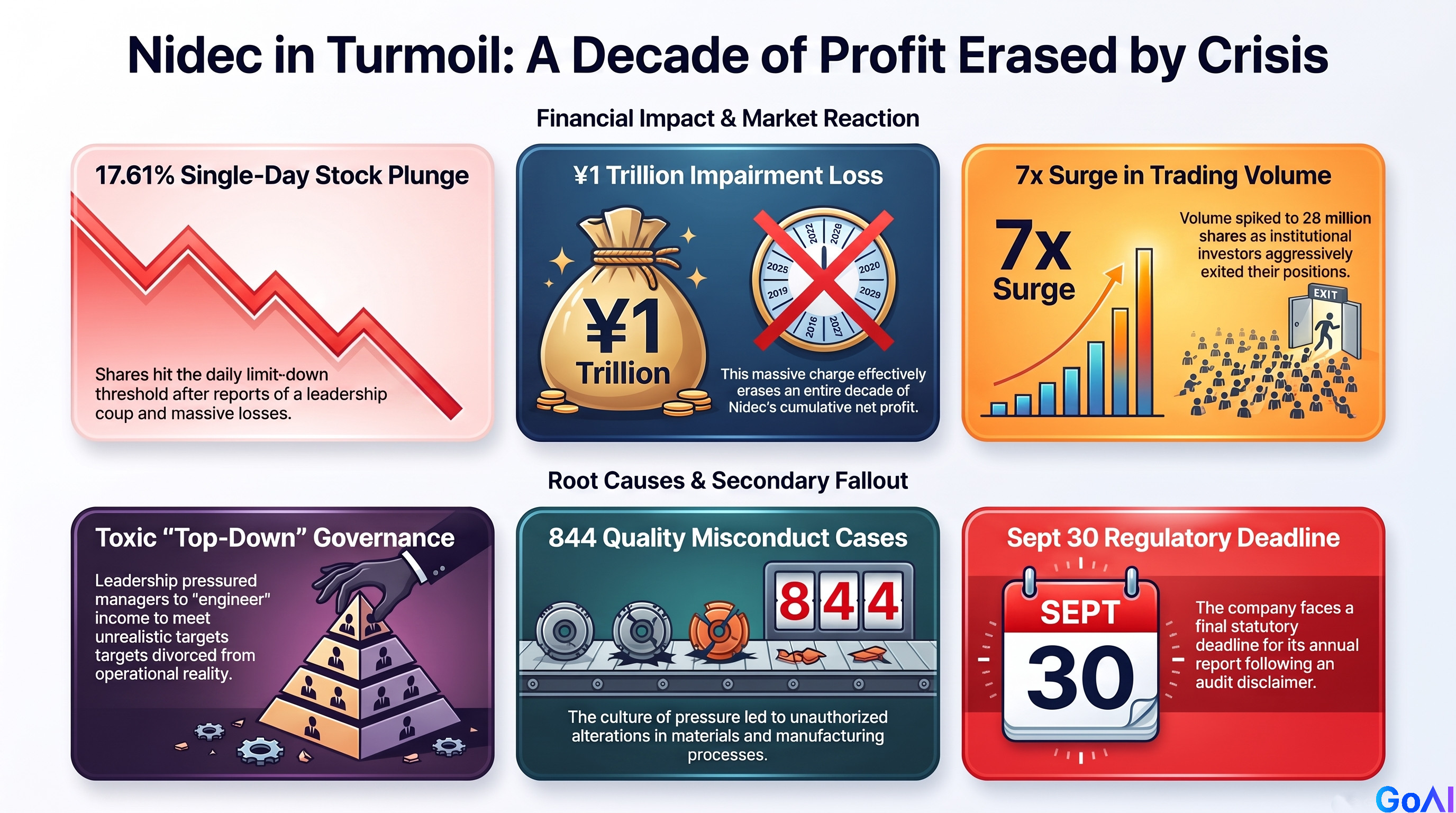
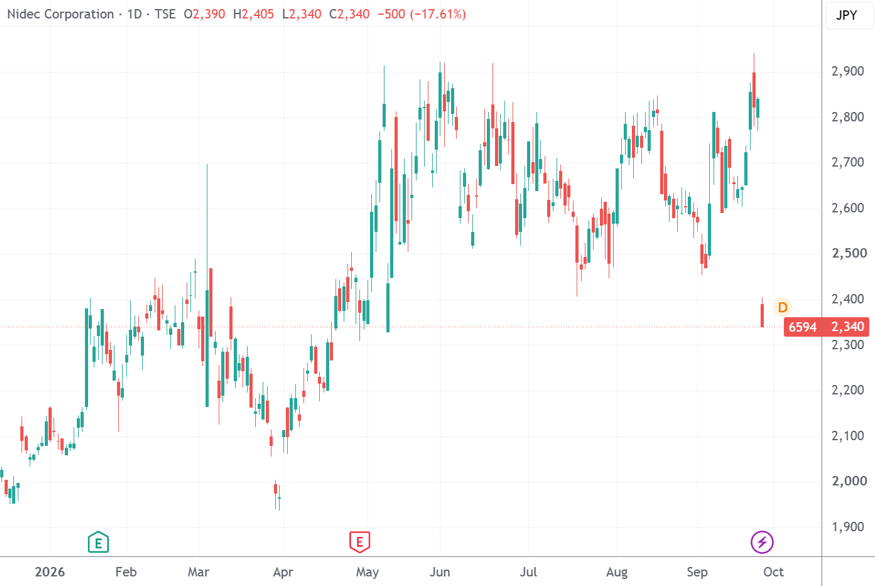
Nidec shares closed down 17.61% at 2,340 yen—tumbling by the Tokyo Stock Exchange’s daily limit-down threshold of 500 yen from Friday’s 2,840 yen close. The stock opened at 2,390 yen, touched an intraday high of just 2,405 yen, and saw trading volume surge past 28 million shares, more than sevenfold the 3.8 million shares recorded on Friday.
The aggressive selloff was ignited by an early-Monday investigative report from Japanese financial outlet Diamond Online.
The report revealed that Nidec convened an extraordinary board meeting on September 25 and resolved to abruptly oust President Mitsuya Kishida, with an official announcement expected as early as Tuesday.
Far more alarming to institutional investors was the report's disclosure that Nidec is preparing to recognize an additional impairment loss of roughly 1 trillion yen ($6.9 billion) for the fiscal year ending March 2026, stemming from its unresolved accounting irregularities.
Prior to Monday’s report, management's projected write-downs were considerably smaller.
An investigative committee report released in April estimated that identified accounting improprieties and errors through the first quarter of fiscal 2025 had cumulatively reduced historical consolidated net sales by 33.1 billion yen, operating profit by 166.4 billion yen, and net income by 160.7 billion yen.
At that time, Nidec noted that retroactively restating prior-year earnings would likely necessitate further goodwill and tangible fixed-asset impairments. Those potential write-downs were primarily concentrated in its automotive division and pegged at approximately 250 billion yen.
According to financial press tallies, a 1-trillion-yen charge would effectively wipe out roughly an entire decade of cumulative net profit.
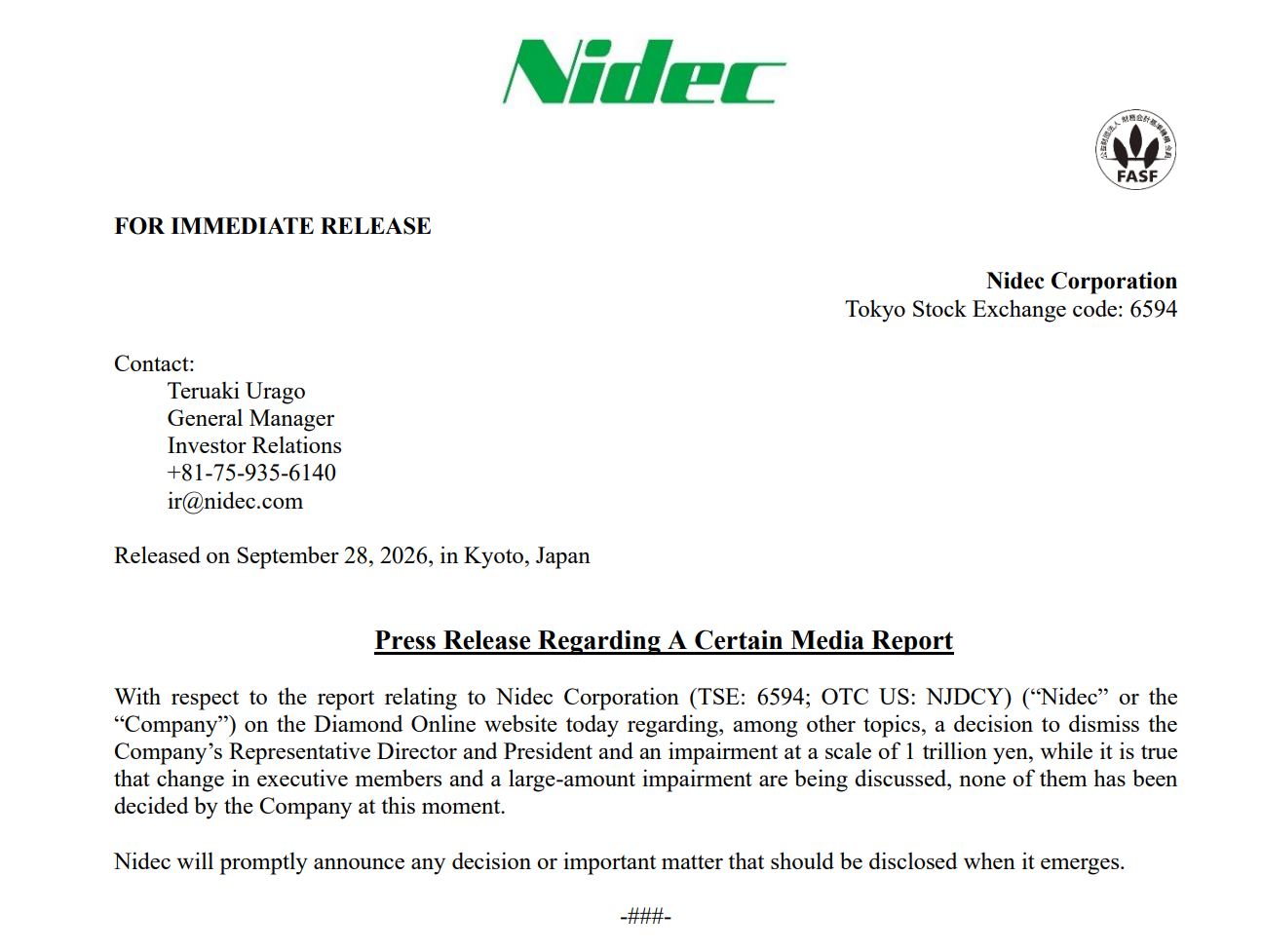
As its stock remained locked at the lower limit, Nidec issued a midday regulatory filing acknowledging that it is indeed "reviewing executive management changes as well as large-scale impairment treatments," though emphasizing that "no definitive corporate determinations have been reached at this juncture."
The statement failed to arrest the stock's slide.
The crisis now approaches another critical regulatory deadline.
Following initial accounting red flags, external auditor PwC Japan issued a "disclaimer of opinion" in September 2025 on Nidec’s annual securities report for the fiscal year ended March 2025, citing insufficient appropriate audit evidence.
The company subsequently missed the statutory June 30 filing deadline for its annual report for the year ended March 2026 amid ongoing probes. Following regulatory deferrals, the firm faces a final submission deadline on September 30.
Nidec's multi-layered crisis traces back to the summer of 2025.
In June 2025, the company postponed filing its annual securities report for the fiscal year ended March 2025 due to trade transaction and tariff issues at an Italian subsidiary, which soon unmasked widespread accounting distortions. As the scope widened, Nidec established an independent third-party committee in September to conduct a group-wide forensic investigation.
The final investigative findings released in April confirmed that multiple operating units had engaged in diverse improper accounting practices—principally deferring realized costs and operational losses into future periods to artificially bolster reported operating profit.
The report placed core blame on toxic corporate governance: relentless, top-down performance pressure.
According to the findings, decades of authoritarian leadership under founder Shigenobu Nagamori institutionalized a zero-tolerance culture toward operating losses. Nagamori routinely dictated aggressive performance targets from the top down, divorced from operational reality and pegged instead to capital market growth expectations.
The report documented egregious governance failures, including divisional managers subjected to marathon meetings and overnight shifts when falling short of targets, under strict mandates to mechanically "engineer" operating income before closing periods.
Compounding its financial turmoil, the accounting scandal subsequently exposed systemic quality-assurance lapses.
In May, Nidec disclosed that certain group products may have undergone alterations in materials, components, manufacturing processes, or designs without prior customer consent, prompting an external expert inquiry.
The investigation confirmed in early September that the group had identified 844 separate instances of product quality misconduct. While Nidec maintained that none of the breaches have shown immediate functional or safety hazards, the company remains engaged in bilateral customer reviews and technical verifications across affected product lines.