
Central Bank Gold Rush Resurges as Fund Managers Forecast Record Highs Within 24 Months

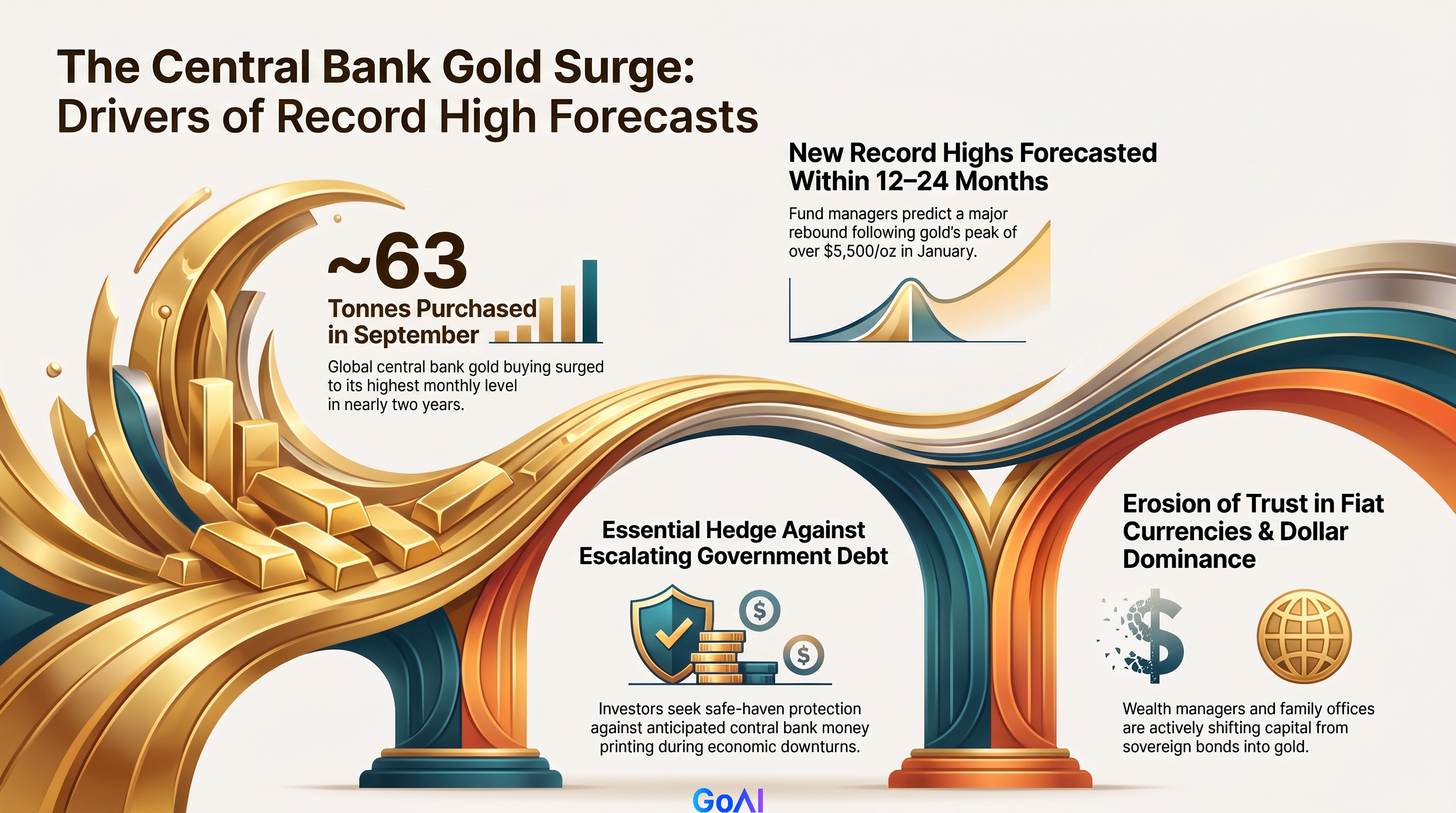
Will bullion print fresh all-time highs within the next two years?
A growing cohort of institutional allocators is betting on that trajectory, bolstered by fresh data indicating that sovereign central banks expanded their gold reserves in September at the fastest clip in nearly two years.
Preliminary figures from the World Gold Council (WGC)—compiled from sovereign monetary authorities and the International Monetary Fund (IMF)—reveal that net central bank gold purchases in September climbed to their highest monthly total since November 2024, absorbing roughly 63 metric tons.
Spot gold fell 2% to $4,075 an ounce on Wednesday, October 14, weighed down by sticky yields as the market priced in the risk of additional Federal Reserve policy tightening.
Even so, portfolio managers anticipate a powerful rebound for the yellow metal.
Gold previously vaulted to a record high above $5,500 an ounce in January following a blistering rally.
While bullion has retraced from those stratospheric peaks, it continues to trade near historic highs.
Asset managers project gold to stage a medium-to-long-term recovery, underpinned by persistent flight-to-safety flows as investors navigate heightened geopolitical volatility, macro fragmentation, and financial instability.
Can Bullion Print Fresh Record Highs?
Speaking Wednesday at the Financial Times Precious Metals Summit, Charlotte Yonge, fund manager at Troy Asset Management, forecast that bullion would eclipse its prior record within 12 to 18 months.
Yonge framed gold as the premier "hedge" against deteriorating "sovereign fiscal balances," citing swelling U.S. national debt alongside widespread expectations that central banks will lean on quantitative easing once "the next recession" arrives. "Gold cannot simply be printed in the same way," she added.
Paul Carne, Chief Investment Officer for EMEA at Allianz Global Investors, argued that gold will set a new record within two years, pointing to the structural fallout of de-dollarization.
"When you weaponize the dollar, you shouldn’t be surprised when counterparties stop using it," Carne noted. "And what do they replace it with?"
Peter Marrone, Chairman and Chief Executive Officer of Allied Gold, urged investors to consider whether "we are standing in the prelude to a financial crisis."
"It feels as though we are teetering on the edge of a significant financial event," Marrone said.
"As the macro backdrop turns more turbulent, family offices are pouring into precious metals, actively rotating out of sovereign paper and into gold to diversify reserves."
Ian Cockerill, Chief Executive of bullion producer Endeavour Mining, emphasized that gold remains anchored by "macro turbulence, a secular erosion of confidence in fiat currencies, and central bankers asking themselves: 'How do I insulate the value of my currency?'"
"That dynamic provides an exceptionally firm floor for the asset," Cockerill remarked. "Is $4,000 the absolute bottom? I don’t know. But if it isn’t, the market is trading very close to that baseline ahead of the next leg higher."
Moreover, Suki Cooper, Global Head of Commodities Research at Standard Chartered, noted that despite localized central bank selling earlier this year—as select sovereigns raised liquidity in the wake of escalating conflicts involving the U.S., Israel, and Iran—underlying official-sector demand for physical gold remains "exceptionally robust."