
Tech Selloff a False Alarm? Wall Street Defends the AI Trade as Demand Holds Firm

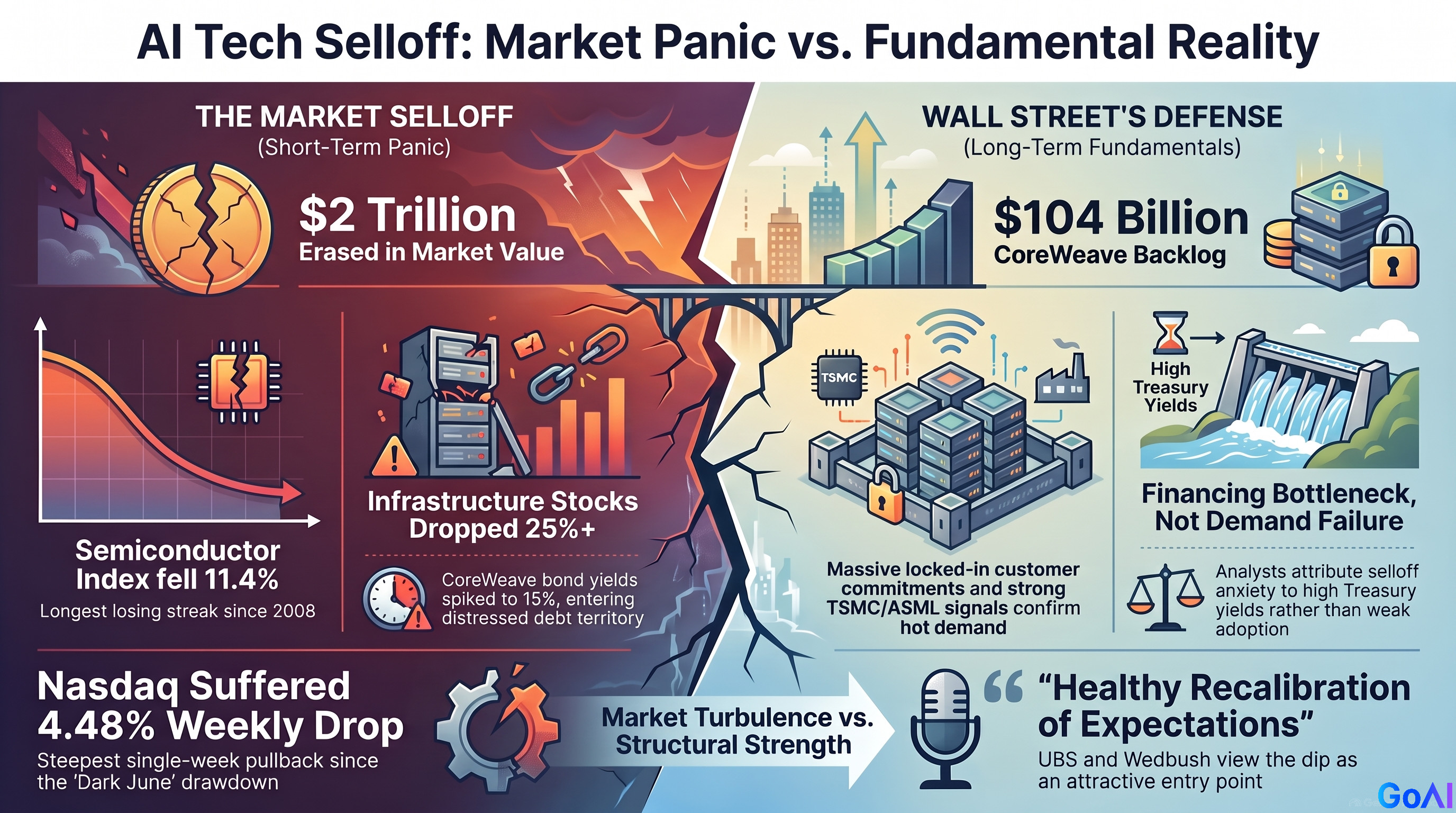
Global tech stocks took a beating last week as mounting anxiety over AI financing risks triggered an aggressive unwind across market darlings.
Even so, Wall Street desks are largely standing by the secular trade, dismissing the drawdown as another knee-jerk panic and insisting end-market AI demand remains intact.
On Friday, the Nasdaq slid more than 2%, taking its weekly loss to 4.48%—its steepest single-week pullback since the "Dark June" drawdown.
With momentum plays like Micron, SanDisk, AMD, Intel, and Lumentum tumbling in tandem, the Philadelphia Semiconductor Index closed lower for an eighth consecutive session on Friday, marking its longest losing streak since 2008.
The SOX index dropped 11.4% on the week and shed over 13% across the eight-day slide, erasing roughly $2 trillion in market value.
Neo-cloud infrastructure provider CoreWeave and peer Nebius each sank more than 25% on the week.
At the epicenter of the selloff, CoreWeave’s bond yields spiked to 15%, entering territory traditionally associated with distressed debt.
In a recent interview, Baird tech strategist Ted Mortonson noted that on free cash flow metrics, these names—alongside Oracle—sit "near the bottom of the tech sector."
He stressed that these capital-intensive firms now confront "higher costs of capital" and "intense scrutiny over circular financing arrangements."
Nvidia Chief Executive Jensen Huang sought to cool market jitters, expressing confidence in CoreWeave. With Nvidia holding an approximate 10% stake in the cloud provider, Huang’s vocal backing carries considerable weight.
Wall Street Doubles Down on the Secular Trade
That constructive view is echoed elsewhere across the Street.
"I see this as just another round of hand-wringing," said Patrick Moorhead, founder and chief analyst at Moor Insights & Strategy. "We navigated the DeepSeek headlines, tariff shocks, and the broader AI apocalypse narrative."
"Given how far the trade has run, allocators are actively looking for reasons to trim rather than add," Moorhead added.
Wedbush tech analyst Dan Ives characterized the pullback as "the same playbook, just different actors." He pointed to CoreWeave’s backlog, which stood near $104 billion at the close of Q2, as evidence of locked-in customer commitments.
"We view this as the 'SaaSpocalypse' moment for AI infrastructure and expect a similar outcome," Ives said, drawing parallels to the software selloff earlier this year triggered by fears that generative models would displace SaaS seats.
Meanwhile, fundamental signals from lithography bellwether ASML and foundry giant TSMC both confirm that underlying AI chip demand continues to run hot.
Ives noted last week that the recent tech slide reflects growing anxiety over the cost of funding massive infrastructure builds as Treasury yields broke above 5%.
He framed this as a financing bottleneck rather than a demand-side failure, reiterating that enterprise appetite for AI compute remains resilient.
Ives argued that demand signals matter far more than rate volatility, viewing the dip as an attractive entry point.
Strategists at UBS similarly described the turmoil as a "healthy recalibration of expectations" rather than an unraveling of the core AI thesis.
"We advise investors to stay focused on segments where AI capex is translating into durable earnings growth and accelerating adoption across both enterprise and consumer workflows," noted Ulrike Hoffmann-Burchardi, Chief Investment Officer for the Americas and Global Head of Equities at UBS.