
Tonight’s Market Watch: Musk and Huang Join Forces to Lift Tech as Markets Eye Mega-Cap Scorecards

Following a resilient session in Seoul that successfully averted early opening drops, the tech-led relief rally is primed to carry over into the U.S. opening bell.
SpaceX’s blockbuster earnings print has effectively tempered anxieties surrounding the broader "AI trade," while Jensen Huang’s Berlin keynote delivered a wave of constructive updates for the hardware ecosystem.
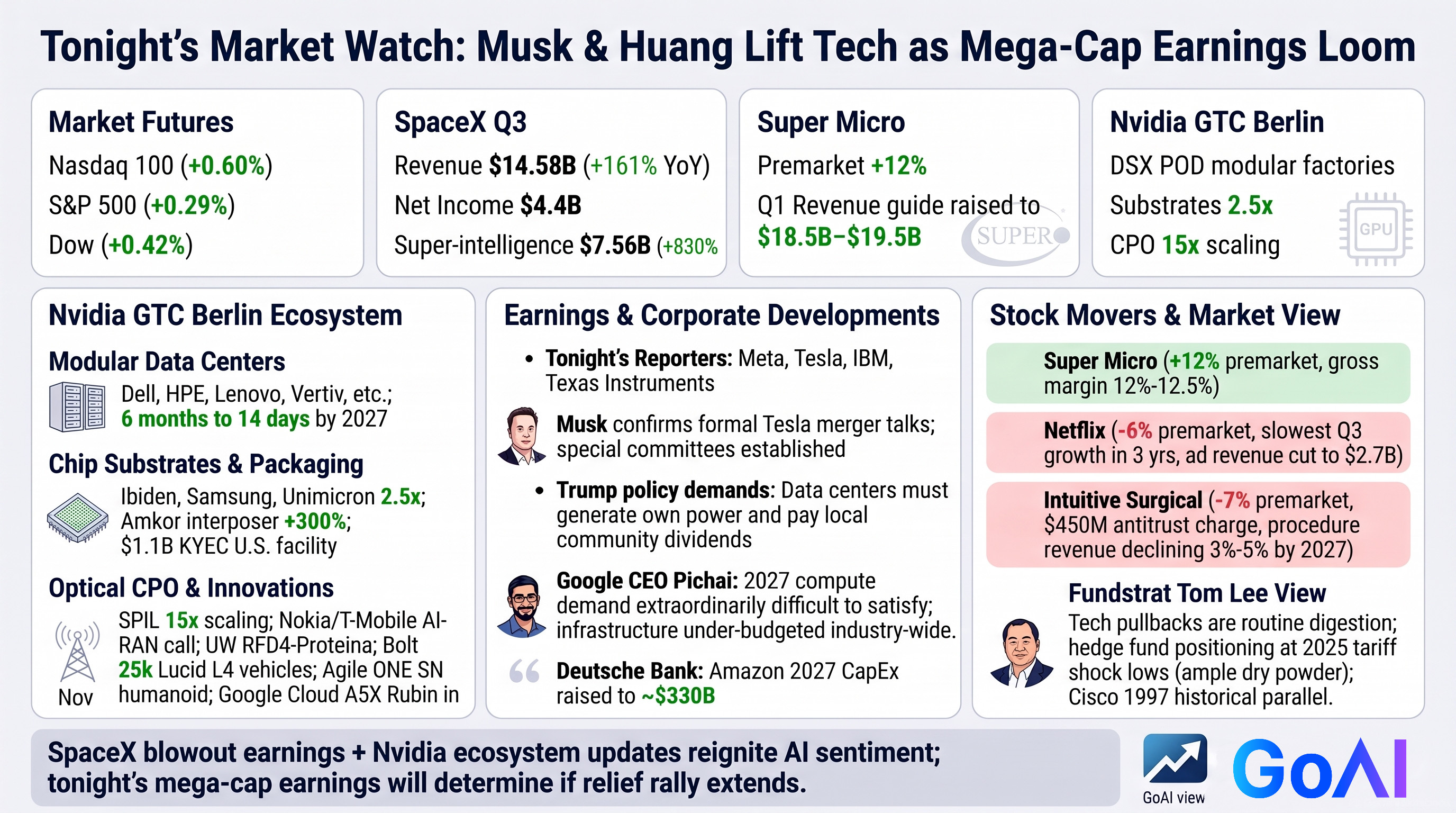
As of press time, Nasdaq 100 futures (December contract) advanced 0.6%, S&P 500 futures gained 0.29%, and Dow futures ticked up 0.42%.
ING Chief Investment Strategist Simon Wiersma noted: "SpaceX appears to have hit the sweet spot for market sentiment, proving that artificial intelligence-related demand remains exceptionally robust.
This dynamic bolsters confidence not only in SpaceX itself, but across the entire AI complex."
In tandem, AI server pioneer Super Micro Computer surged over 10% premarket after issuing preliminary quarterly results that trounced consensus estimates.
In South Korea, data center developer Elice—which suffered a sharp pullback on its market debut—bounced straight to its 29.92% daily ceiling at the open.
Just ahead of the bell, AI bellwether Jensen Huang delivered his GTC keynote in Berlin. While the presentation lacked radical surprises, Nvidia’s unmatched ecosystem reach ensures that even incremental updates send powerful ripples across the supply chain:
- Modular Data Centers: Nvidia teamed up with Dell, HPE, Lenovo, Schneider Electric, Vertiv, Eaton, and Delta to launch DSX POD modular AI factories. Slated for delivery by early 2027, the systems can shrink on-site deployment times from six months down to as little as 14 days where power and cooling infrastructure are pre-vetted.
- Chip Substrates: Nvidia inked capacity agreements with Ibiden, Samsung Electro-Mechanics, and Unimicron to expand associated substrate output by 2.5 times over the next three years.
- Advanced Packaging & Testing: Amkor aims to boost interposer wafer capacity by over 300% by late 2028; Nvidia prepayments of $1.1 billion to KYEC will fund a new U.S. testing facility targeted for volume production by April 2027, with total test capacity expected to double by 2027.
- CPO Optical Engines: Nvidia expanded capacity partnerships with SPIL, targeting a 15-fold scaling by mid-2027 and a subsequent doubling by late 2028.
- AI-RAN: Nvidia, Nokia, and T-Mobile completed the world's first commercial AI-RAN voice call.
- AI Drug Discovery: Nvidia and the University of Washington unveiled RFD4-Proteina, an open protein design model.
- Autonomous Driving & Robotaxi: Bolt adopted Nvidia’s autonomous software stack to deploy at least 25,000 L4-capable Lucid vehicles built on the Hyperion platform in Europe.
- Humanoid Robotics: Robotec.ai-backed Agile One introduced the Agile ONE SN humanoid reference platform powered by Nvidia GR00T and Jetson Thor, targeting early 2027 rollouts.
- GPU-Accelerated Industrial Simulation: Nvidia cuDSS is now generally available, with integrations across Applied Materials, Dassault Systèmes, Siemens, Cadence, and Synopsys.
- Google Cloud Rubin Deployment: Google Cloud’s A5X instances powered by Vera Rubin NVL72 are scheduled for commercial rollout in November.
Weighing in on the market correction, Fundstrat Head of Research Tom Lee characterized recent tech weakness as a routine digestion phase.
Drawing parallels to Cisco’s historical trajectory—when growth skepticism, rising rates, and competition shaved its stock from a split-adjusted ~$9 down to $5 around 1997 before rebounding to $18 a year later and peaking near $80 in 2000—Lee noted that hedge fund net positioning has slumped to lows not seen since the 2025 tariff shock, leaving ample dry powder for eventual re-entry.
After Wednesday’s closing bell, a wave of tech heavyweights—including Meta, Tesla, IBM, and Texas Instruments—will report earnings, offering a fresh read on the health of the AI stack from silicon to end applications.
Corporate Developments
Trump Demands Large Data Centers Power Themselves
U.S. President Donald Trump posted on social media that newly constructed hyperscale data centers should generate their own power and channel surplus electricity back to local communities or the grid to prevent surging residential utility bills.
He also urged data center operators to pay direct "dividends" to local communities to secure public support through shared economic benefits. Trump had previously suggested that tech giants should build dedicated power plants to cover the energy footprints of their massive computing facilities.
Google CEO Sees Severe Bottlenecks in 2027 Compute Market
In an appearance on the Big Technology podcast, Alphabet CEO Sundar Pichai remarked: "If a customer comes to us today looking for compute capacity in 2027, satisfying that demand is extraordinarily difficult."
Pichai revealed that Google briefly rented external compute capacity last year to meet client overflow, noting that across the industry, every player wishes they had doubled their initial infrastructure buildout forecasts.
SpaceX Posts Profit; Musk Confirms Tesla Merger Talks Underway
Commercial space titan SpaceX rallied over 7% premarket after reporting stellar third-quarter earnings. Revenue jumped 161% year-over-year to $14.58 billion—up roughly 87% sequentially from $7.81 billion in Q2 and crushing the Street's $12.8 billion consensus.
Net income hit $4.4 billion, blowing past expectations of $1.88 billion. Super-intelligence services served as the primary growth engine, surging 830% YoY to $7.56 billion from $813 million.
Elon Musk also confirmed for the first time that merger discussions are formally underway, calling the acquisition of Tesla "a good idea" and noting that special committees have been established across both boards to evaluate a potential combination.
Intuitive Surgical Slips 7% Premarket on Legal Charges and Pricing Headwinds
Surgical robotics maker Intuitive Surgical dropped up to 7.6% premarket.
While Q3 revenue of $3.05 billion and adjusted EPS of $3.00 both beat consensus, the company booked a $450 million pre-tax charge related to an antitrust lawsuit settlement.
Management also guided that underlying da Vinci instrument and accessory revenue per procedure will decline roughly 3% to 5% by 2027 on a constant product-mix basis. Worldwide da Vinci procedures grew 10% year-over-year domestically, lagging behind a 20% growth rate internationally.
Super Micro Computer Upgrades Guidance, Surging 12% Premarket
Super Micro Computer jumped as much as 12.2% premarket after issuing a stellar preliminary financial update.
The server maker projects fiscal Q1 revenue (ended September) between $18.5 billion and $19.5 billion, smashing prior guidance of $14.5 billion to $15.5 billion and the Street's $15.23 billion estimate, driven by insatiable AI platform demand.
Gross margins are expected to land between 12% and 12.5%, up from prior guidance of 10.4% to 10.8%, helped by favorable product and customer mixes. Full financial results will be released on November 3.
Netflix Slumps 6% Premarket on Trimmed Ad Revenue Outlook
Netflix shares slid over 6% premarket after reporting third-quarter revenue grew 11.8% YoY to $12.87 billion, marking its slowest growth rate in nearly three years, alongside a downgrade to its full-year ad revenue forecast from $3.0 billion to $2.7 billion.
Although headline figures edged past expectations, fourth-quarter guidance called for revenue of $13.44 billion and EPS of $0.67, both trailing the Street's targets of $13.51 billion and $0.73, respectively.
Sluggish ad-tier monetization and plateauing engagement growth amplified investor anxieties over its intermediate trajectory.
Deutsche Bank Sees Amazon Capex Reaching $330 Billion Next Year
In an earnings preview note released October 20, Deutsche Bank projected that accelerating AWS demand, resilient advertising revenue, and normalized e-commerce comps will help Amazon print toward the higher end of its revenue guidance range.
However, stronger growth comes with heavy reinvestment: Deutsche Bank raised its 2027 capital expenditure forecast for Amazon to approximately $330 billion while leaving its 2026 and 2027 EPS estimates largely unchanged.