
New Safe Haven in an AI Shock? Goldman Says Yen Is Regaining Defensive Appeal as a Superior Hedge

The Japanese yen is re-emerging as an effective safe-haven buffer against financial market turbulence—particularly disruptions stemming from the artificial intelligence complex—according to a new research note from Goldman Sachs Group Inc.
With structural adjustments in Japan’s policy landscape diminishing the risk of steep yen selloffs during global yield spikes, Goldman strategists, including Kamakshya Trivedi, noted:
"While the global economic backdrop still suggests scope for further yen weakness, the yen now looks like a much more attractive hedge for cyclical asset portfolios compared to recent years."
Rising Appetite for Safe-Haven Assets
Demand for traditional defensive hedges has accelerated as mounting skepticism surrounding ballooning AI capital expenditures pressures equity valuations and drives U.S. Treasury yields lower.
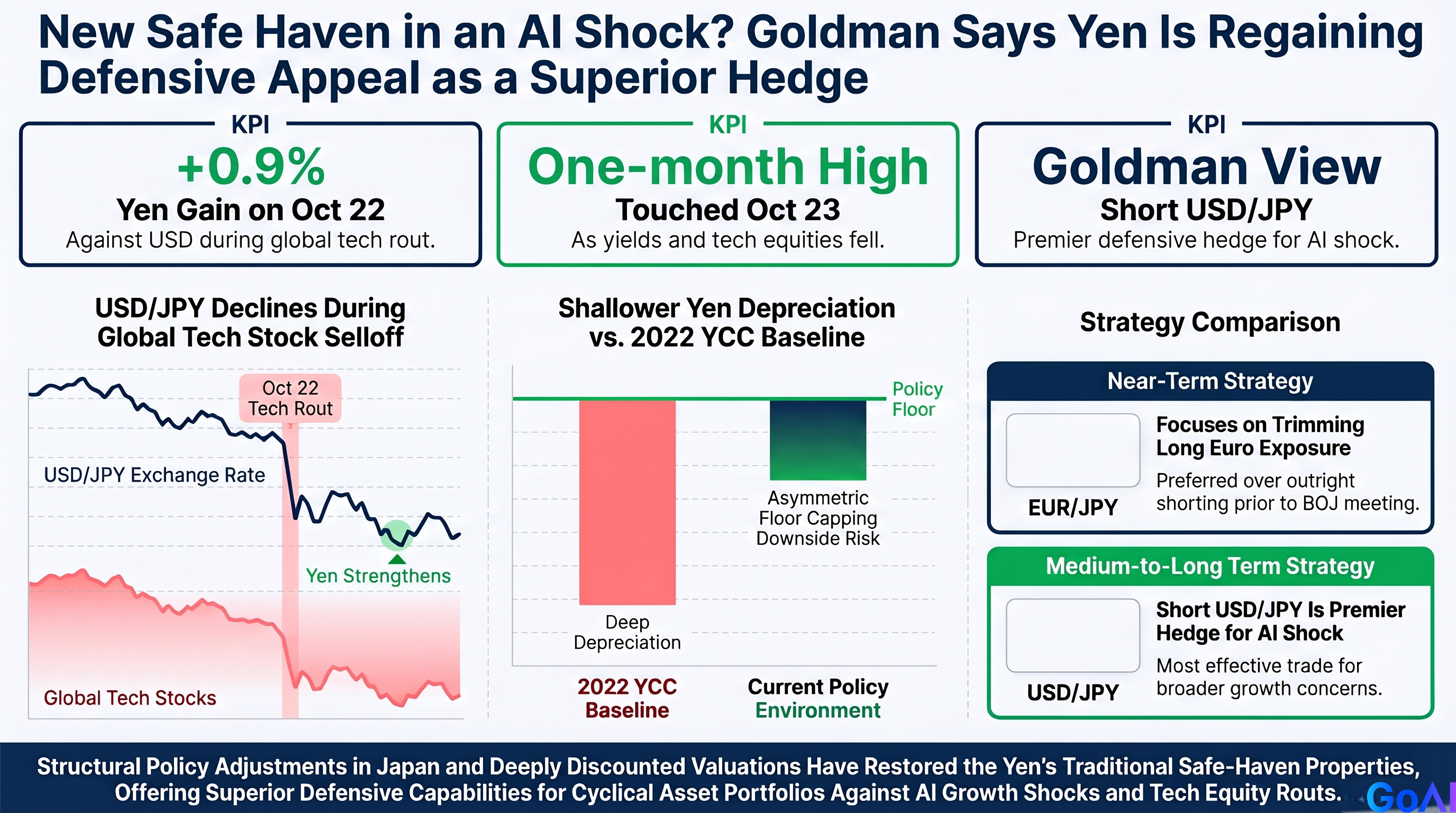
The yen gained traction during last week's global technology rout, rising 0.9% against the dollar on Oct. 22 and touching a one-month high on Oct. 23.
Goldman pointed out that the AI capex cycle has left both U.S. equities and the greenback increasingly sensitive to growth-slowdown risks, emphasizing that the yen demonstrates outsized strength when equity prices and bond yields retreat simultaneously.
Goldman cited the evolving Bank of Japan policy framework as a central catalyst reinforcing the currency's defensive properties.
The yen’s depreciation during recent global bond yield run-ups has been noticeably shallower than the baseline observed over the past six to seven years—a sharp contrast to 2022, when the BOJ rigidly defended its yield curve control (YCC) framework.
An improved monetary policy backdrop, deeply discounted valuation multiples, and the persistent threat of official FX intervention have established an asymmetric floor, capping downside tail risks for the currency. As a result, institutional allocators have greater justification to absorb negative carry costs when holding long yen hedges.
In the near term, Goldman views trimming long euro positions as a superior strategy to outright shorting EUR/JPY, projecting that the BOJ is unlikely to deliver an unexpectedly hawkish signal at its Oct. 30 rate-setting meeting, while domestic catalysts for an aggressive rally remain limited.
Over the medium-to-longer horizon, however, Goldman advocates positioning for yen strength against the dollar: "To hedge broader growth concerns or a broad-based AI shock, being short USD/JPY is the most effective expression."