
Parsing the Four U.S. Midterm Scenarios: How Markets Are Positioned to React

As voters head to the polls for the U.S. midterm elections, Wall Street's largest lender is projecting that equities are broadly poised to push higher once the political dust settles.
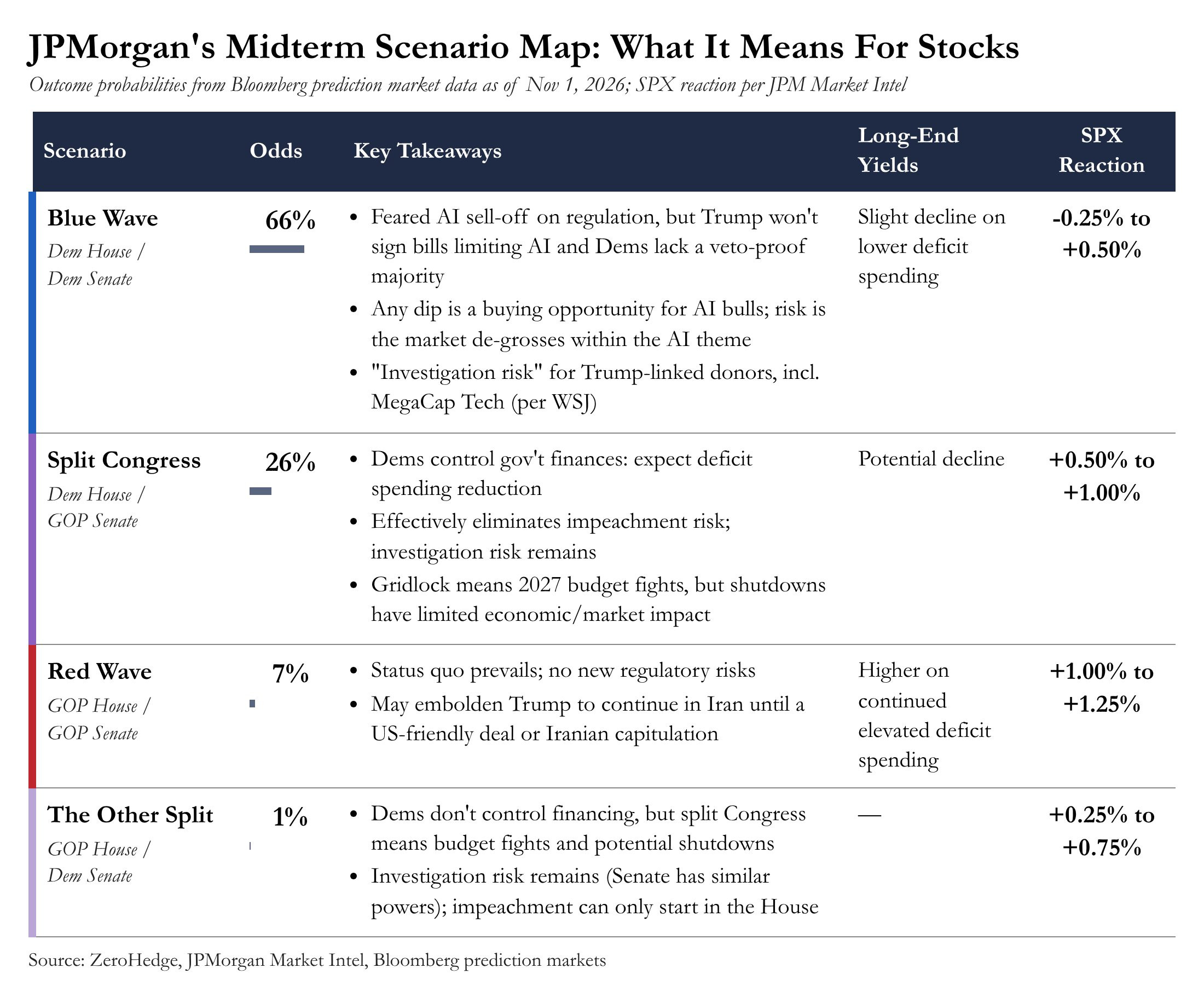
In a research note released this week, JPMorgan Chase & Co. quantified the probability distribution of Capitol Hill’s post-election makeup and mapped out the likely short-term performance of the S&P 500 across each outcome.
Historically, both midterm and presidential election cycles have served as dependable tailwinds for risk assets—a precedent supported by recent trading patterns.
However, the magnitude and sector distribution of the post-election move will hinge on whether markets confront a "Blue Wave," a status-quo Republican sweep, or legislative gridlock.
JPMorgan’s Scenario Matrix and S&P 500 Projections
- Blue Wave (Democratic sweep of both chambers): 66% probability; S&P 500: -0.25% to +0.50%
- Divided Congress (Democratic House, Republican Senate): 26% probability; S&P 500: +0.50% to +1.00%
- Red Wave (Republicans retain both chambers): 7% probability; S&P 500: +1.00% to +1.25%
- Divided Congress (Republican House, Democratic Senate): 1% probability; S&P 500: +0.25% to +0.75%
Scenario 1: Blue Wave — Democratic Sweep (66% Probability)
JPMorgan assigns a 66% probability to Democrats sweeping both the House of Representatives and the Senate, making it the consensus base case.
Under this scenario, the bank models S&P 500 performance ranging from a modest 0.25% decline to a 0.50% gain.
An outright Democratic victory would likely amplify market concerns over stricter regulatory oversight targeting hyperscale data centers and Big Tech, potentially triggering an initial knee-jerk de-risking in AI-leveraged names.
However, JPMorgan strategists emphasize that any legislative efforts to restrict AI infrastructure or commercialization would face a formidable barrier in President Trump’s executive veto pen. Consequently, the bank advises traders to view any election-induced tech retreat as a buying opportunity.
On the macro front, Democratic stewardship over congressional purse strings would likely constrain deficit spending, putting downward pressure on benchmark long-end Treasury yields and supporting bond prices.
Conversely, corporate donors and business executives aligned with the Trump administration could face heightened risk of congressional investigations.
Scenario 2: Divided Congress — Dem House, GOP Senate (26% Probability)
JPMorgan pegs the likelihood of a classic split legislature—with Democrats flipping the House and Republicans preserving their Senate majority—at 26%.
In this environment, legislative paralysis becomes a market catalyst.
Because neither party would command the unilateral leverage required to force through major policy shifts or expand discretionary spending, institutional allocators would welcome the gridlock as a policy relief valve, lifting the S&P 500 by an estimated 0.50% to 1.00%.
Long-dated Treasury yields would still be expected to drift lower given the Democratic majority in the House, while targeted committee oversight of specific corporate entities and corporate donors would persist.
Scenario 3: Red Wave — Republicans Retain Capitol Hill (7% Probability)
JPMorgan views the preservation of the status quo—Republicans maintaining unified control of both the House and Senate—as an outside bet, assigning it just a 7% probability.
Should a Red Wave materialize, the total absence of incremental regulatory headwinds would likely ignite an immediate relief rally, driving the S&P 500 up 1.00% to 1.25%.
On the geopolitical and macro fronts, this result could embolden the Trump administration to escalate military actions against Iran.
At the same time, expectations of widening fiscal deficits and unconstrained borrowing would likely drive long-term U.S. Treasury yields higher, steepening the yield curve.
Scenario 4: Inverted Divided Congress — GOP House, Dem Senate (1% Probability)
The least probable permutation, carrying an implied probability of just 1%, is an inverted split where Republicans retain the House while Democrats claim the Senate.
Under this setup, the S&P 500 is projected to advance between 0.25% and 0.75%. Deep institutional polarization would lead to protracted legislative stalemate, acrimonious fiscal showdowns, and elevated risks of government shutdowns.
Additionally, the Democratic-led Senate would wield subpoena and confirmation powers, keeping regulatory and investigative overhangs alive for corporate targets.
Ultimately, JPMorgan strategists note that whichever scenario plays out, the conclusion of Tuesday’s voting will remove a substantial event-risk overhang, providing traders and asset allocators with much-needed policy clarity.