
Has Wall Street Entered a "Stealth Bear Market"? Goldman Warns Pullback Is Far From Over

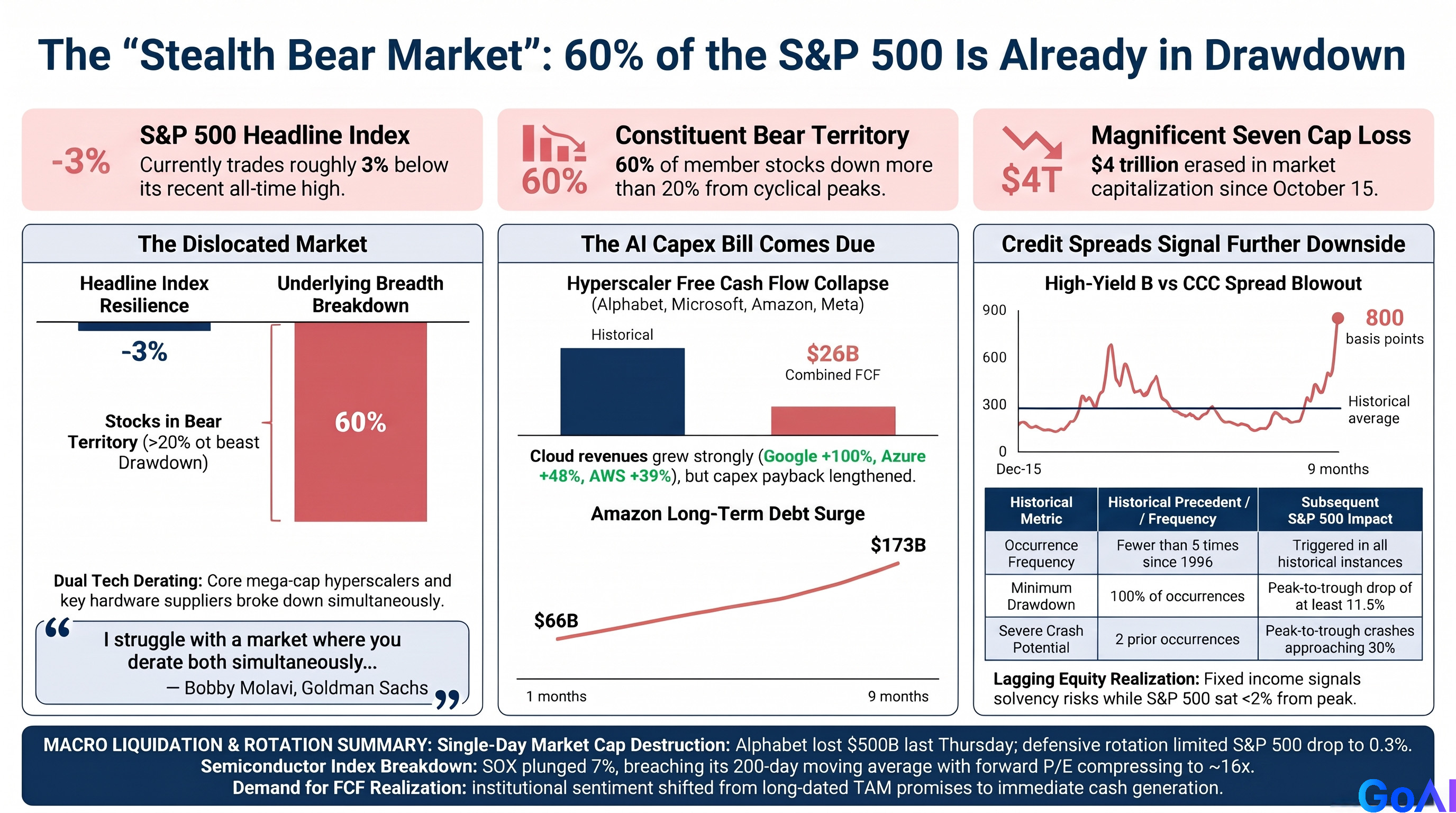
While headline U.S. stock benchmarks hover within striking distance of record highs, a stark divergence under the surface suggests broader equities have already plunged into what Goldman Sachs Group Inc. characterizes as a "stealth bear market"—with the majority of underlying constituent shares nursing severe drawdowns.
More critically, steep selloffs in mega-cap technology shares following last week's earnings reports mark the first time in the current artificial intelligence boom that blockbuster prints have failed to defend lofty equity valuations.
Compounding the macro vulnerability, warning signals flashing across the credit market suggest the broader equity retrenchment may only be in its early innings.
A Dislocated Market: The "Stealth Bear" Regime
Despite recent softness, the S&P 500 trades roughly 3% below its recent all-time high.
Yet behind the resilient headline index, fully 60% of its constituent members are mired in formal bear-market territory, having tumbled more than 20% from their respective cyclical peaks.
Bobby Molavi, managing director and head of execution services for EMEA at Goldman Sachs, highlighted this acute market dislocation in a research note.
He pointed out the prevailing anomaly: while the market's multi-year bull run has been overwhelmingly propelled by the AI narrative, both the core mega-cap hyperscalers driving the thesis and the hardware suppliers absorbing their capital outlays have broken down simultaneously.
"I struggle with a market where you derate both simultaneously, particularly while the base case remains that AI will change everything," Molavi wrote, characterizing the underlying structure as a "stealth bear market."
The AI Capex Bill Comes Due
Over recent weeks, mounting anxiety surrounding the sustainability of ballooning infrastructure spending has triggered a sharp unwinding of crowded AI trades.
While institutional de-risking hammered the tech complex, a rapid rotation into under-allocated, defensive enclaves helped lift the majority of S&P 500 constituents over the past month.
Molavi noted that the "Magnificent Seven" tech bellwethers have collectively erased $4 trillion in market capitalization since October 15. In his view, this marks the first instance where stellar top- and bottom-line deliveries proved insufficient to arrest post-earnings selling pressure.
When Alphabet shed $500 billion in market value last Thursday—its steepest single-day market cap destruction in two decades—the S&P 500 fell just 0.3%, shielded by capital inflows rotating into healthcare, real estate, and consumer staples.
The semiconductor complex enjoyed no such buffer. The Philadelphia Semiconductor Index (SOX) plunged 7% last Friday, breaching its 200-day moving average for the first time in over a year and compressing its forward price-to-earnings multiple to a cyclical low of roughly 16x.
Importantly, Molavi emphasized that the end-market demand narrative remains fundamentally intact: Google Cloud revenue doubled year-over-year, Microsoft Azure expanded 48%, and Amazon Web Services (AWS) accelerated to a five-year peak growth rate of 39%.
Instead, investor anxiety centers squarely on the ballooning capital bill and the lengthening payback horizons.
Hyperscalers that once operated as premier free-cash-flow engines have transformed into capital-intensive builders facing multi-year expenditure cycles.
Combined free cash flow across the four major hyperscalers (Alphabet, Microsoft, Amazon, and Meta Platforms) has shrunk to just $26 billion, a steep departure from historical run-rates.
To fund compute clusters and grid connectivity, firms have increasingly turned to debt markets and equity issuance alongside balance-sheet cash.
Notably, Amazon's long-term debt burden surged from $66 billion to $173 billion in a span of just nine months.
Molavi concluded that last week's post-earnings liquidation represents a moment where the "bill came due" for AI capex.
Institutional sentiment has undergone a decisive regime shift: long-dated promises of future TAM expansion have been eclipsed by demands for near-term margin realization, and unchecked capital expenditure has taken a backseat to free-cash-flow generation.
Credit Spreads Signal Further Downside Ahead
Beyond equity fundamentals, Molavi pointed to ominous developments in credit markets.
Historically, instances where the spread between B-rated and CCC-rated high-yield corporate debt blew out to 800 basis points (8%) have occurred fewer than five times since 1996.
In every prior occurrence, the S&P 500 went on to suffer a peak-to-trough drawdown of at least 11.5% from its 52-week high, with two instances resulting in crashes approaching 30%.
When the high-yield credit trigger fired last week, the S&P 500 sat less than 2% below its zenith—suggesting equity markets have yet to fully discount the liquidity and solvency risks signaled by fixed income.