
Nasdaq Drops Over 5% as Tech Rout Deepens on AI Capex Concerns and Election Fallout

U.S. technology shares plunged on Thursday, dragging the Nasdaq Composite into technical correction territory as the relief rally spurred by the Democratic sweep in the midterm elections quickly unraveled.
Leading artificial intelligence chipmakers, including Nvidia Corp. and Broadcom Inc., declined for a second consecutive session, while data-center operators and cloud-computing infrastructure providers faced broad-based liquidation.
The tech-heavy Nasdaq sank more than 5% in intraday trade, while the S&P 500 fell 3.5% and the Dow Jones Industrial Average shed 1.6%.
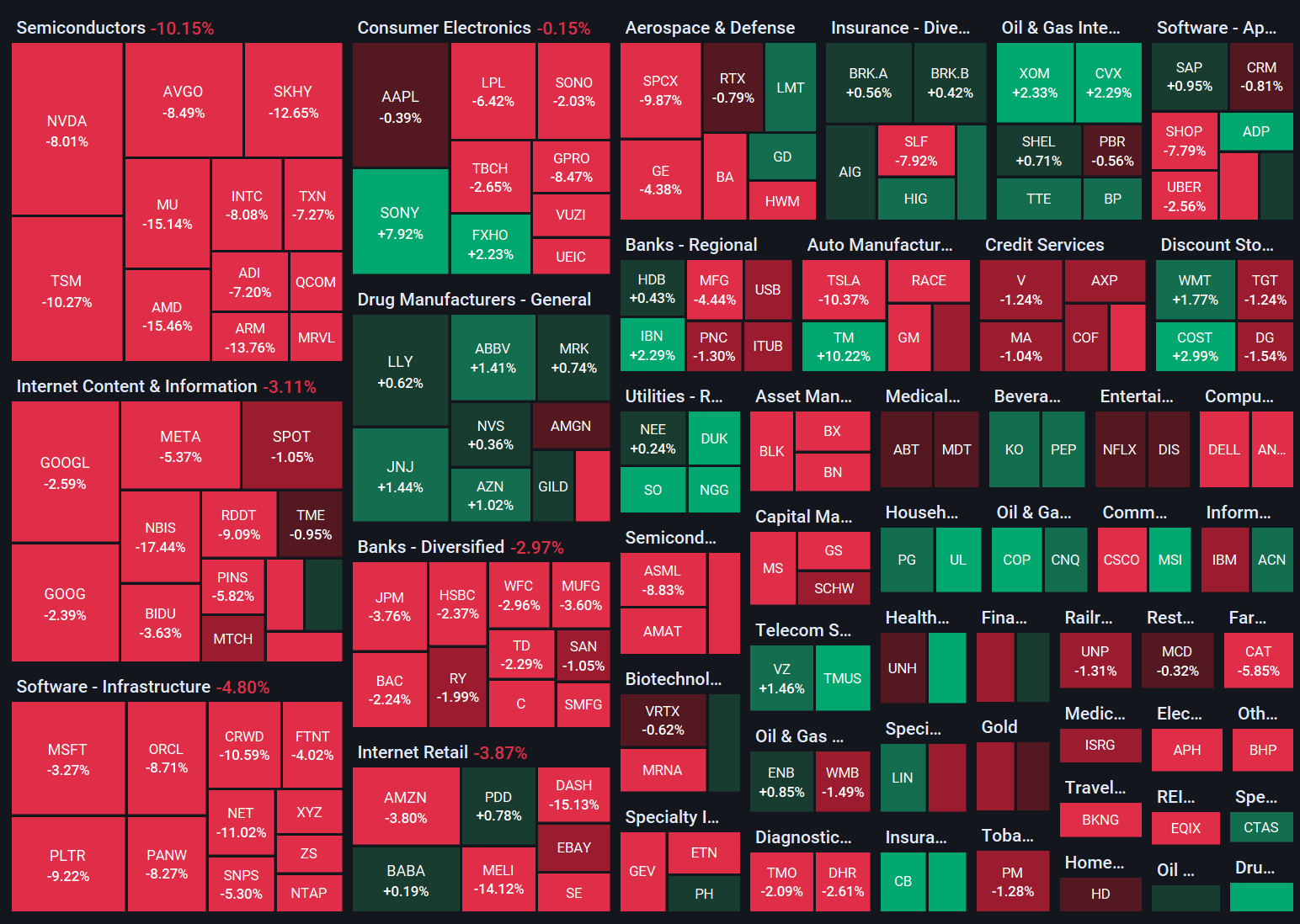
Although cyclical and non-technology shares demonstrated relative resilience, concentrated weakness across AI-leveraged names exerted an outsized drag on broader market benchmarks.
The retreat centered heavily on the AI value chain, hitting chipmakers, data-center developers, and emerging cloud providers.
The Philadelphia Semiconductor Index tumbled 9% on the day to trade near 9,331.
While mega-cap technology firms have aggressively escalated infrastructure spending over recent quarters, investor anxiety regarding whether these ballooning capital outlays will generate commensurate returns on investment has continued to escalate.
Persistently high borrowing costs have compounded market skepticism.
Developing hyperscale data centers requires substantial capital commitments for advanced silicon, server racks, and power-generation equipment, and elevated debt-servicing costs threaten to slow the pace of new project deployments.
Compounding these headwinds, this week’s midterm election results introduced fresh policy crosscurrents.
With Democrats capturing majorities in both chambers of Congress and flipping key gubernatorial races, investors fear heightened scrutiny from federal and municipal authorities could trigger permitting bottlenecks or construction moratoria on regional data centers.
Analysts at UBS estimate that roughly 30% of planned U.S. data-center capacity additions through 2028 face potential risk from development freezes, shifting market skepticism from multiple compression toward broader questions over addressable demand across the supply chain.
Across individual equities, Broadcom and Nvidia each slid more than 7%, spearheading the drawdown across large-cap tech, while Oracle Corp. dropped nearly 5%.
Elon Musk-affiliated companies also came under heavy pressure, with Tesla Inc. tumbling 9% and SpaceX sliding 8% in secondary trading. Qualcomm Inc. fell 10% after issuing a downbeat forward revenue outlook that overshadowed an otherwise forecast-beating quarterly print.
Next-generation AI cloud providers bore the brunt of the liquidation, with CoreWeave dropping 9%, Nebius falling 13%, and Iren losing 11%.
Fears of slowing facility rollouts spilled into utility suppliers and power-equipment manufacturers, weighing on the balance-of-plant value chain.
Bucking the broader tech slump, AI-driven advertising software provider AppLovin Corp. surged 32% on the back of forecast-beating results and upbeat forward guidance.
Jordan Watson, portfolio manager at Tandem Investment Advisors, noted that Wednesday’s sharp bounce and the subsequent rotation out of AI momentum plays reflect elevated near-term volatility. "As investors digest the election outcome and evaluate potential policy implications, the market will likely navigate further turbulence,"
Watson said. "Wednesday's tape should not be viewed as an 'all-clear' signal, but rather as a reminder that the market must critically reassess capital deployment into AI infrastructure—scrutinizing whether current capex trajectories remain economically justified and capable of delivering projected returns."
In commodity markets, U.S. crude benchmarks rebounded after sliding below $90 a barrel the previous session on speculation that a Democratic-controlled legislature might push the Trump administration toward a diplomatic resolution with Iran.
West Texas Intermediate crude futures gained 2.3% to trade around $90.10 a barrel, while global benchmark Brent crude rose more than 2% to near $97.00.
Treasury yields continued their descent. The yield on the benchmark 10-year Treasury note eased to 4.86%, down from 4.90% late Wednesday and off an election-night high of 4.95%, having traded north of 5.30% last month.