
Is 'Black Friday' Just the Beginning? Fund Manager Warns Nasdaq Could Plunge 35% This Year on 'Twin Catalysts'

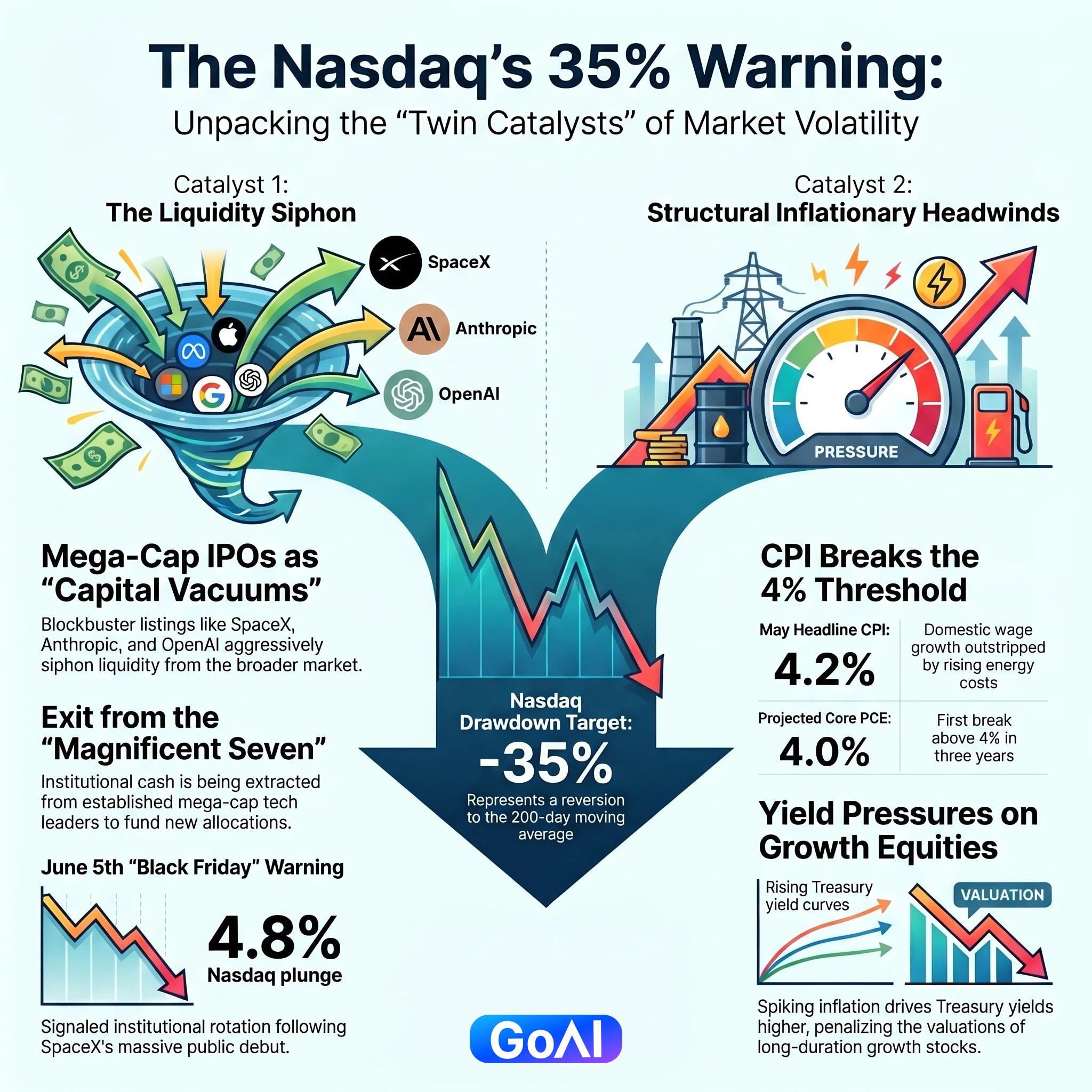
A top US fund manager warns that the Nasdaq Composite could plummet 35% this year, presenting a severe threat to the current bull market.
He attributes this potential correction to a destructive combination of sticky inflationary pressures and a major liquidity drain triggered by a wave of blockbuster IPOs.
Over the past two weeks, semiconductor and growth equities have experienced violent volatility. This turbulence culminated in a 4.8% plunge for the Nasdaq on June 5, a session trading desks have quickly dubbed "Black Friday."
Slavik Kolesnik, co-manager of the Morningstar five-star rated Leader Capital High Quality Income Fund (LCATX), believes these localized drawdowns are merely early warning signs of a deeper structural retreat.
"This is just the beginning," Kolesnik cautioned.
The primary driver behind Kolesnik’s bearish thesis is the sheer volume of mega-cap IPOs slated for this year, highlighted by SpaceX’s massive public debut last Friday. He notes that these blockbuster listings act as giant capital vacuums, orchestrating a profound siphon effect across the broader market.
The liquidity required to fund these allocations will inevitably be carved out of existing equity positions—most notably the "Magnificent Seven" mega-caps that heavily anchor major benchmarks like the Nasdaq.
Early data suggests institutional cash is already rotating aggressively to fund these deals.
According to BofA Securities client flow data for the week ending June 5, the bank's clients pulled a record-breaking amount of capital out of US technology stocks just as the S&P 500 printed its steepest single-week drop since April 2025.
Compounding this structural drain, highly anticipated public listings for Anthropic and OpenAI are still projected to hit the tape later this year.
"That capital has to be extracted from somewhere, and the prime target is the Magnificent Seven," Kolesnik noted.
The second major headwind, according to Kolesnik, is a sustained acceleration in consumer prices.
Driven by escalating military hostilities with Iran pushing energy corridors higher, the US Consumer Price Index (CPI) accelerated 4.2% year-over-year in May. This marked its first break above the 4% threshold in three years and its fastest expansion since May 2023, effectively outstripping domestic wage growth.
Crucially, however, core CPI—which strips out volatile food and energy inputs—ticked up a modest 0.2% month-over-month, coming in below consensus estimates.
While core inflation metrics have remained relatively well-behaved so far, Kolesnik argues it is only a matter of time before soaring headline energy costs systematically pass through into broader economic inputs.
Historically, spiking inflation drives long-duration Treasury yields higher as fixed-income desks price in a higher-for-longer interest rate regime. This macro environment heavily penalizes growth equities, whose rich long-term earnings valuations are heavily discounted against rising risk-free government yields.
Kolesnik noted that his base-case model projects the core Personal Consumption Expenditures (PCE) price index surging toward the 4% threshold, up from the 3.3% year-over-year expansion printed in April.
Regarding his call for a 35% drawdown, Kolesnik emphasized that such a correction would simply mean the Nasdaq mean-reverting to its 200-day moving average—a critical technical threshold for the benchmark index.