
Highest Since 1995: BOJ Delivers Expected Rate Hike to Combat Persistent Inflation Pressures

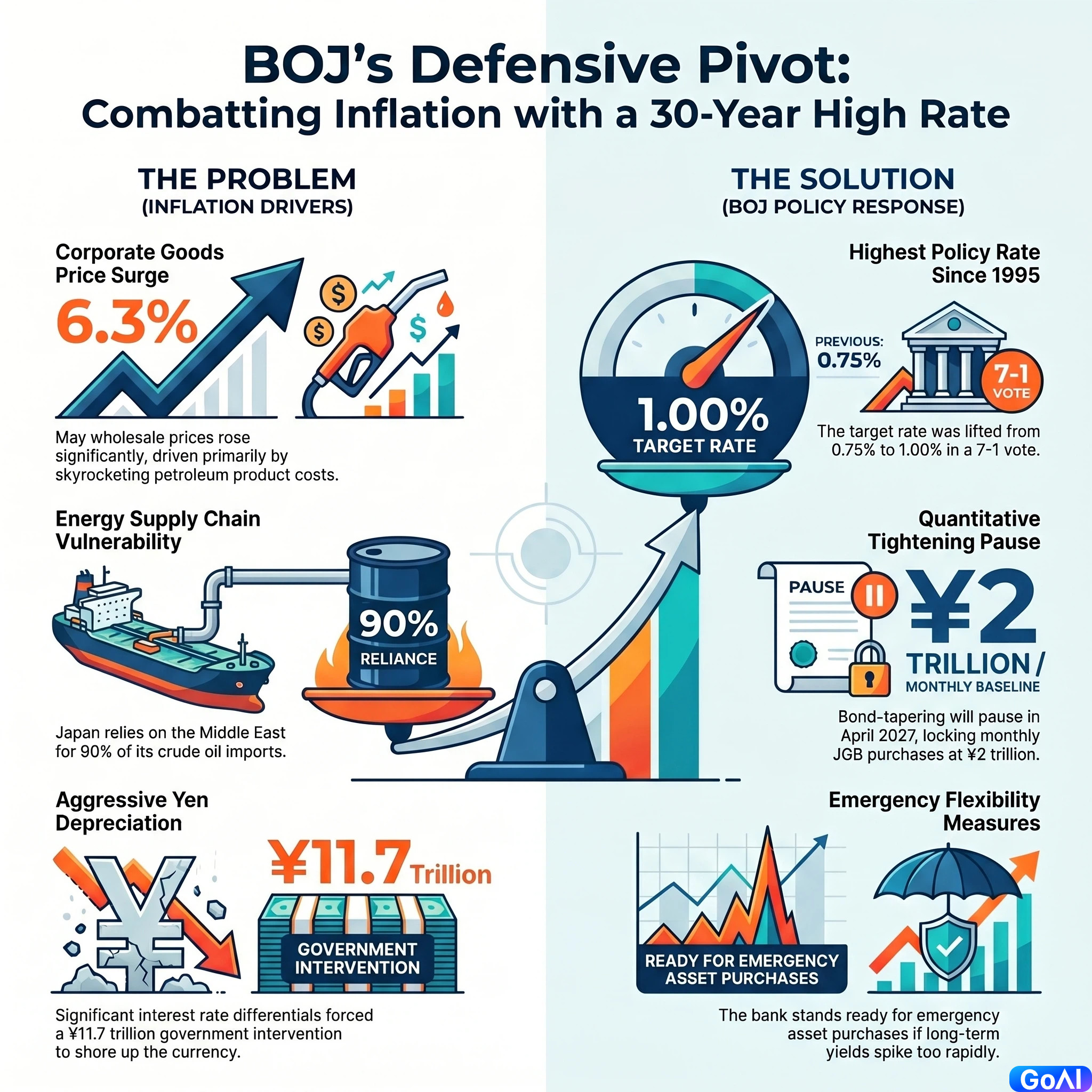
The Bank of Japan announced a 25-basis-point interest rate hike on Tuesday, lifting its policy target rate from 0.75% to 1.00%. The tactical adjustment marks the highest borrowing costs for the nation since 1995.
Concurrently, the central bank declared it will pause its quantitative tightening program beginning April 2027, locking in monthly Japanese Government Bond (JGB) purchases at a steady baseline of approximately ¥2 trillion.
First Hike in Six Months
The policy shift marks the BOJ’s first rate hike in roughly six months, following its last tightening cycle in December.
The move signals that despite the preliminary peace accord between the US and Iran, Tokyo faces immediate structural inflation mandates triggered by the broader Middle East conflict.
The BOJ follows in the footsteps of the European Central Bank and Bank Indonesia, both of which executed rate hikes last week.
The policy directive cleared the board in a 7-1 vote. Policy Committee Member Toichiro Asada cast the lone dissenting vote, advocating to maintain the target rate at 0.75%.
In its accompanying policy statement, the BOJ acknowledged that the pass-through effect of elevated international crude prices is accelerating at a relatively quick pace, which risks driving widespread consumer price increases across a broad basket of domestic goods.
While the US and Iran announced a comprehensive treaty on Monday to conclude three months of active military hostilities and reopen the strategically vital Strait of Hormuz—the corridor for roughly one-fifth of global oil shipments—the operational lag to normalize global trade flows presents a persistent challenge.
For Japan, securing a stable normalization of energy and raw material supply chains will likely require an extended timeline.
Prior to the outbreak of the war, Japan relied on the Middle East for approximately 90% of its crude imports. The subsequent price spikes in international oil benchmarks dramatically amplified domestic cost-push inflationary pressures.
Compounding the problem, a wide US-Japan interest rate differential had triggered an aggressive depreciation of the yen in recent months, further exacerbating import-driven inflation.
The currency stress forced the Japanese government to deploy roughly ¥11.7 trillion ($72 billion) last month in direct FX intervention to shore up the currency.
Given this macro backdrop, fixed-income desks viewed a June rate hike as entirely unavoidable.
Shigeto Nagai, Head of Japan Economics at Oxford Economics, recently noted that the BOJ "could not afford to delay lifting its policy rate," warning that inaction "would have severely disappointed financial markets and catalyzed further speculative depreciation of the yen."
JGB Taper Paused
Beyond the widely anticipated rate hike, the BOJ’s decision to freeze its bond-tapering program drew significant market attention.
The central bank stated it will discontinue its mid-term reviews of the JGB taper timeline.
Management emphasized that if long-term yields spike too rapidly, the bank will pivot flexibly via emergency asset purchases and fixed-rate operations, adding it stands ready to recalibrate the tapering blueprint at future policy sessions if necessary.
BOJ Deputy Governor Shinichi Uchida is scheduled to host a press briefing Tuesday afternoon to elaborate on the policy rationale.
Governor Kazuo Ueda was absent from the proceedings due to hospitalization.
Latest wholesale prints released by the BOJ last week show Japan’s May Corporate Goods Price Index (CGPI) surged 6.3% year-over-year, driven by skyrocketing petroleum product costs.
Internal central bank deliberations have grown increasingly hawkish, reflecting deep institutional anxiety that lagging behind the curve could let structural inflation run unchecked.