
Macro Strategy Note: Has the Secular Peak for South Korean Equities Arrived?

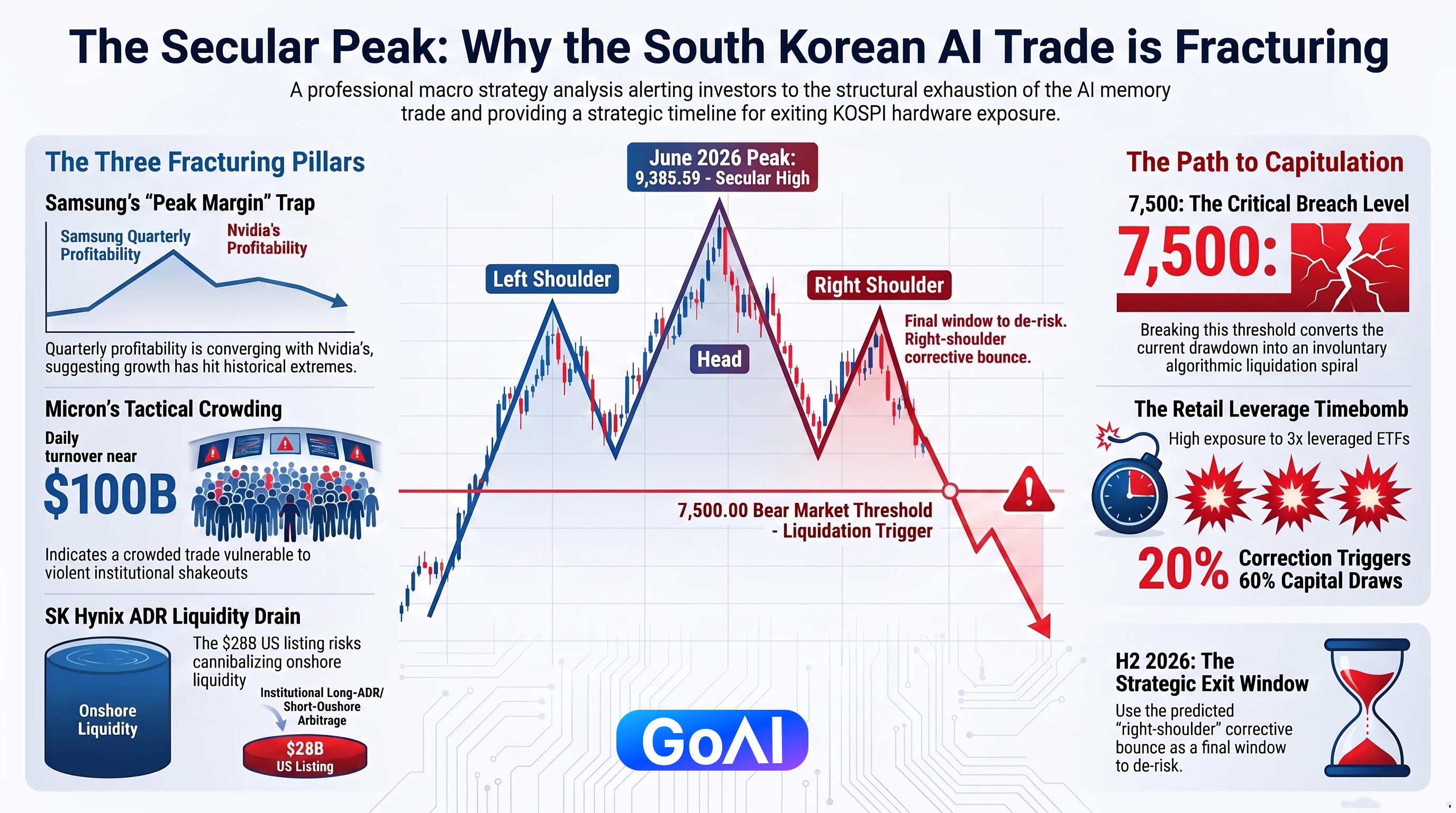
The global artificial intelligence (AI) hardware trade is flashing signs of exhaustion, leaving South Korea’s benchmark KOSPI index hovering on the precipice of a technical bear market.
Driven by an explosive memory upcycle, the KOSPI notched a secular high of 9,385.59 in June 2026, but has since endured an 18% peak-to-trough drawdown to the 7,755 level as of July 7.
While a near-term tactical rebound is expected ahead of SK Hynix’s USD 28 billion ADR listing, this counter-trend rally should be viewed as a critical de-risking window rather than a buying opportunity.
The underlying bull case has fractured across three structural pillars: peak operating margins at Samsung, severe positional crowding in Micron, and impending liquidity cannibalization from the SK Hynix ADR.
The Fracturing Pillars of the AI Memory Trade
1. Samsung Electronics: The Perils of Peak Margins
The core vulnerability for Samsung Electronics lies not in fundamental underperformance, but in the near-impossible task of sustaining its current rate of marginal growth.
Wall Street expects Samsung’s preliminary Q2 operating profit to hover around KRW 86 trillion, meaning its quarterly profitability is effectively converging with or exceeding Nvidia’s recent GAAP operating profit of $53.54 billion.
Growth equities face the highest risk of re-rating when operating margins hit historical extremes, as capital markets trade the marginal rate of change rather than absolute numbers.
With the bullish catalysts of HBM price hikes and tight DRAM supply fully priced in, the market will invariably question sequential upside, turning pristine income statements into a reliable indicator for equity tops.
2. Micron Technology: Technical Crowding and Broken Order Flow
Micron has served as a primary vehicle for institutional deployment into the AI memory thesis, but its parabolic ascent has left massive overhead supply trapped near cyclical highs.
Following its latest earnings print, daily turnover frequently approached the $100 billion threshold, indicating a highly crowded trade where market mechanics transition into an aggressive order-book battle.
Even if the structural thesis remains intact, institutional players will likely enforce violent shakeouts to flush out weak-handed retail leverage before mounting any sustained recovery.
3. The SK Hynix ADR: A Liquidity Drain and Arbitrage Mechanism
SK Hynix’s launch of its USD 28 billion US listing functions primarily as a cross-border liquidity reallocation event rather than a milestone for true price discovery.
Active managers are buying ahead of passive inflows to front-run future semiconductor index and ETF inclusions, creating an artificial demand peak that risks collapsing once passive mandates complete execution.
Concurrently, institutional desks are primed to execute long-ADR/short-onshore equity pairs, exploiting liquidity disparities between Seoul and New York rather than reflecting actual hardware demand.
The Crowded Trade and Retail Leverage Vulnerability
The technical parameters of the KOSPI point to a structural Head-and-Shoulders top configuration, with the technical bear market threshold sitting dangerously close at roughly 7,500.
The systemic threat is magnified by South Korea's highly financialized retail trading ecosystem, which has relied heavily on 2x and 3x leveraged tech ETFs during this AI cycle.
If an investor utilizes multiple accounts combined with triple-leveraged vehicles, a 20% baseline index correction amplifies into a 60% draw on capital, pushing accounts into immediate margin call territory.
Should the KOSPI breach the 7,500 threshold, the correction will shift into an involuntary liquidation spiral as forced algorithmic liquidations convert a dip-buying mentality into panicked capitulation.
Strategic Conclusion and Asset Allocation Direction
The long-term secular thesis for AI infrastructure remains valid, and structural demand for HBM, advanced packaging, and AI servers will persist over a multi-year horizon.
However, structural industry growth does not immunize equities from severe near-term multiple compression during periods of extreme structural crowding.
The upcoming macro calendar—highlighted by Samsung’s Q2 update and the listing velocity of the SK Hynix ADR—will likely provide the necessary sentiment backing for a final right-shoulder corrective bounce.
This specific window represents the most favorable exit point for AI hardware risk exposure for the remainder of H2 2026, as secular tops are routinely forged when the structural narrative is seamless and stories look best.