
US Q2 Earnings Preview: Non-Tech Resilience Shines as Mega-Cap Tech Faces a High Bar to Impress

Wall Street is heading into an earnings season with profits near historic highs, but for investors, the overarching question remains: will it be enough to keep the roaring US bull market on track?
The second-quarter earnings season kicks off this Tuesday. Data compiled by media networks show that analysts expect S&P 500 companies to post a 24% surge in Q2 profits, marking one of the strongest performances on record.
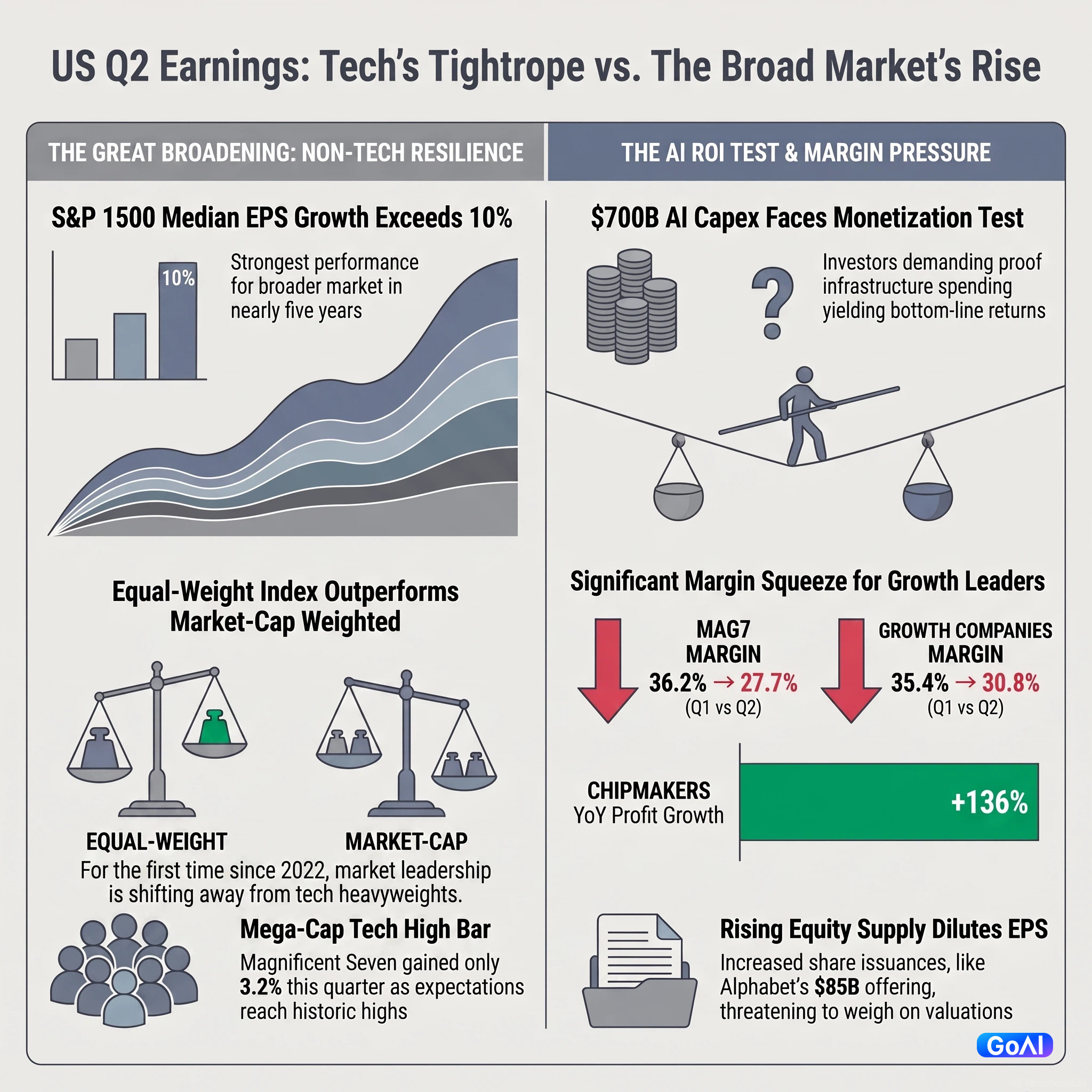
Interestingly, the mega-cap tech stocks known as the "Magnificent Seven (Mag7)"—traditionally the engines of the market rally—were relatively sluggish this past quarter and contributed little to the S&P 500's appreciation. An index tracking these seven tech giants gained a modest 3.2% over the quarter.
As corporate report cards roll out, here are the core themes driving investor sentiment:
Earnings Resilience Outside of Tech
Morgan Stanley strategist Michael Wilson and his team note that US equities outside of the mega-cap tech cohort are poised to report robust earnings, a shift that could broaden the market’s rally.
According to the team, the median year-over-year growth in earnings per share (EPS) for S&P 1500 companies topped 10%. This marks the strongest performance in the nearly five years since the post-pandemic economic recovery began.
Wall Street analysts are continuously upgrading earnings estimates for economically sensitive sectors like consumer discretionary and transportation.
Notably, the S&P 500 Equal Weight Index—designed to neutralize the outsized impact of tech giants—outperformed the market-cap-weighted index for the first time since 2022.
This signals that market leadership is broadening away from a handful of tech heavyweights toward the wider market, formalizing a healthy sector rotation.
Peaking Expectations
Market valuations currently sit at historically stretched levels. Despite a rocky start earlier this year, the S&P 500 has managed to climb over 10% year to date.
"In this earnings season, simply matching expectations will be treated as bad news, particularly for the previous market leaders," said Violeta Todorova, senior research analyst at leverage ETP issuer Leverage Shares.
Wall Street analysts have been aggressively lifting their outlooks for S&P 500 components.
Data from independent research firm Ned Davis Research shows that nearly 64% of companies in the benchmark index received upward earnings revisions in May, hitting a historic high. While that metric edged down slightly to 63.6% in June, it remains heavily elevated.
"High valuations rarely pose an issue when earnings growth is robust," noted Ed Clissold, chief US strategist at Ned Davis Research. "However, that does not mean the market will be immune to a pullback if EPS growth begins to decelerate."
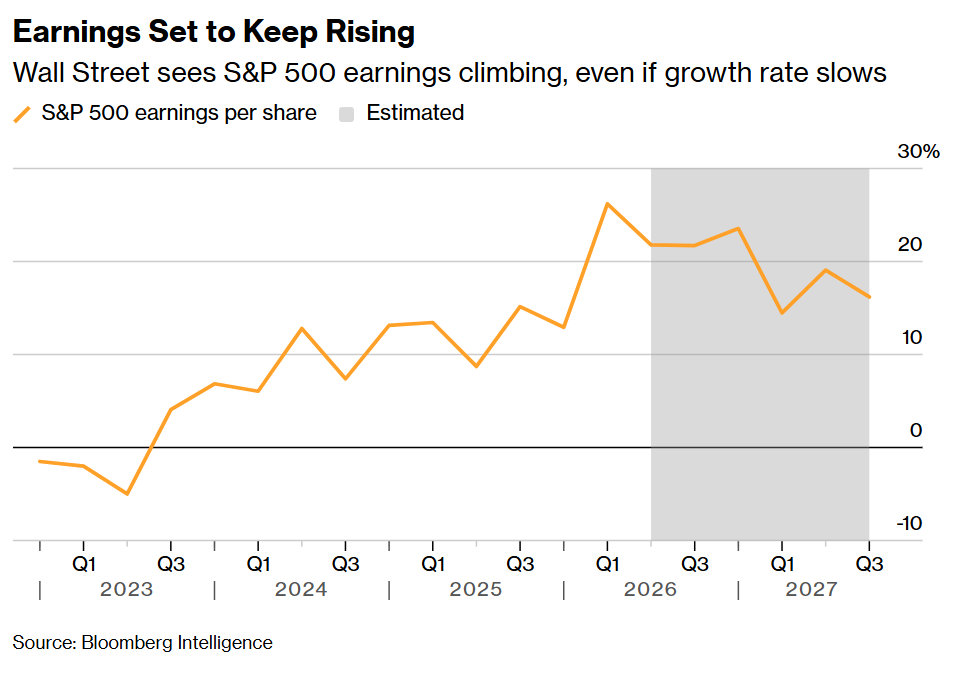
(Note: The orange line represents historical actual S&P 500 EPS year-over-year growth; the line within the shaded gray area represents consensus forecasts.)
Most sectors across the market are facing a deceleration in earnings growth, including consumer discretionary, consumer staples, financials, industrials, and healthcare.
In sharp contrast, chipmakers are projected to deliver a stunning 136% year-over-year profit explosion, fueled by relentless spending from AI buyers.
The AI Monetization Midterm Exam
Technology stocks remain the undeniable main event this season. Second-quarter profits for US information technology firms are projected to surge 67% year-over-year. This ranks second among all S&P 500 sectors, eclipsed only by energy's 118% growth.
However, the market has become increasingly unforgiving. Samsung Electronics and Micron Technology recently delivered blockbuster numbers, yet their stocks failed to push the broader semiconductor sector higher due to overarching valuation concerns.
The MSCI World Semiconductor & Investment Services Index has dropped 6.1% since hitting a record high on June 22, making upcoming reports from ASML and TSMC critical tests for market sentiment.
The massive buyers of AI infrastructure—Alphabet, Amazon, Meta, Microsoft, and Oracle—will report their financials in the coming weeks, providing crucial guidance on whether their massive capital expenditures are yielding actual returns.
This group had been the biggest winners of the AI trade until investors recently began questioning whether their massive cash outflows would translate into matching bottom-line returns. Total capital expenditure for the largest US AI players is projected to top $700 billion this year.
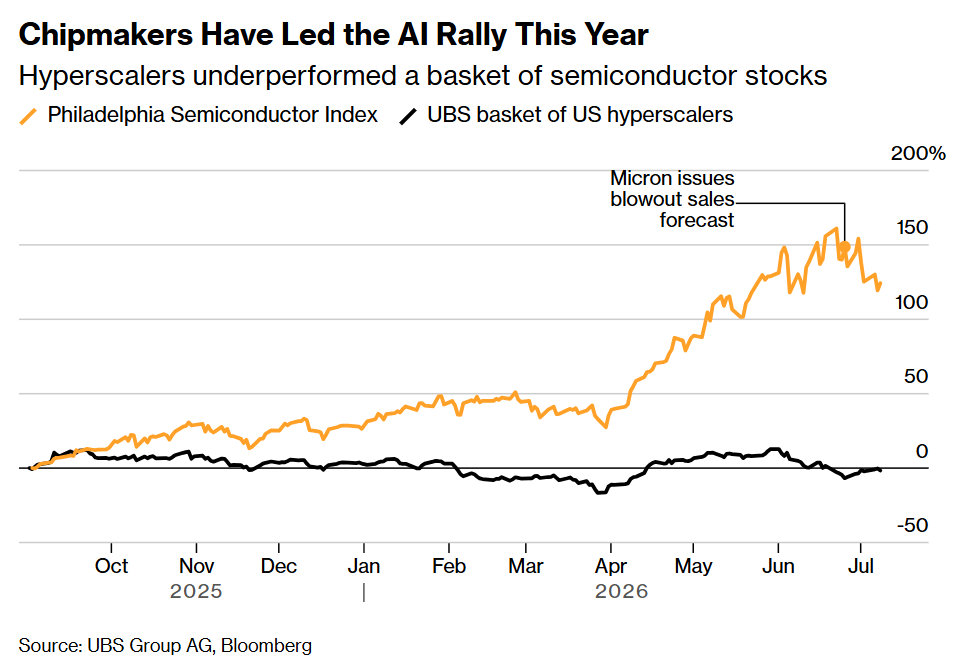
(Note: The orange line represents the Philadelphia Semiconductor Index; the black line represents a UBS-compiled basket of US hyperscale cloud provider stocks. Both curves plot cumulative performance over the same period.)
Margins Under Pressure
With geopolitical tensions flaring up again in the Middle East, the oil supply shocks that previously disrupted markets could make a comeback.
Investors will have to navigate a tricky environment marked by inflation touching three-year highs, rising memory chip prices, and hawkish expectations of Federal Reserve rate hikes.
Industry consensus suggests that profit margins will contract across almost every sector of the S&P 500, with energy and materials being the sole exceptions.
Savita Subramanian, head of US equity and quantitative strategy at BofA Securities, noted that market leadership is shifting. Cyclical sectors like semiconductors are expected to be primary beneficiaries of the massive capex deployed by AI hyperscalers.
In fact, cyclicals are among the few S&P 500 sectors where Wall Street expects the least amount of margin compression.
By contrast, growth companies are projected to see their Q2 profit margins slide to 30.8%, down from 35.4% in the first quarter.
For the Magnificent Seven, the margin squeeze is expected to be even more pronounced, plummeting from 36.2% last quarter to 27.7% in Q2, as these companies spend hundreds of billions to build out AI infrastructure.
Rising Equity Supply
As mega-cap tech companies pivot their cash toward business expansion, their stock buyback momentum has cooled.
Data shows that the outstanding share counts for Microsoft, Meta, and Apple all expanded during the second quarter. This shift has concerned several Wall Street strategists, as buybacks may no longer offer enough cover to offset new share issuances.
Alphabet recently wrapped up an $85 billion secondary offering, marking the largest equity financing among S&P 500 components this quarter. Super Micro Computer, Constellation Energy, American Electric Power, and Digital Realty Trust also issued fresh equity.
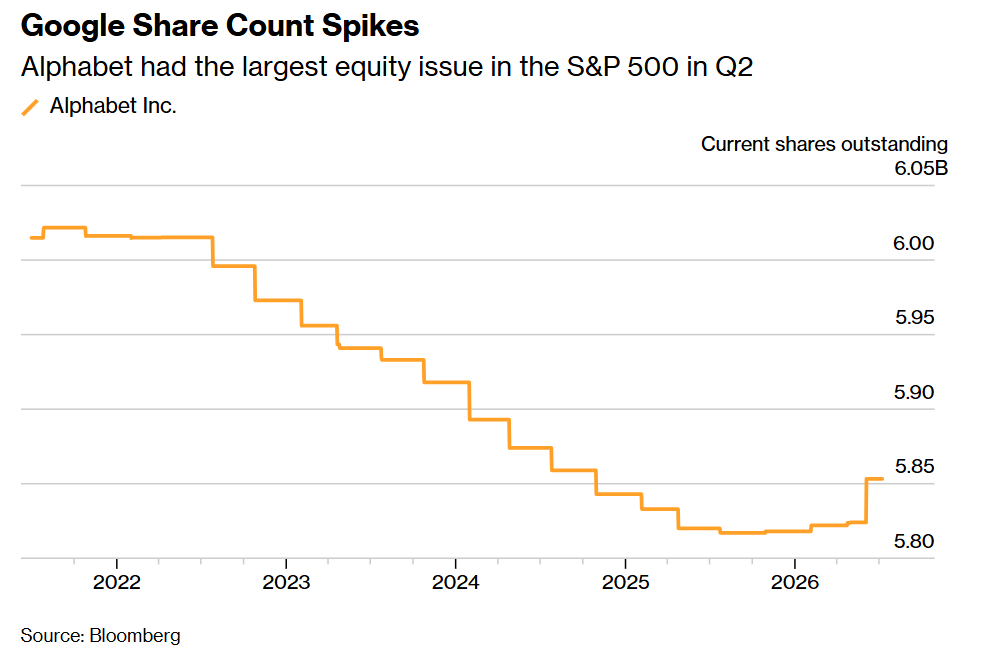
(Note: The orange line tracks the historical trend of Alphabet's total shares outstanding.)
Equity sales outside major indexes, including SpaceX’s landmark IPO, have further accelerated the sudden spike in equity supply. This influx of shares threatens to dilute EPS, dent free cash flow, and weigh on both earnings metrics and broader market valuations.
Erin Kolo, senior vice president of equity and fixed income research at Baird, noted that besides equity issuance, traders are heavily focused on mega-cap debt deals and their ultimate impact on free cash flow.
"Wall Street wants to see proof that despite these massive investment outlays, the seeds are starting to bear fruit," Kolo said. "For these tech titans, cash flow metrics are going to take center stage this season."