
Market Value Halved in a Month: Japanese Memory Giant Kioxia Plunges, Raising Fears of an AI Cool-Down

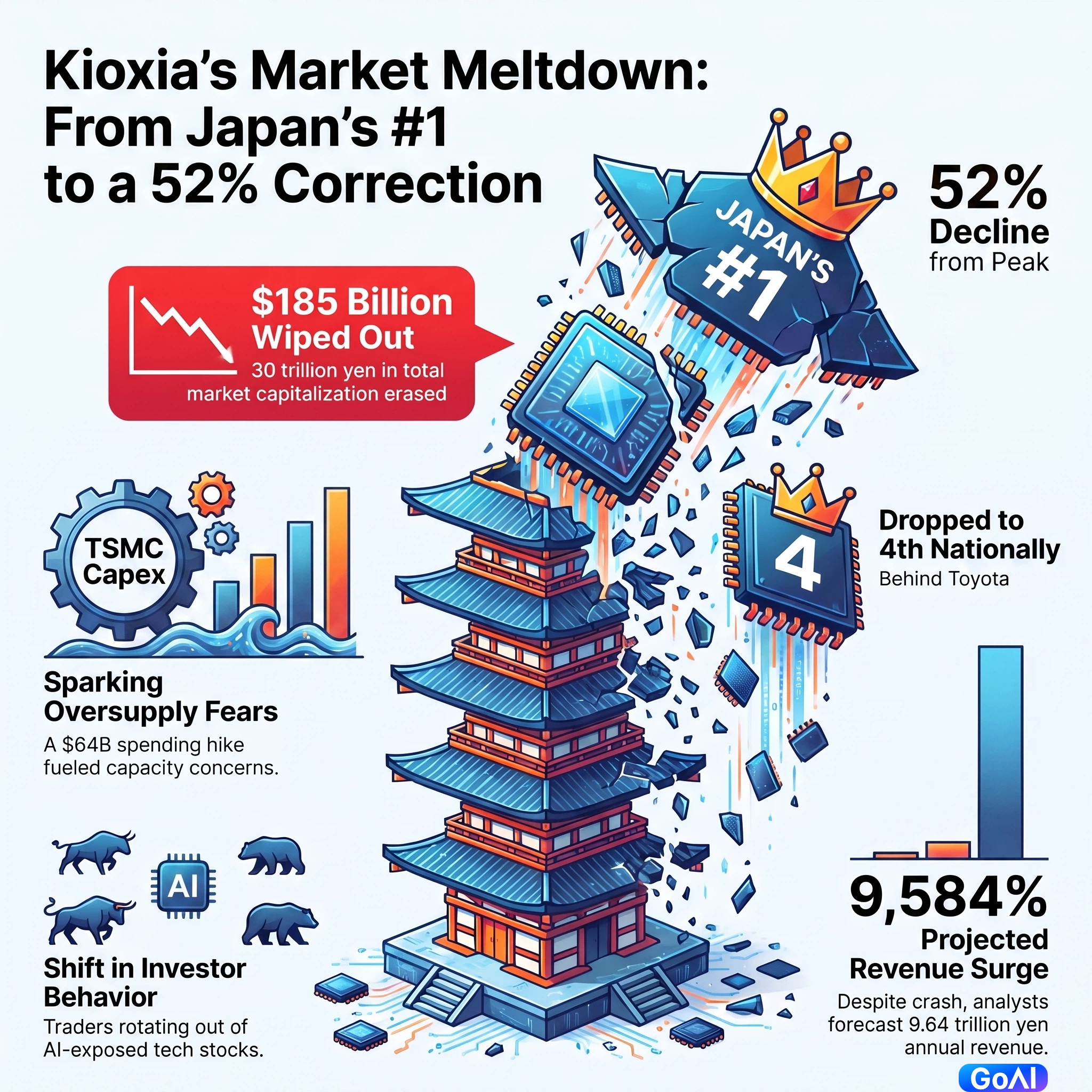
Japanese memory chipmaker Kioxia Holdings Corp. plunged as much as 16% in Friday morning trading, marking a 52% decline from its peak last month.
This rapid descent means the company has shed half its market value just a month after claiming the title of Japan’s most valuable enterprise.
The selloff is primarily driven by growing anxiety among investors that the AI-fueled rally in memory stocks has run too far.
A Swift Halving
Since its listing in 2024, Kioxia's shares have surged on the back of skyrocketing demand for AI-related memory chips, making it one of the top performers in the MSCI World Index.
Driven by the AI boom and robust demand for memory and data storage, Kioxia’s stock had rallied over 600% since the start of the year. It briefly eclipsed automotive giant Toyota Motor Corp. to become Japan’s most valuable company. However, the subsequent correction has dragged its market capitalization down to fourth place nationwide.
On Friday morning, Kioxia shares slid as much as 16% from the open in Tokyo, extending losses to 52% from last month’s record high. The pullback has wiped out at least 30 trillion yen (approximately $185 billion) in market value.
"The chip sector is highly cyclical, and we have seen this pattern play out many times before," said Yugo Tsuboi, chief strategist at Daiwa Securities.
Tsuboi noted a growing consensus that global memory prices may be stabilizing. "It is becoming increasingly difficult to sustain accelerating earnings growth, and fast-money investors are likely rushing to lock in profits," he added.
TSMC’s Capex Hike as a Catalyst
As investors question whether the returns on massive AI investments justify current lofty valuations, global semiconductor firms are coming under closer scrutiny.
A spending update from Taiwan Semiconductor Manufacturing Co. (TSMC) on Thursday may have acted as the catalyst for Kioxia's sharp decline.
TSMC announced Thursday that it is raising its 2026 capital expenditure ceiling to $64 billion, projecting that its investments over the next three years will significantly outpace historical cycles.
This move has fueled concerns that rising industry capacity could undermine the upward momentum of memory prices.
In recent months, a growing number of traders have begun trimming exposure to AI-exposed tech stocks, rotating instead into lagging sectors.
Mixed Outlook and Retail Risks
On the whole, Wall Street analysts remain optimistic about Kioxia, forecasting continued top-line expansion over the coming year.
Consensus estimates project annual revenue to surge to 9.64 trillion yen—a year-on-year increase of 9,584%—with next fiscal year’s revenue expected to grow an additional 28% to reach 12.4 trillion yen.
Furthermore, an upcoming rebalancing of Japan's Topix index in October is expected to trigger substantial passive inflows into the stock.
However, leveraged positions held by Japanese retail investors in Kioxia remain a potential headwind. If retail selling pressure accelerates, it could exacerbate the stock's downward momentum.
Additionally, some market participants view the recent partial exit of major shareholder Bain Capital as a sign that the semiconductor cycle and the broader stock rally may be nearing their peak.