
Meta Poised for Upside Rally

Over the past month, Meta's stock price surged 11%, while the S&P 500 rose only 0.76% over the same period, significantly outperforming the market. In just one short month, Meta's market logic has been fundamentally rewritten.
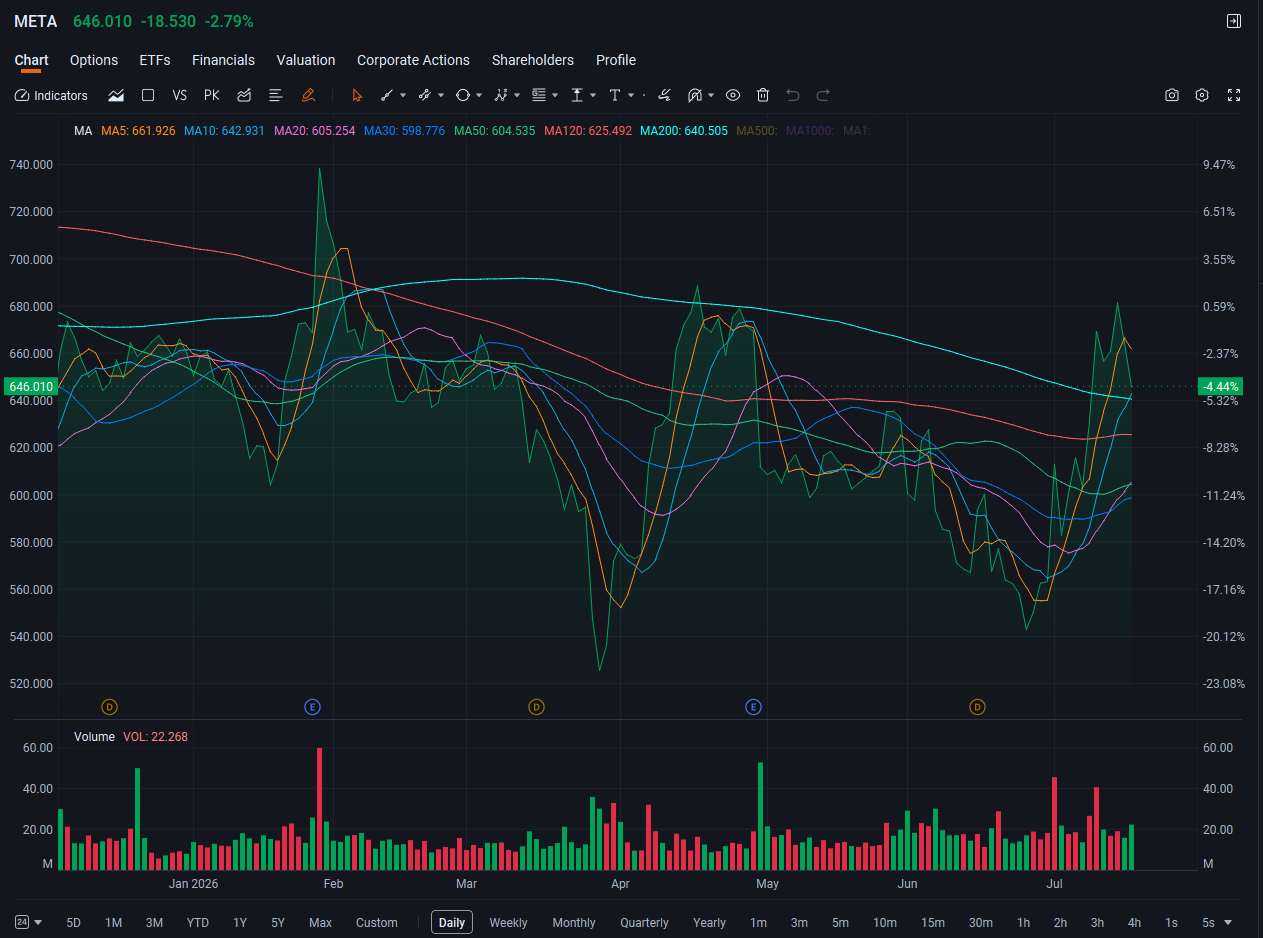
The trigger for this strong rally: Meta is secretly positioning its cloud computing business, preparing to monetize its massive surplus computing power resources externally.
Replicating AWS, Unlocking a New Path for Computing Power Monetization
Reviewing the Q1 2026 earnings call, Meta CFO Susan Li clearly released a key signal: the company is aggressively increasing its computing power infrastructure, fundamentally because it is bullish on computing power as the core of future technology development, and the entire architectural design has reserved plenty of flexibility.
This layout perfectly replicates the growth path of Amazon AWS. Amazon initially built its computing power system only to support its own e-commerce business.
Later, it launched an external leasing business with surplus computing power, eventually growing into a top global cloud computing giant and its core profit pillar.
Meta's thinking is exactly the same, yet more flexible and pragmatic:
-
First, it activates idle computing power assets, eliminates resource waste, and opens up a brand new revenue curve;
-
Second, it dynamically adjusts capital expenditures; if market demand falls short of expectations, it can cut investments at any time to avoid ineffective cash burn;
-
Third, it patches the shortcomings of its business model, turning huge AI infrastructure investments from a "cost burden" into a "profitable asset."
The implementation of this step directly resolves my previous biggest concern.
Meta's AI capital expenditure is no longer a pure cost consumption, but a high-quality investment with two-way monetization capabilities, making the long-term profitability logic completely smooth.
Giants Enter the Field, New Cloud Vendors Suffer Heavy Losses
Meta's entry into cloud computing is an epic benefit for itself, but for the entire AI computing power industry, it is a severe shock, completely rewriting the industry profit distribution rules.
Over the past three years, the supply of AI computing power fell short of demand, giving rise to a group of new cloud service providers, including Nebius (NBIS), CoreWeave (CRWV), IREN, etc.
These vendors grew wildly through computing power leasing businesses, and their stock prices experienced explosive rallies: NBIS rose over 1,000% in three years, and IREN rose 402.97%.
But their business models have a fatal flaw: they highly depend on orders from super tech giants like Meta and Google, lack their own core ecosystem, and survive solely by "hoarding computing power and earning the spread."
Meta's cross-border entry directly cuts off the growth logic of these vendors:
-
On one hand, Meta is one of the largest customers of several new cloud vendors. Now, changing from a "computing power buyer" to a "computing power seller," it directly reduces external procurement needs and steals core customers;
-
On the other hand, Meta possesses self-developed chips, massive computing power, and extreme cost advantages, completely crushing small and medium computing power vendors. The industry officially says goodbye to the "grassroots arbitrage era" and enters the giant harvest stage.
Data confirms the severe divergence in the market: over the past month, Meta's return was as high as 15.83%, while IREN plunged 34.78%. The pattern of strength and weakness is clear at a glance.
Profitability Rivals Top Cloud Giants
Many people question: can Meta, making a cross-border move into cloud, beat Microsoft, Amazon, and Google, who have been deeply rooted for many years?
The answer is hidden in the bright financial data. Even without starting cloud business monetization, Meta's profitability already rivals the top players in the industry:
Meta's current EBIT margin reaches 41.21%, far exceeding Google's 32.69%, and is only slightly lower than Microsoft's 46.80%; while among mature cloud vendors, Microsoft Azure's EBIT margin is 41.41%, AWS is 35.18%, and Google Cloud is 27.58%.
This means that without the help of cloud business, Meta's operational efficiency and profitability level are already in the industry's first tier.
In the future, as the cloud business lands and cost synergy effects are released, its profit margin has full potential to benchmark or even surpass Microsoft Azure.
At the same time, Meta's growth resilience is equally prominent. Under the premise of not having any AI cloud revenue, the company's revenue growth rate has already led the vast majority of hyperscale data center operators.
Relying on its own computing power to optimize internal businesses and improve advertising and user retention, Meta has already achieved efficient organic growth.
When the cloud business officially lands, with new external revenue coupled with cost optimization, the company's EBITDA growth rate is expected to continuously outperform its revenue growth rate, fully opening up growth space.
Valuation Cost-Performance Stands Out, Risks and Opportunities Coexist
From the valuation dimension, Meta's current investment cost-performance is extremely high.
Compared to the regular P/E ratio, the free cash flow multiple can better measure the true value of asset-heavy technology companies.
Microsoft and Meta are the only two giants in the industry that can still maintain double-digit free cash flow margins under huge capital expenditures, showing top-tier cash conversion capabilities.
Even rarer, Meta's free cash flow multiple is still lower than its industry peers while it has not yet realized its AI cloud value.
The landing of the cloud business will become the core catalyst for valuation recovery, and the current price possesses an adequate margin of safety and upside potential.
Of course, investment risks cannot be ignored either.
First is the business execution risk; expanding into a new track will inevitably be accompanied by unknown operating costs, which may slightly suppress profitability in the short term.
Second is the industry demand uncertainty; under the background of AI computing power oversupply, fluctuations in industry demand may affect medium-term stock price performance.
In addition, Meta will release its Q2 earnings report on the 29th of this month. The market is highly concerned about core information such as the cloud business implementation progress, cost synergy space, and order reserves.
Stock prices are highly likely to experience severe fluctuations around the earnings report, and investors need to manage position sizes cautiously.
Meta's cloud pivot transforms its AI CapEx from a cost overhang into a high-margin enterprise catalyst.
Despite execution risks and fierce competition, Meta's elite cash flow and discounted multiple offer a strong margin of safety ahead of its July 29 print.