
Is the Recent Pullback in Chip Stocks Just a Blip? JPM Predicts Q2 Results Will Ignite the Next Wave of Gains

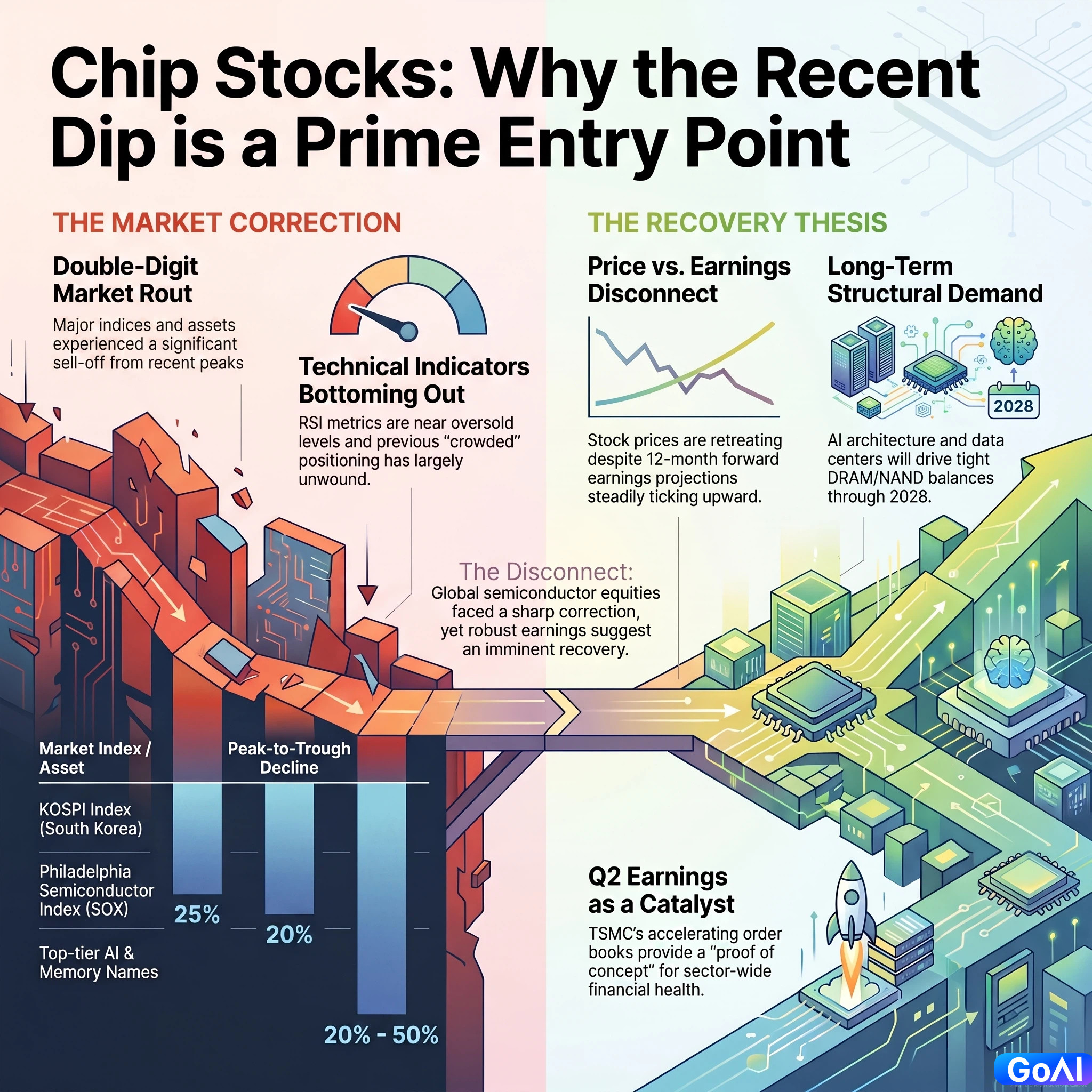
Lately, global AI plays—particularly semiconductor equities—have weathered a painful correction. Driven down by a rout in memory names, South Korea’s KOSPI index gave up 25% from its peak, while the Philadelphia Semiconductor Index (SOX) slid 20%.
Zooming into individual names, memory titans such as Samsung, SK Hynix, and Micron, alongside other AI-associated enterprises, have seen their market values chopped by 20% to 50% from prior highs.
Even with this steep sell-off, market strategists at JPMorgan don't view it as the start of a prolonged bear market. Instead, they interpret the dip as a healthy consolidation phase before chip stocks launch their next leg higher.
"We don't expect the ongoing capital rotation to trigger an extended period of market sluggishness," noted the strategy group headed by Mislav Matejka.
Tech Earnings Prospects Stay Robust
JPMorgan highlighted that the double-digit plunge in top-tier AI semiconductor names has created an expanding mismatch between share prices and core business metrics.
This disconnect is glaringly obvious among European chipmakers: their stock prices are currently trailing the broader market averages, even as their projected 12-month forward earnings keep ticking upward.
"What stands out is how stock prices have retreated despite corporate earnings holding up remarkably well, widening the gap between the two," JPMorgan observed.
"Given that the industry's underlying health remains intact, our view is that market participants should use the summer months to scale up exposure to this space."
Simultaneously, technical charts point to a bottoming out. The bank mentioned that the SOX index’s RSI metric is hitting near-oversold territory, while the massive crowded positioning that recently hoisted tech indicators to highs not seen since the dot-com bubble era has largely unwound.
Additionally, the firm's internal metrics tracking short-term tactical trades suggest that systematic positioning has shifted toward a more compressed state.
Will Second-Quarter Earnings Act as the Turning Point?
From a structural standpoint, JPMorgan maintains a bright outlook on the sector. They project that tight market balances for both DRAM and NAND will stretch out to 2028, fueled by secular demand from AI architecture and data centers, as well as the industry-wide pivot toward HBM.
Though share prices have dropped recently, DRAM pricing remains firm at high levels, leading the bank to forecast that global memory players will see substantial DRAM revenue expansion over the next several years.
Furthermore, the bank pointed out that the upcoming Q2 reporting cycle will provide another powerful tailwind for technology equities.
JPMorgan noted that TSMC’s financial results from last week—marked by accelerating order books and a very upbeat roadmap for 2027 capital investments—have already served as a preliminary proof of concept that the sector can deliver stellar financial performance to underpin the broader market.
When it comes to portfolio strategy, JPMorgan labels the semiconductor space as a highly recommended overweight, concluding that the recent slide offers a highly appealing entry window for long-term investors.