
Is the Three-Year AI Bull Market Reaching a Turning Point? Wall Street Divided Over Conflicting Outlooks

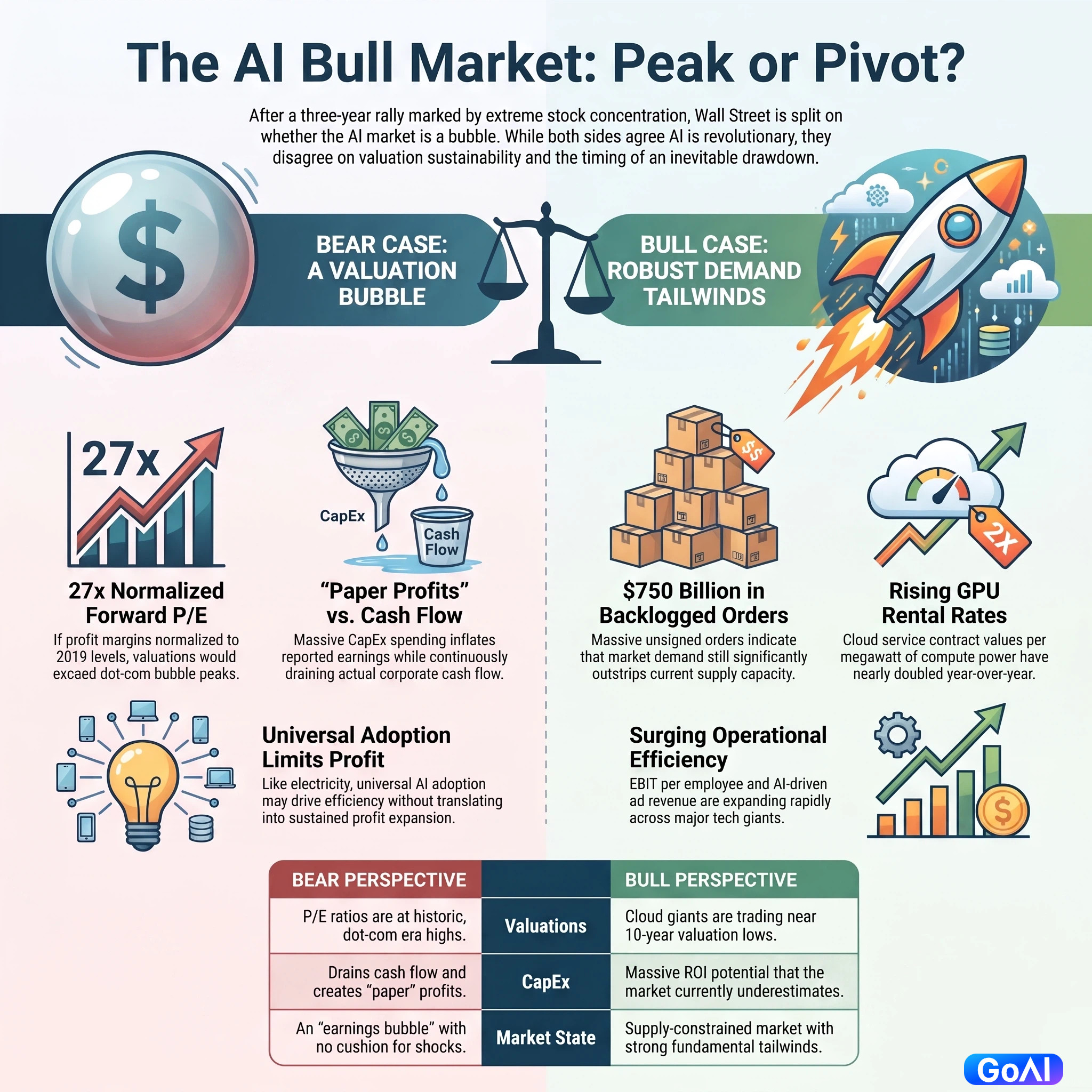
The AI rally has lasted for three years, delivering some of the strongest U.S. stock returns in decades alongside the most extreme single-stock concentration in history.
Yet, Wall Street remains deeply divided over whether the current market is a bubble, how long the rally can last, and what will ultimately bring it to an end.
Intriguingly, a sharp divide between bulls and bears has also emerged within BCA Research, a well-known Wall Street macro research firm, leading to a heated debate during a recent webinar.
Bears: A Broad-based Valuation Bubble
Peter Berezin, Chief Economist at BCA Research, and Arthur Budaghyan, Head of Core Macro Research and Chief Emerging Markets Strategist, take the bearish stance. Their core thesis: U.S. equities are currently trapped in an earnings bubble.
Speaking at a webinar last week, the two stated:
"Corporate profits do remain elevated, but margin sustainability is far less solid than it appears on the surface. Current valuations have already fully priced in best-case growth expectations, leaving stock prices with virtually no cushion against negative shocks."
They noted that nearly every valuation metric indicates U.S. stocks are severely overvalued. If the S&P 500's profit margin were normalized to 2019 levels, the index's forward P/E ratio would stand at a staggering 27x, surpassing the previous record of roughly 26.5x set at the peak of the dot-com bubble in March 2000.
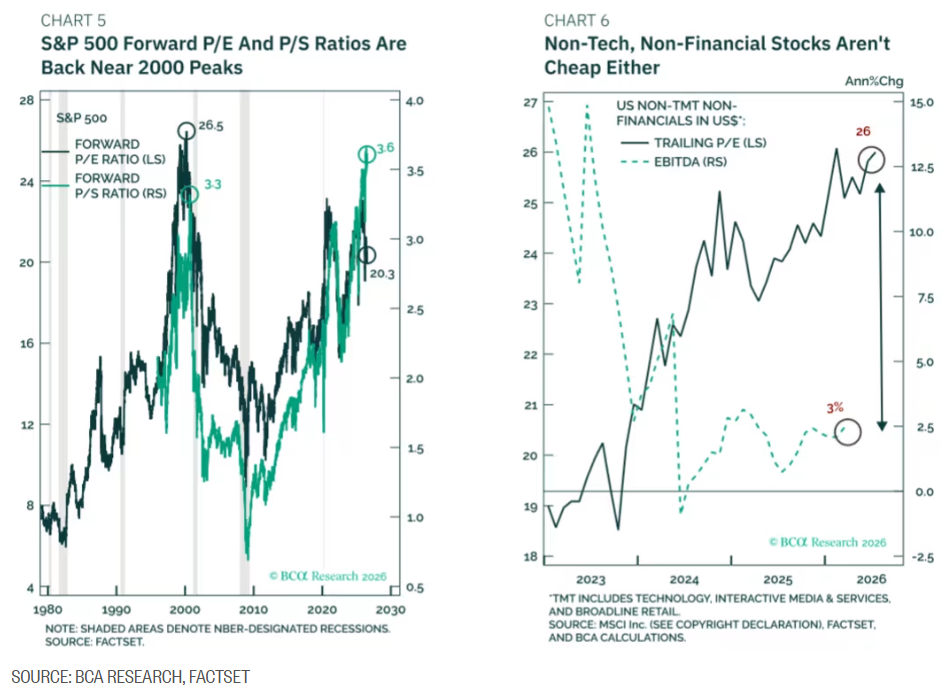
Data compiled by BCA shows that even when excluding tech and financial stocks, the rest of the market can hardly be considered cheap: the overall trailing P/E ratio reaches 26x, despite average annual earnings growth hovering at just around 3% over the past two to three years.
Major tech hyperscalers are currently making massive bets on AI capital expenditures—pouring more than $700 billion combined into building data centers, developing proprietary chips, and upgrading power grids alongside energy infrastructure.
Bears argue that while this massive CapEx boosts reported earnings, it continuously drains corporate cash flow.
Berezin and Budaghyan explained:
"Chip vendors book every sale as revenue and profit, whereas cloud providers purchasing these chips capitalize the expense rather than treating it as an operating cost. This inflates reported profits on paper, even as operating cash flow fails to keep pace."
Berezin also pointed out: "AI will ultimately resemble electricity in driving broad-based operational efficiency across companies. However, if AI adoption becomes universal, it will not necessarily translate into sustained profit expansion."
Bulls: Robust Demand and Deceptively Low Valuations
On the bullish side, Juan Correa, Head of Portfolio Strategy, and Noah Weisberger, Head of Equity Research at BCA Research, argue that the computing market faces supply constraints rather than overcapacity.
They contend that the market severely underestimates the ROI of this CapEx cycle, and that earnings growth extends far beyond the few well-known market leaders.
BCA data reveals that over the past two quarters alone, hyperscalers added approximately $750 billion in backlogged orders that are signed but yet to be delivered—clear evidence that market demand continues to outstrip supply capacity.
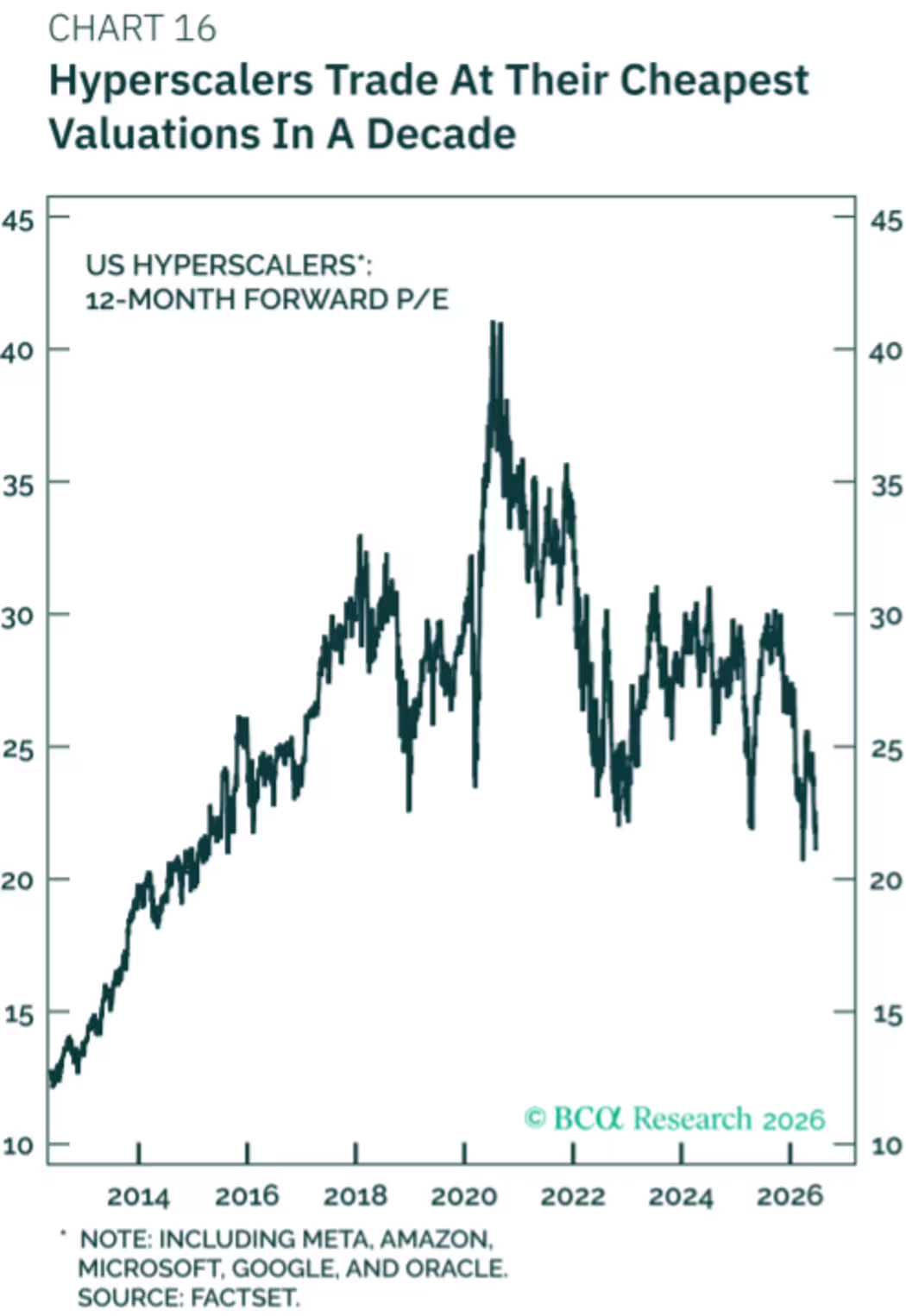
While broader valuation concerns persist, some market observers note that major cloud giants are actually trading near ten-year valuation lows.
Looking across the year, rental rates for latest-generation GPUs continue to climb; cloud service contract value per megawatt of compute power has nearly doubled year-over-year; EBIT per employee has surged; and profit engines beyond core cloud businesses are expanding rapidly—as seen in Meta's AI-driven ad revenue growth and Google Search's reaccelerating momentum.
Correa and Weisberger stated:
"We expect the market to significantly underestimate the actual revenue generated by this CapEx cycle over the next two quarters. Continued earnings beats should reverse the prevailing market pessimism."
The two analysts acknowledged: "This CapEx-driven rally will eventually come to an end, likely triggering a sharp downturn. At present, however, economic fundamentals and sectoral tailwinds remain in control. The primary risk concerning bulls is not a recession or an earnings collapse, but rather valuation multiple compression."
The core debate does not hinge on whether the AI industry is real, or whether AI is actively reshaping the U.S. economy, revolutionizing productivity, capital allocation, and labor markets—both sides agree on these facts. Instead, the contention centers on timing: how much longer the AI CapEx boom can withstand market skepticism, and how severe the drawdown will be when the turning point finally arrives.