
U.S. market braces for largest share unlock in history as SpaceX faces true test

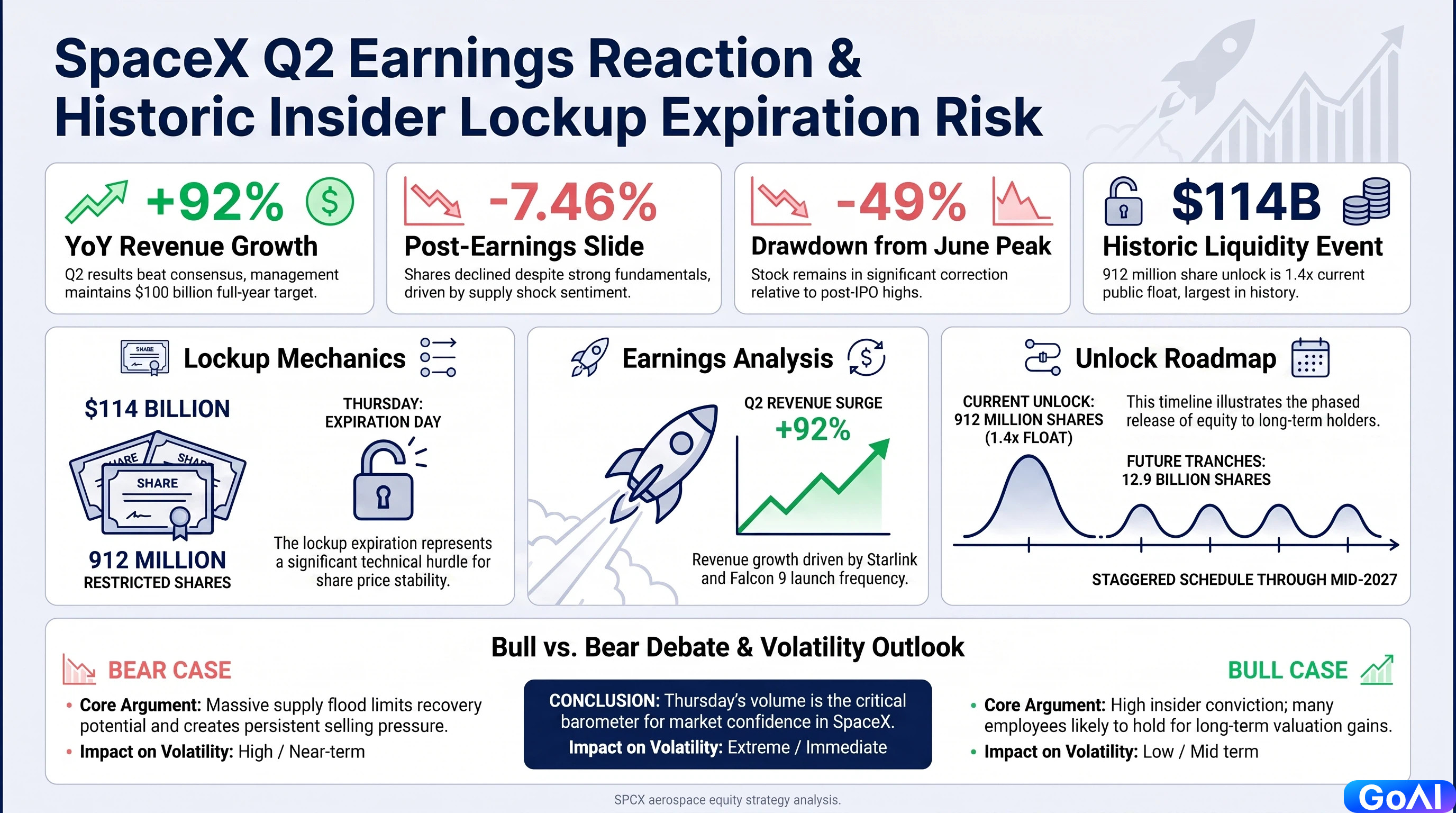
Following the release of its maiden post-IPO earnings report on Tuesday after the bell, SpaceX shares dropped 7.46% in extended trading.
Now, investors face their next hurdle: on Thursday, up to 912 million restricted shares held by employees and other pre-IPO shareholders will unlock and become eligible for sale.
This means employees and early backers who acquired company equity months or years ago at rock-bottom cost bases are poised to realize substantial gains as lockup restrictions expire.
However, potential selling from these insiders could exert fresh downward pressure on the stock.
Largest lockup expiration in U.S. market history?
The upcoming unlock involves 912 million shares. Based on Tuesday’s closing price of $125.33, the unlocked block is valued at approximately $114 billion—roughly 1.4 times the company's current public float—marking the largest single lockup expiration in U.S. capital markets history.
Crucially, a lockup expiration does not automatically equate to immediate selling, as actual trading volume depends on individual shareholder inclination to realize gains.
Nevertheless, market participants expect substantial selling pressure in the near term. The actual magnitude of secondary market supply will serve as a key barometer for investor confidence in the company's long-term outlook, particularly with shares already down 49% from their June peak.
"This is shaping up to be perhaps the most closely watched IPO lockup event in history," said Robert Hackel, CEO of institutional brokerage R.F. Lafferty & Co. "You are going to see a significant amount of selling."
Hackel noted he has recently been taking calls from early pre-IPO investors looking to monetize portions of their SpaceX holdings to free up liquidity for private rounds in other late-stage companies, such as AI giants Anthropic and OpenAI, as well as defense tech unicorn Anduril Industries.
"It will be very difficult for SpaceX employees and early investors to resist selling, given the massive unrealized gains sitting on their balance sheets," stated Matt Kennedy, senior strategist at Renaissance Capital, an IPO research and investment firm. "There is a powerful incentive to lock in returns and diversify."
On Tuesday after the close, SpaceX reported a 92% year-over-year jump in second-quarter revenue, topping consensus estimates.
However, despite CFO Bret Johnsen assuring investors on the conference call that annual revenue is projected to reach $100 billion by year-end, the stock slid 7.46% in after-hours trading.
Brian Mulberry, chief market strategist at Zacks Investment Management, suggested the impending lockup was a primary driver behind the after-hours weakness. He noted the sell-off appeared largely sentiment-driven, as many insiders prepared to offload shares following the strong earnings print while expectations were fully priced in.
Billions more shares await future unlocks
Lockup agreements are standard practice following an IPO to restrict insider sales for a set duration. However, SpaceX’s lockup structure is unique: underwriters designed a staggered timeline spanning nearly a year, rather than flooding the market with billions of restricted shares in a single day.
As a result, the phased unlock schedule extends through mid-2027. Beyond the 912 million shares unlocking this Thursday, an additional 12.9 billion shares are slated to unlock over subsequent tranches.
"This time, the unlocked float is a multiple of the existing tradeable shares rather than a small fraction," said Andrew Chanin, CEO of Procure AM, which manages the Procure Space ETF. "These lockup dates will serve as a definitive litmus test of early investors' commitment to supporting the company over the long haul."
IPOX Research analyst Lukas Muehlbauer noted that the volume of selling among early backers will send a strong signal regarding institutional confidence in SpaceX’s valuation trajectory.
To gauge the potential for a massive wave of supply on Thursday, Gabriel Shahin, founder of Falcon Wealth Planning, recently reached out to several SpaceX insiders and employees. His takeaway: few seem in a rush to liquidate.
"They remain bullish on SpaceX long-term, so we lean toward optimism that insiders won't flood the market immediately," Shahin observed, though he acknowledged that each upcoming lockup expiration could amplify volatility in SpaceX shares.