
AI Concerns Trigger Asian Stock Outflows: Foreign Capital Flees South Korea in July Amid Nine-Month Capital Drain

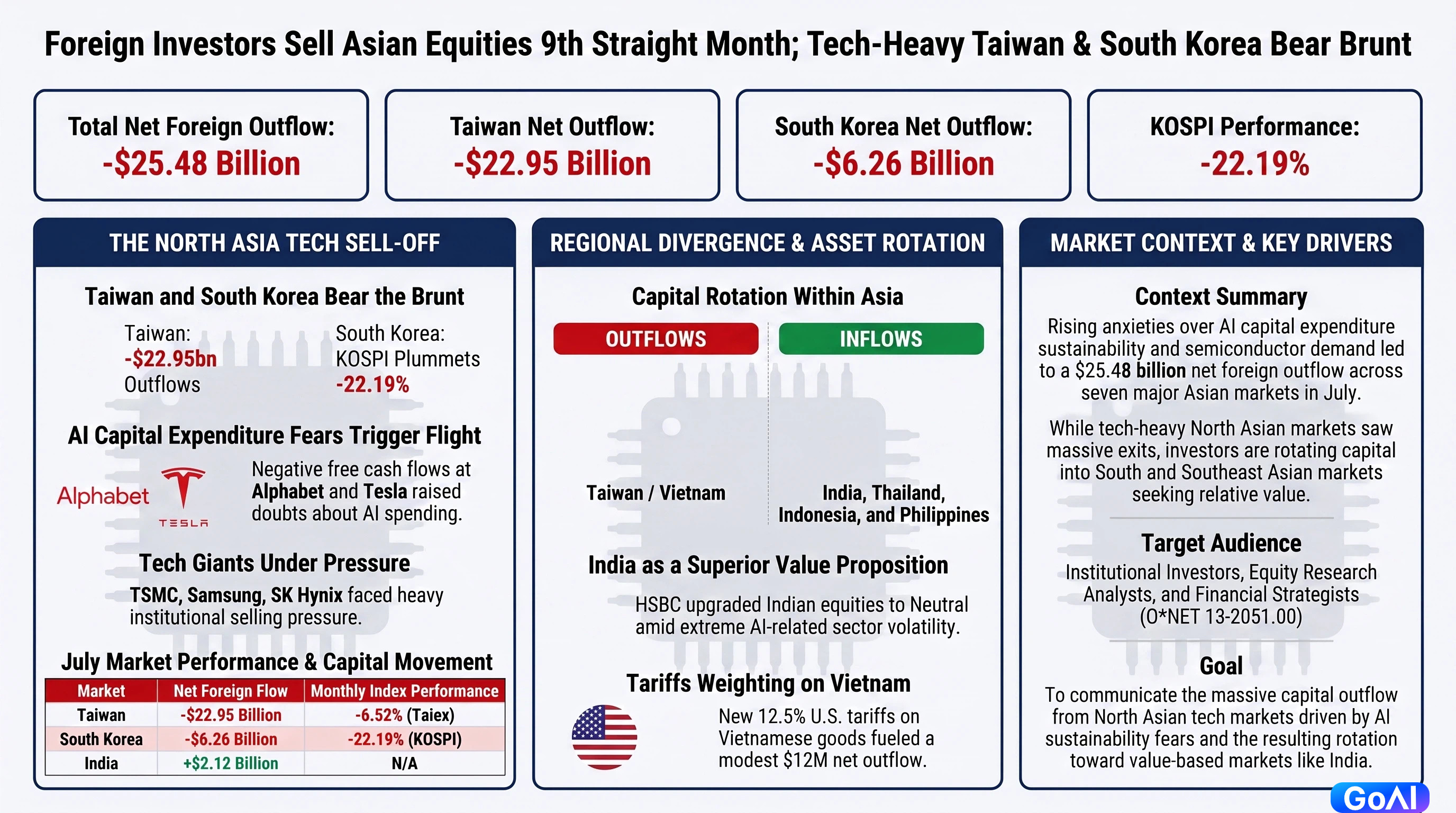
Escalating market anxieties over AI capital expenditure and the demand outlook for semiconductors drove foreign investors to net sell Asian equities for a ninth consecutive month in July, with Taiwan and South Korea enduring the heaviest sell-offs.
AI Fears Spark Widespread Capital Outflow Across Asia
According to LSEG data, foreign investors pulled a net $25.48 billion out of seven major Asian equity markets in July—spanning South Korea, Taiwan, India, Indonesia, Thailand, Vietnam, and the Philippines.
Taiwan bore the brunt of the flight, recording $22.95 billion in foreign net outflows in July, up sharply from roughly $8 billion in June.
Meanwhile, South Korea saw $6.26 billion in net foreign outflows, marking its third consecutive month of capital flight following net outflows of $27.879 billion in May and $12.625 billion in June.
The broader market impact was severe: Taiwan's Taiex Index sank 6.52% in July, while South Korea's KOSPI index plummeted 22.19%.
The route intensified last month after Google parent Alphabet and Tesla both disclosed negative free cash flows, stoking fears that AI-related cash burn is intensifying and raising doubts about whether corporate capital spending levels can be sustained.
Against this backdrop, major Asian tech exporters—including SK Hynix, Samsung Electronics, and TSMC—faced heavy selling pressure.
"Investors are beginning to question the chip demand outlook and debt-servicing capabilities of AI leaders in South Korea and Taiwan, triggering massive sell-offs in these names," BNP Paribas analysts wrote in a July research note.
The analysts added that the release of Kimi 3 in early July—a low-cost, high-performance AI model from Chinese startup Moonshot AI that stunned the industry—further deepened market pessimism regarding the semiconductor sector's growth trajectory.
Vietnam Sees Minor Outflows; South Asia Offers a Cushion
Vietnam also recorded a modest net foreign outflow of $12 million in July, largely fueled by new 12.5% U.S. tariffs on Vietnamese goods that took effect on July 24 amid ongoing labor and overcapacity investigations.
Vietnam's benchmark VN-Index slipped 7.04% in July.
Conversely, equity markets in India, Thailand, Indonesia, and the Philippines recorded net foreign inflows of $2.12 billion, $1.46 billion, $88 million, and $69 million, respectively, helping partially offset the broader regional capital flight.
"Extreme volatility in AI-related sectors recently has prompted global investors to diversify their allocations.
From this perspective, we believe India currently presents a superior relative value proposition," noted Herald van der Linde, Head of Equity Strategy for Asia-Pacific at HSBC, in a recent research report.
"Consequently, we recently upgraded our allocation rating for Indian equities in Asia to Neutral," van der Linde added.