
Exaggerated Expectations? mRNA Cancer Vaccine Breakthrough Sparks Market Rally as Analysts Urge Caution Over Hype

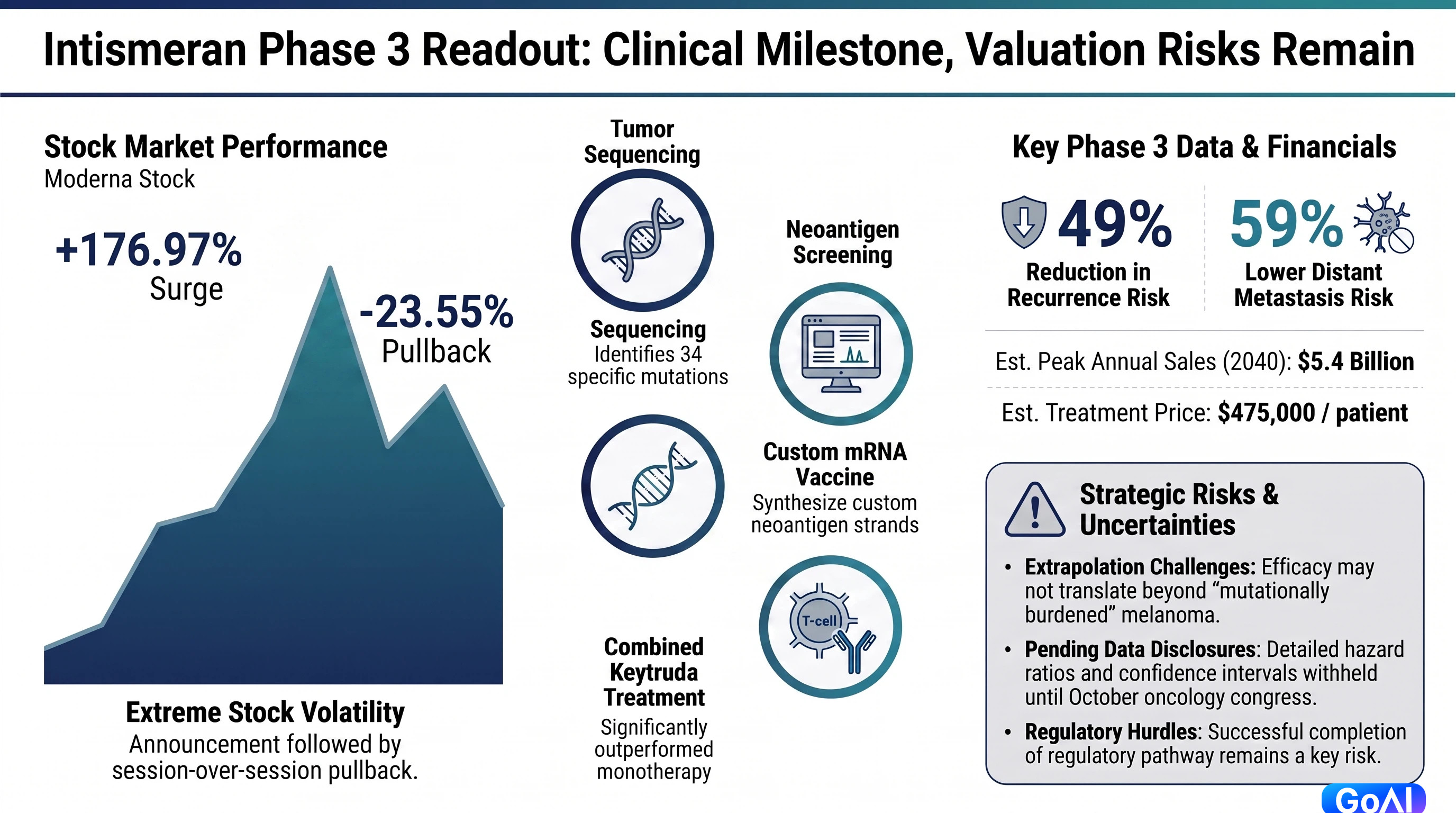
Recent news that the mRNA individualized neoantigen therapy intismeran met its primary endpoint in a Phase 3 study has drawn intense attention across global healthcare markets.
While analysts note the platform could reshape melanoma treatment, some warn the subsequent stock surge reflects excessive market hype.
On August 19, Merck & Co. and Moderna jointly announced that their co-developed personalized mRNA cancer vaccine, intismeran autogene, achieved its primary endpoint in a Phase 3 trial.
The study enrolled patients with high-risk melanoma—an aggressive form of skin cancer—following complete surgical resection.
Following the announcement, Moderna shares saw volatile swings, surging before undergoing a partial pullback.
Moderna stock spiked from $62.96 to close up 176.97% at $174.38 on the day of the announcement, before profit-taking drove a 23.55% decline in the subsequent session to finish at $133.32.
Mechanism of Action
Personalized cancer vaccines differ fundamentally from traditional preventative inoculations.
Rather than protecting healthy individuals from infection, the approach operates as a therapeutic vaccine, designed to prime the patient's immune system to prevent cancer recurrence and metastasis.
The mechanism proceeds through the following steps:
Following complete surgical resection, tumor tissue samples are sent to Moderna's laboratories for next-generation genomic sequencing to identify mutation-bearing sequences exclusive to the patient's malignant cells.
Proprietary algorithms select up to 34 patient-specific mutations encoding neoantigens. Scientists then synthesize custom mRNA strands corresponding to these genetic sequences to formulate the individualized vaccine.
The patient subsequently receives an approximately one-year regimen combining intismeran autogene with Merck's Keytruda, the world's top-selling cancer therapy.
In prior Phase 2 data, the combination regimen reduced the risk of recurrence or death by 49% and cut the risk of distant metastasis or death by 59%.
The Phase 3 trial confirmed that the intismeran-Keytruda combination demonstrated superior efficacy compared to Keytruda monotherapy.
"The higher the cancer stage, the higher the risk of recurrence," said Michael Atkins, Deputy Director of Georgetown Lombardi Comprehensive Cancer Center and a Phase 2 investigator. "This vaccine substantially lowers that recurrence risk."
Despite promising clinical data, commercial rollout remains subject to formal regulatory review and approval by the U.S. Food and Drug Administration (FDA).
Furthermore, the treatment is not universally applicable across all melanoma cases. Michael Christopher, an Arizona-based dermatologist, noted that patient tumors must meet specific baseline volume criteria to qualify for the personalized therapy.
Wall Street Flags Valuation and Extrapolation Risks
William Blair analyst Miles Minter estimates that, if approved for melanoma, the joint program could generate $5.4 billion in combined annual sales for the two pharmaceutical partners by 2040.
The projection models an estimated price of $475,000 per patient, in line with commercial CAR-T cell therapies—another personalized modality that requires extracting and re-engineering patient cells.
For Moderna, which posted $1.9 billion in total revenue last year amid falling COVID-19 vaccine sales, commercialization would provide a meaningful top-line catalyst as the biotech seeks new growth drivers.
However, several analysts caution that the market's initial reaction may be overextended.
Melanoma is characterized by high tumor mutational burden (TMB)—meaning the tumor DNA contains dense clusters of mutations—making it uniquely responsive to neoantigen vaccines and checkpoint inhibitors.
Most other solid tumors do not share this genomic profile, suggesting efficacy observed in melanoma may not readily translate to other ongoing trials, such as renal cell carcinoma or bladder cancer.
"While we acknowledge the trial's success in confirming the vaccine's utility in the adjuvant setting, melanoma is among the most immune-sensitive and mutationally burdened tumors," Leerink Partners analyst Daina Graybosch wrote in a Thursday note. "
Because it is uniquely suited to this approach, translating these results directly to other oncology indications remains challenging."
Market caution also stems from the lack of granular clinical metrics. Moderna and Merck announced that the study met its primary and secondary endpoints but withheld detailed efficacy measures such as hazard ratios and confidence intervals.
Full trial data is expected to be presented at an international oncology congress in Madrid this October, following standard clinical disclosure timelines.
Analysts caution that top-line headline summaries can occasionally diverge from full data disclosures upon peer review. As Graybosch noted: "The market's initial response appears overly optimistic, establishing expectations that we believe may prove difficult to meet."