
Goldman Sachs Lifts Asia-Pacific Equity Targets on Robust AI-Driven Tech Earnings

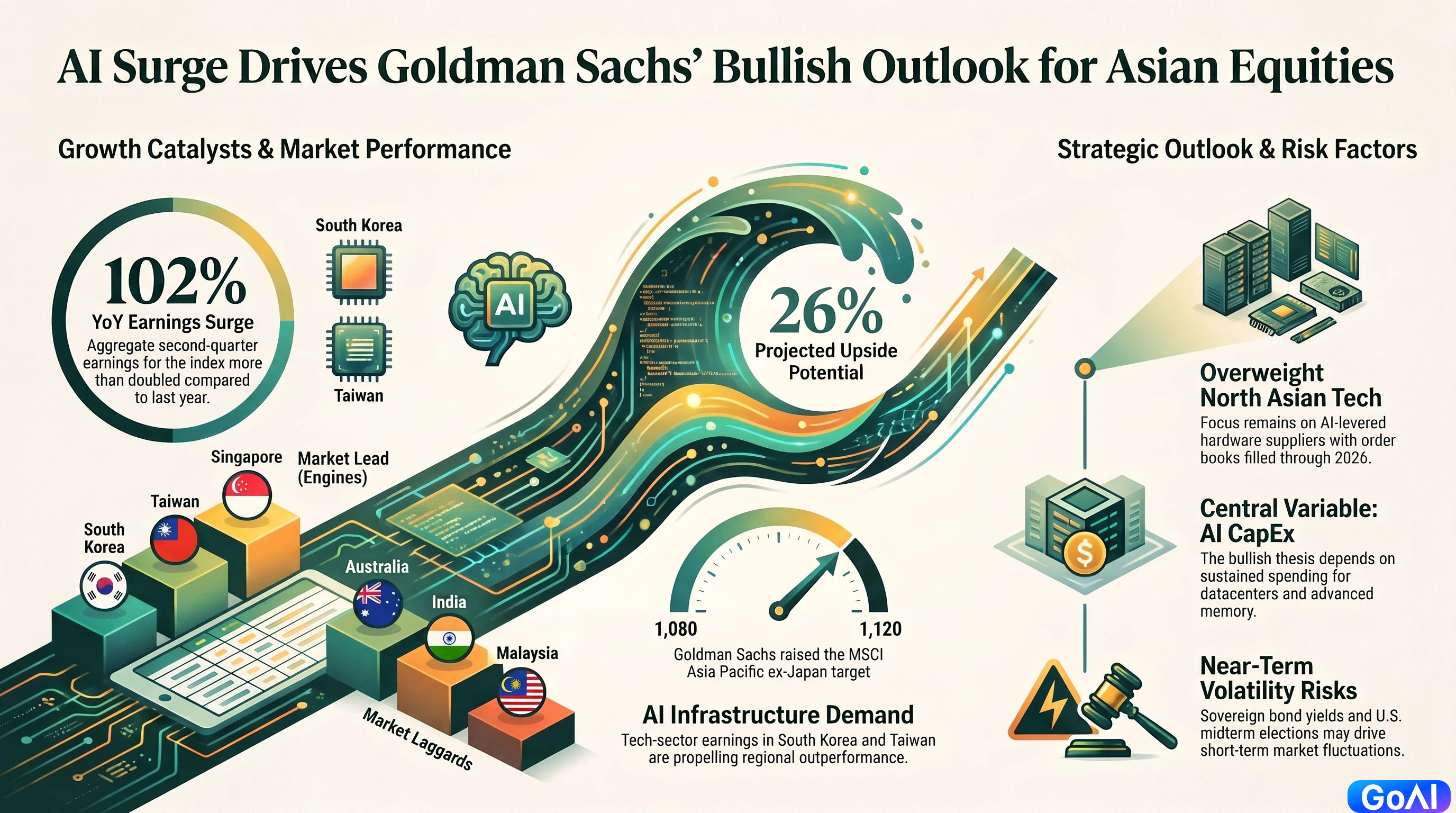
Goldman Sachs has raised its target for the MSCI Asia Pacific ex-Japan Index from 1,080 to 1,120 points, implying approximately 26% upside potential from current levels.
Regional Target Upgraded on Tech Strength
The upward revision is primarily underpinned by outperformance across South Korean and Taiwanese equity benchmarks, where surging tech-sector earnings have been propelled by relentless demand for artificial intelligence infrastructure.
Goldman reiterated its constructive outlook on Asian equities despite third-quarter consolidation, citing resilient tech earnings growth, attractive structural valuations in select markets, and healthier positioning profiles following recent market pullbacks.
However, the regional target hike does not signal an indiscriminate, broad-based bull market call across all Asian equities.
Goldman noted that aggregate second-quarter earnings for the MSCI Asia Pacific ex-Japan Index surged 102% year-over-year, with 44% of companies beating consensus estimates and 27% missing expectations.
At the market level, corporate earnings expansion was heavily led by Singapore, Taiwan, and Indonesia, while Australia, Malaysia, and India lagged. On balance, Goldman identified South Korea and Taiwan as the primary engines driving aggregate regional upward revisions.
AI Infrastructure Momentum Remains the Crucial Test
Goldman observed that order books for select Korean and Taiwanese suppliers embedded in the global AI supply chain are already fully booked through 2026. Consequently, the endurance of capital spending across AI datacenters and advanced memory semiconductors serves as the central variable governing whether this bullish thesis materializes.
Against this backdrop, the firm maintains an overweight tilt toward North Asian markets and AI-levered tech hardware suppliers, while selectively tracking thematic tailwinds in energy security, defense, and capital-return expansion.
Goldman cautioned that near-term volatility could persist, driven by elevated sovereign bond yields, escalating Middle East geopolitical frictions, and the approaching U.S. midterm elections.
Nevertheless, the bank projects that regional macro conditions will turn increasingly constructive once these risk catalysts clear, recommending derivative overlay strategies to hedge downside drawdowns while capturing upside beta.