
Is Wall Street’s Rally Nearing Its End? Bond Giant Pimco Warns 10-Year Treasury Yields Could Breach 6%

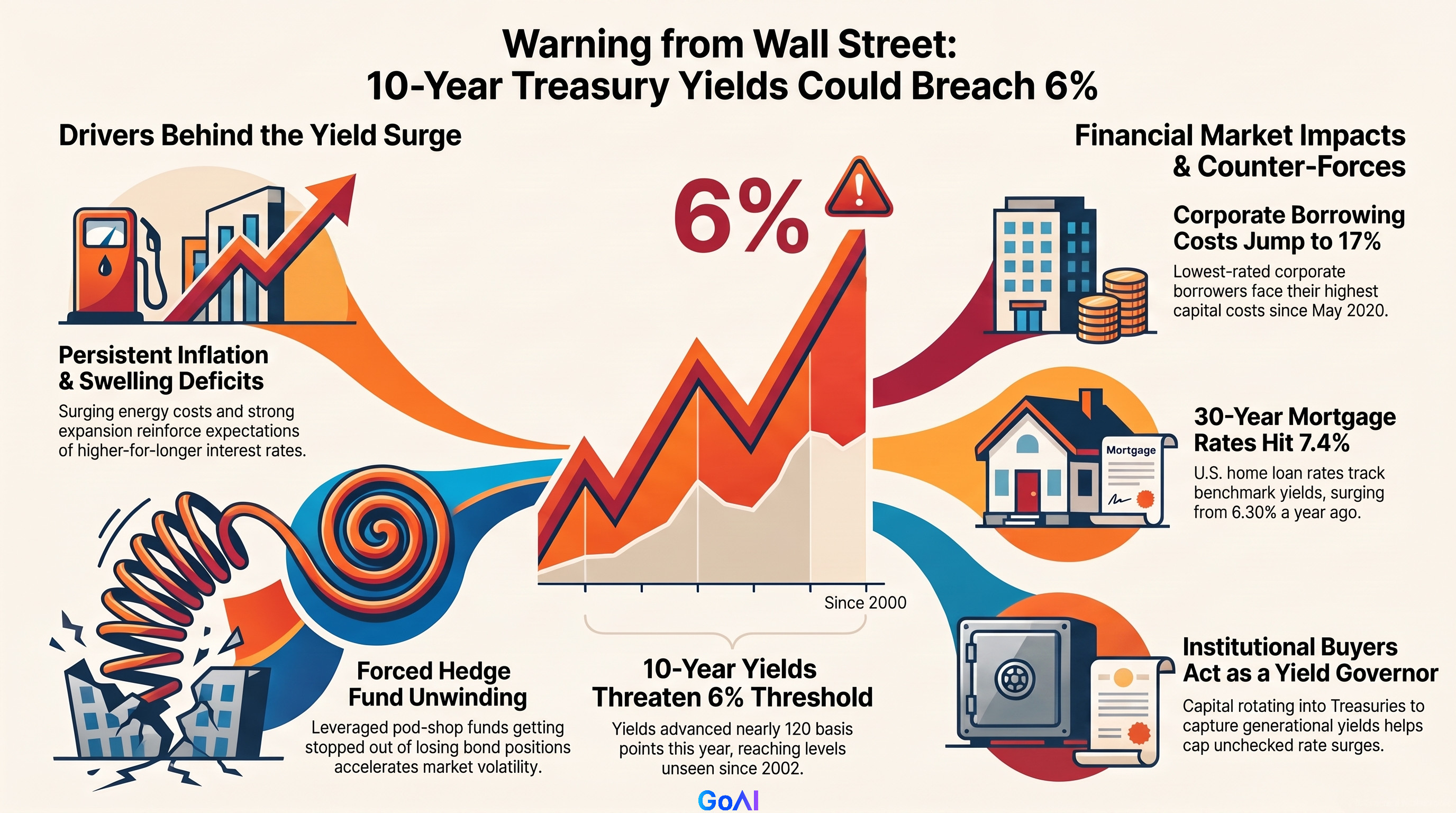
Dan Ivascyn, Chief Investment Officer at Pacific Investment Management Co. (Pimco), warned that benchmark 10-year U.S. Treasury yields could climb to 6% for the first time since 2000, driven by persistent oil-fueled inflation concerns and mounting anxiety over the swelling U.S. fiscal deficit.
As the foundational pricing benchmark for global borrowing costs and risk assets, the 10-year Treasury yield has already advanced nearly 120 basis points this year. The benchmark currently trades just below the 5.34% level touched last week—its highest print since 2002.
Speaking in an interview on Friday, Ivascyn noted that a sharp move higher from the current 5.29% handle is "possible" in the near term, citing forced de-risking as multi-manager hedge funds unwind losing bond positions.
"It is certainly possible, even purely from a short-term trading dynamic," Ivascyn said.
"A portion of the volatility over the past few weeks has been driven by adverse technicals, with pod-shop hedge funds and other leveraged players getting stopped out. Touching 6% is entirely within the realm of possibility."
Risk Assets Under Intensifying Pressure
Ivascyn cautioned that a further leg higher in sovereign yields would compound stress on equities, corporate credit, and broader risk assets. Pushing past 5.5% could trigger "pretty meaningful weakness in risk markets, both credit and equities."
Squeezed by multi-year peaks in benchmark yields and widened risk premia, borrowing costs for the lowest-rated corporate borrowers climbed to 17% this month—the highest level recorded since May 2020.
However, Ivascyn added that institutional asset allocators will ultimately step in to rotate substantial capital into Treasuries to lock in generational yields, which should act as "a natural governor on yields running away too far from current levels."
Solid absorption at this week’s 10-year and 30-year Treasury auctions suggests institutional buyers are already beginning to step in to capture these coupons.
Global fixed-income assets have endured unrelenting selling pressure throughout 2026. Surging energy costs have stoked inflation prints, while robust AI-led economic expansion has cemented investor bets on a "higher-for-longer" monetary policy regime.
Yields move inversely to bond prices. In the three months through September, the 10-year U.S. Treasury notched its steepest quarterly yield surge of the 21st century.
Concurrently, U.S. mortgage rates—which closely track the 10-year benchmark—have reached their highest levels since 2023.
As of October 8, the average rate on a 30-year fixed-rate mortgage rose to 7.4%, up from 7.28% last week and 6.30% during the same period last year.