
AI to Devour Over Half of New U.S. Power Demand as Bernstein Projects 4% Annual Grid Growth Through 2030

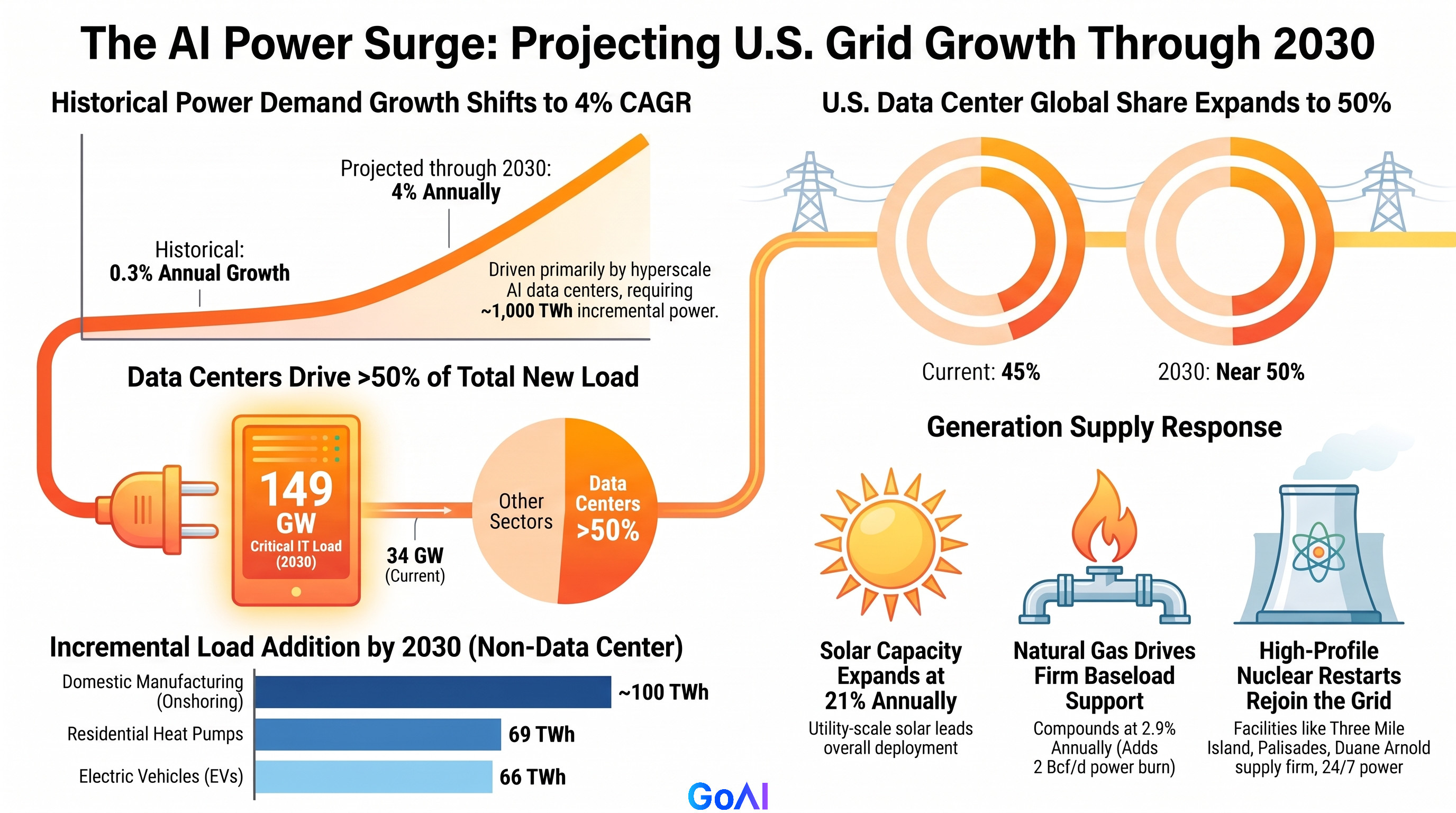
Driven by an unprecedented surge in artificial intelligence data center construction, U.S. electricity demand is poised to compound at an annual rate of 4% through 2030, according to a research note from Bernstein.
In the report, analysts Sunaina Ocalan and Raphael Lee lifted their long-term power growth forecast from 3% to 4%, projecting approximately 1,000 terawatt-hours (TWh) of incremental power demand across the U.S. between 2025 and 2030.
Data centers alone are expected to account for more than half of that aggregate load growth.
"Since 2019, U.S. power demand has grown at a 1.2% CAGR, and at just 0.3% since 2000—substantially trailing broader GDP growth," Bernstein wrote.
"Today, however, we are witnessing a step-change inflection in power consumption, underpinned primarily by the expansion of U.S. data center capacity."
Data Center Capacity Set to Explode
Bernstein forecasts that the U.S. share of global data center footprint will expand from roughly 45% today to near 50% by 2030.
Under the bank's base-case framework—modeling a power usage effectiveness (PUE) ratio of 1.25x—U.S. data center critical IT load is projected to surge from 34 gigawatts (GW) in 2025 to 149 GW by 2030.
That net addition of 115 GW represents over 500 TWh in annualized incremental power consumption from computing infrastructure alone.
Outside of tech workloads, a modest onshoring resurgence in domestic manufacturing is expected to add roughly 100 TWh of industrial load by 2030.
Meanwhile, residential electrification tailwinds—led by the continued adoption of electric vehicles and heat pumps—are slated to add 66 TWh and 69 TWh of incremental demand, respectively.
Filling the Generation Deficit
To satisfy this mounting baseload demand while compensating for scheduled coal plant retirements, Bernstein models natural gas and utility-scale solar PV as the primary incremental supply pillars.
The bank projects natural gas-fired generation to compound at 2.9% annually through 2030, driving roughly 2 billion cubic feet per day (Bcf/d) of incremental power burn. Solar capacity is expected to lead overall deployment, compounding at an annual clip of 21% over the same horizon.
Bernstein also incorporated nuclear restarts into its dispatch outlook, highlighting three high-profile revival assets: Constellation Energy’s Three Mile Island unit, Holtec International’s Palisades plant, and NextEra Energy’s Duane Arnold facility.
Unlike solar generation, which remains subject to intermittency and weather conditions, natural gas, nuclear, and geothermal generation offer firm, dispatchable capacity—an indispensable requirement for hyperscale AI data centers operating around the clock.