
Musk Sets Sights on "Off-World Cities" with SpaceX: Moon Base in 10 Years, Mars in 20

Elon Musk declared on Sunday that SpaceX has shifted its focus to building a "self-expanding city" on the Moon, a goal he anticipates achieving in less than a decade. Despite the pivot, his ultimate "Mars vision" remains firmly on the horizon.
"For those who aren't aware, SpaceX has shifted focus to building an expanding city on the Moon; we could potentially achieve this in less than 10 years, whereas Mars will take over 20," Musk posted on X.
He added, "SpaceX's mission remains the same: extending consciousness and life as we know it to the stars."
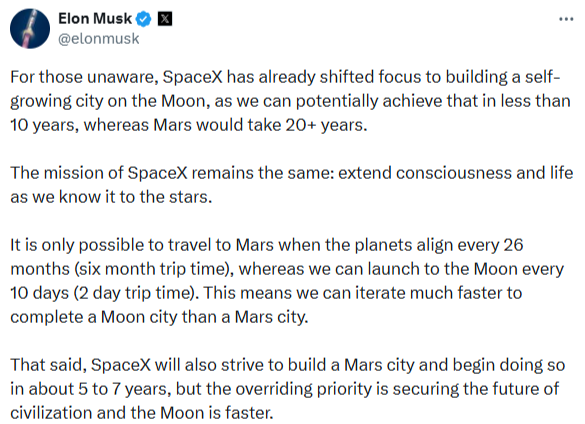
Musk elaborated on the logistics, noting that Mars windows only open every 26 months with a 6-month journey, while lunar launches can occur as often as every 10 days with only a 2-day transit. This allows for a much faster iteration speed for a lunar city. "
That said, SpaceX will also strive to build a city on Mars and plans to start implementation in 5 to 7 years, but the priority is securing the future of civilization, and the Moon is faster," he added.
A Strategic Pivot Toward Artemis
This strategic shift is not entirely unexpected. While 2026 was originally seen as a critical window for uncrewed Mars exploration, reports indicate SpaceX has informed investors that it is concentrating resources on NASA’s Artemis program.
- Contract Details: SpaceX secured a $4 billion NASA contract in 2021 to adapt its massive Starship rocket into a Human Landing System (HLS) for astronauts.
- Artemis III: SpaceX is committed to readying Starship for the Artemis III mission, which will mark the first American lunar landing in over half a century.
- Revised Timeline: NASA's current schedule targets April 2026 for Artemis II (a crewed lunar flyby) and 2027 for Artemis III (the lunar South Pole landing).
The Concept of "Self-Expanding" Cities
Industry analysts emphasized that the "self-expanding" aspect of Musk's vision is the key differentiator. "This implies the base won't just be self-sufficient; it will use robotics and automation to grow continuously—similar to cellular division—rather than relying solely on Earth for supplies," one analyst noted.
SpaceX has previously demonstrated proof-of-concepts for using lunar regolith (soil) to create building materials and extract oxygen and water. If a self-sustaining foothold is established within a decade, the Moon would become humanity's first true off-world settlement.