
Does the SpaceX IPO Have an Ulterior Motive? Veteran Analyst Warns Retail Investors Will Lose Everything, Stock Only Worth $30

SpaceX shares have dropped roughly 28% from their post-"epic IPO" peak of over $200.
This slide has prompted veteran investor George Noble to double down on his bearish stance, warning that the stock is staring down a massive wave of insider selling in the coming months and is fundamentally worth just $30 per share.
"The largest IPO in history is turning into the largest exit liquidity event in history," Noble wrote in a lengthy post on X last Saturday, adding that "the purpose of this IPO was to separate retail investors from their money."
The hedge fund manager, who brings over 40 years of investment management experience and previously ran the Fidelity Overseas Fund for consecutive years, explained the mechanics behind his thesis:
-
SpaceX went public at a price-to-sales multiple exceeding 90x, and insiders who acquired their shares at a fraction of current prices are about to dump them onto retail investors.
-
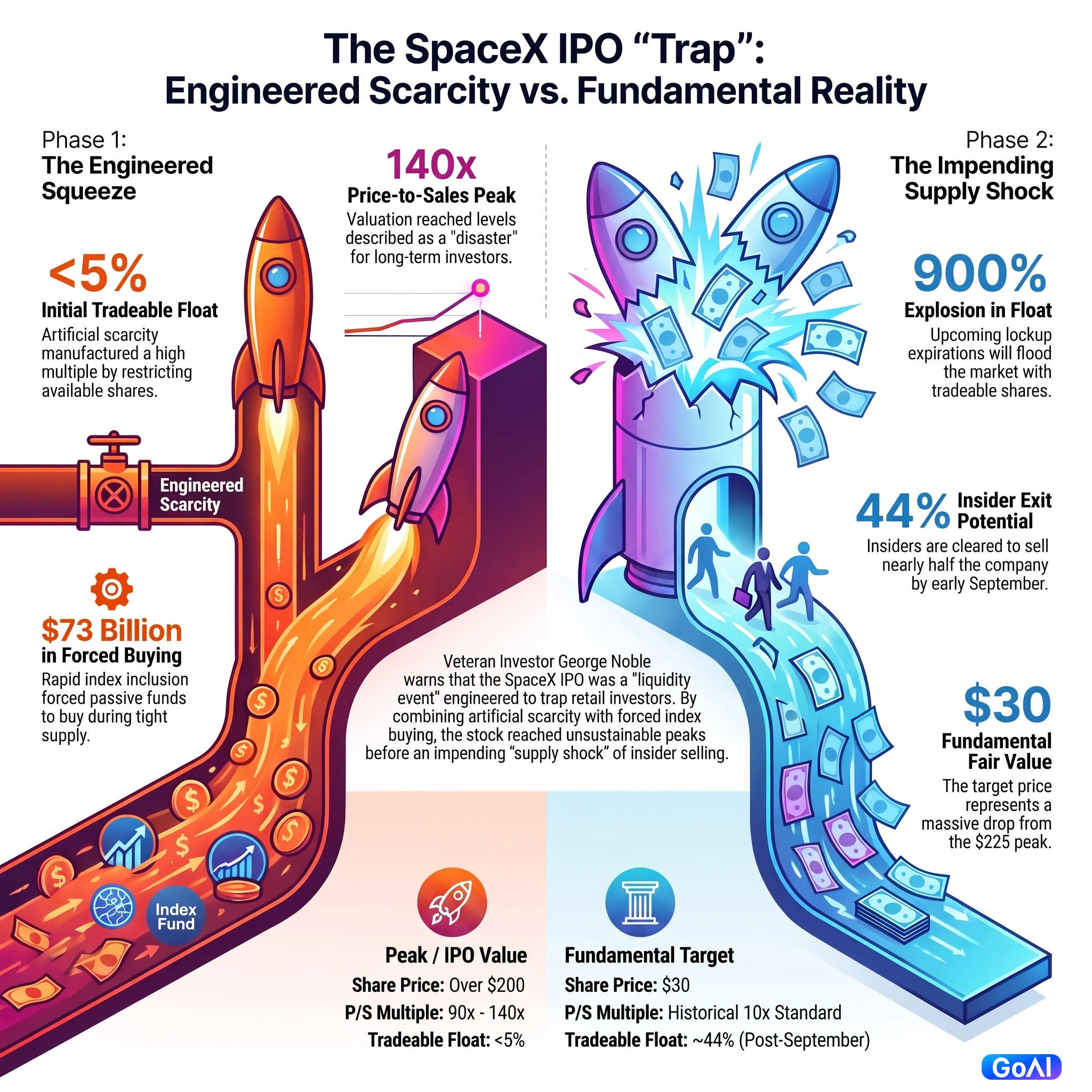
Let me explain why this IPO was designed to leave retail investors holding the bag: SpaceX has never turned a profit and lost nearly $5 billion last year. At the offering, you paid over 90x sales, and at the stock's absolute peak, the market multiple approached 140x.
-
Three decades ago, the president of Sun Microsystems detailed why paying even 10x sales almost always ends in disaster, and he was absolutely right.
However, Noble pointed out that valuation itself is not the real issue—artificial scarcity is what manufactured such a high multiple. The post-IPO lockup timeline, which will inevitably destroy this scarcity, will ultimately crush the stock price.
-
At the time of the IPO, less than 5% of SpaceX's actual shares were available for trading. Then, index committees tweaked their rules to fast-track the stock into the NASDAQ 100 just 15 trading days after its debut, forcing every passive fund and index ETF in the country to buy shares at the exact moment float was at its tightest.
-
The NASDAQ inclusion alone forced roughly $43 billion in buying pressure, while the Russell index reweighting tacked on another $30 billion. Supply was virtually nonexistent, and the buying was mandatory. It was an engineered short squeeze, which is why the stock cleared $225 in its opening week.
Noble emphasized that SpaceX’s valuation remains completely unmoored from its fundamentals. The initial rally was not driven by underlying performance, but was rather the product of what he calls "engineered crowding."
He further noted that this trend is on the verge of reversing. Specifically, he explained that the company's disclosed lockup expiration schedule dictates a phased unlocking of insider shares starting right after the Q2 earnings release and continuing through the end of the year, with the final batch set to untie in June 2027.
Noble believes the arrival of these lockup expirations will dramatically flood the market with tradeable float as employees and early-stage investors gain the green light to sell. He pointed out that over the next few months, the mechanics of this supply unlock—rather than company fundamentals—will act as the primary catalyst for the stock price.
"When you add all these shares up, insiders will be cleared to sell up to 44% of the entire company by early September, which will trigger a staggering 900% explosion in tradeable float. All of this supply is heading straight into the inventory that SpaceX deliberately carved out for retail investors, given that SpaceX reserved nearly 30% of the offering for individual investors instead of the standard 10%," he added.
Ultimately, Noble pointed out that Starlink remains the company's only consistently profitable business unit, but argued it is nowhere near enough to prop up SpaceX's current market capitalization.
He estimates the fair value of the stock to be around $30 per share, labeling SpaceX "the most overvalued stock I have ever seen."
"I can tell you that this is one of the worst wealth transfers I have seen in my lifetime, just wrapped up in a fancy narrative. Tesla was the greatest case of capital misallocation in stock market history. SpaceX may have just surpassed it," he concluded.