
Will Pain in the Memory Sector Pave the Way for a More Balanced Market?

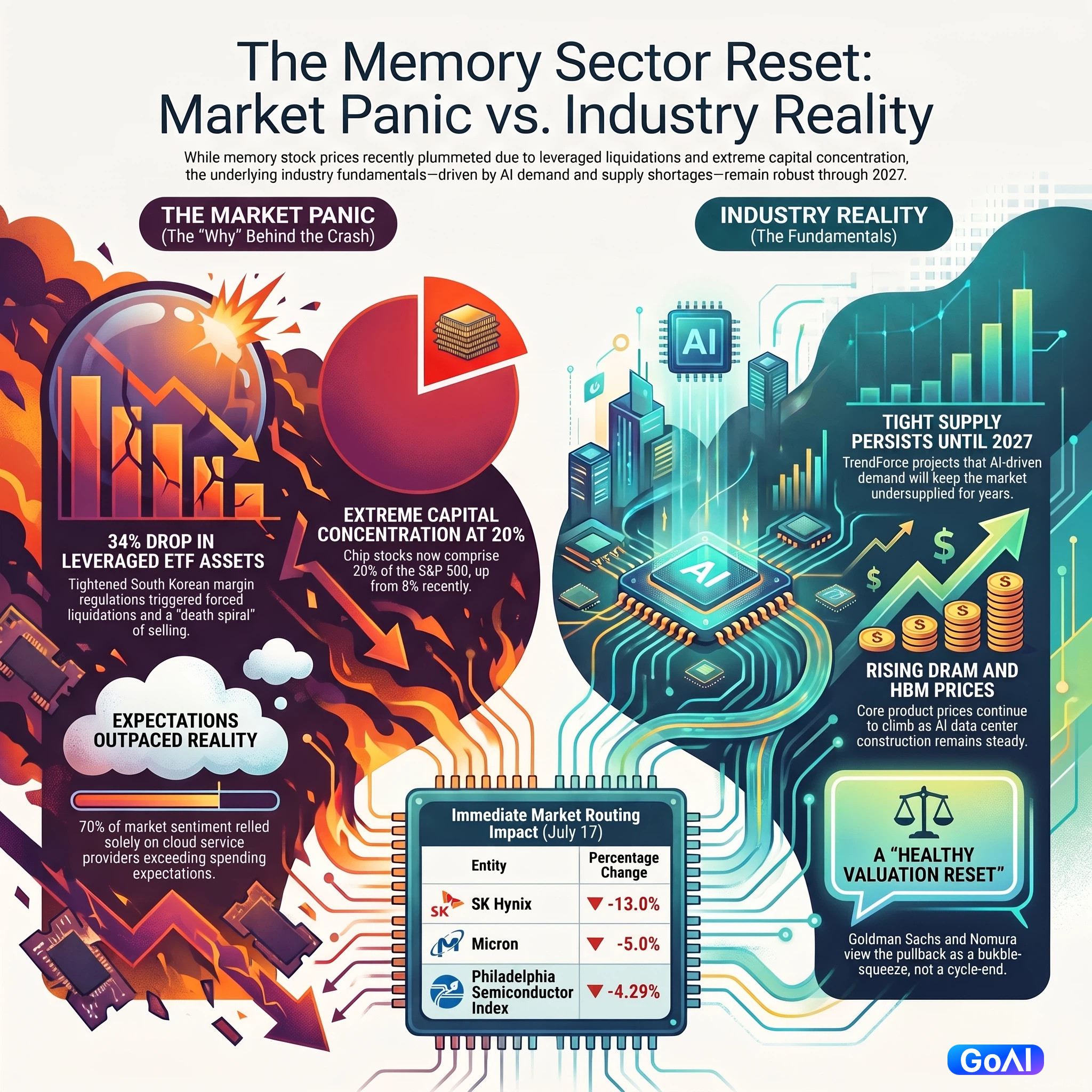
In the early hours of July 17, U.S. memory stocks suffered a collective routing, with SK Hynix plunging over 13% and Micron falling over 5%. The Philadelphia Semiconductor Index plummeted 4.29% in a single day.
Prior to this, memory chip concept stocks in A-shares, Hong Kong, and South Korea had already led the decline.
Looking at the red numbers in their portfolios, many investors’ immediate reaction must be: Has something gone terribly wrong in the memory sector? Has the inflection point for AI chip demand arrived?
In reality, this rout is both a stampede of market sentiment and a reflection of a severe mismatch between industry pacing and market expectations.
However, the deeper issue likely extends far beyond the chip industry itself.
The Direct Trigger: Leveraged Liquidations
Let us first look at the direct trigger.
South Korea’s Financial Services Commission suddenly tightened regulations on single-stock leveraged ETFs, raising the minimum margin requirement from 10 million won to 30 million won.
Korean retail investors had just flooded into these products in May. Once regulators acted, leveraged funds were forced to liquidate, triggering a death spiral of forced selling and further declines.
According to JPMorgan data, assets under management in leveraged memory chip ETFs have shrunk by 34% since their peak in June.
This is entirely a stampede amplified by emotional leverage, having little to do with industry fundamentals.
Expectations Running Ahead of Reality
Yet, the industry itself indeed has some digestion to do.
In the first half of the year, memory chips rallied too sharply, with leaders like Micron and SK Hynix more than doubling their share prices.
The market spun elaborate narratives around AI memory demand, and expectations ran far ahead of reality.
A JPMorgan survey pointed out that about 70% of market sentiment was bet on a single variable: whether cloud service providers' capex could continue to beat expectations.
Consequently, at the slightest sign of trouble, share prices could not hold up.
Additionally, the market feared that South Korea’s ten-year semiconductor investment plan would lead to overcapacity.
However, Nomura Securities believes these concerns are overblown.
The core contradiction remains a supply shortage, AI demand is far from peaking, and TrendForce also projects that tight supply and demand will persist at least until the second half of 2027.
The Mismatch of Pacing
Thus, the current situation is this: the industry is still moving forward step-by-step, but market sentiment has entered a state of "pulling up seedlings to help them grow."
Before earnings could be realized, share prices had already priced in three years of future growth.
When good news arrived, it instead became a reason to sell. This mismatch, in essence, is not created by the chip industry alone.
The Root Cause: Extreme Capital Concentration
The root of the problem lies in the extreme concentration of global capital. It seems people have forgotten how to invest in anything other than tech stocks and AI.
Three or four years ago, chip stocks accounted for only about 8% of the S&P 500; now they exceed 20%. With such high concentration, once high-valuation sectors fluctuate, the entire market begins to shiver.
Coupled with a global economic slowdown, people have pinned all hopes of growth on technology. This single-track market structure is inherently extremely fragile.
Capital crowds in until valuations defy gravity, and then rushes out all at once, leaving the retail investors who chased the highs to bear the brunt of the damage.
A Healthy Valuation Reset
The only cure for this distorted situation is the market's own correction.
Goldman Sachs, Bank of America, and Nomura all view this pullback as a healthy valuation reset rather than the end of a cycle.
Simply put, prices went up too much. It is time to squeeze out the bubble and return valuations to more reasonable levels.
For ordinary investors, haste makes waste, and it pays to take a longer-term view. The fundamentals of memory chips have not changed.
DRAM prices are still rising, HBM demand is still expanding, and AI data centers are still being built. The industry has its own pace, and demanding that it beat expectations every single quarter is unrealistic.
Beyond the Chip Industry
More importantly, what we need to reflect on goes far beyond the chip industry. Consumer goods, healthcare, energy, and finance—each industry has its own cycle and value.
When capital is overly concentrated in a single track, those who chased the peaks will ultimately pay the price. What the market needs is balance, not exclusive adoration.
This crash may serve as a wake-up call: give industries the time they need to grow naturally, and give yourself the opportunity to look at other landscapes. Only after the pain of adjustment can we welcome a healthier and more sustainable market.