
JPMorgan: U.S. Stocks Face Limited Upside in H2 as Four Major Risks Threaten to Rattle Markets

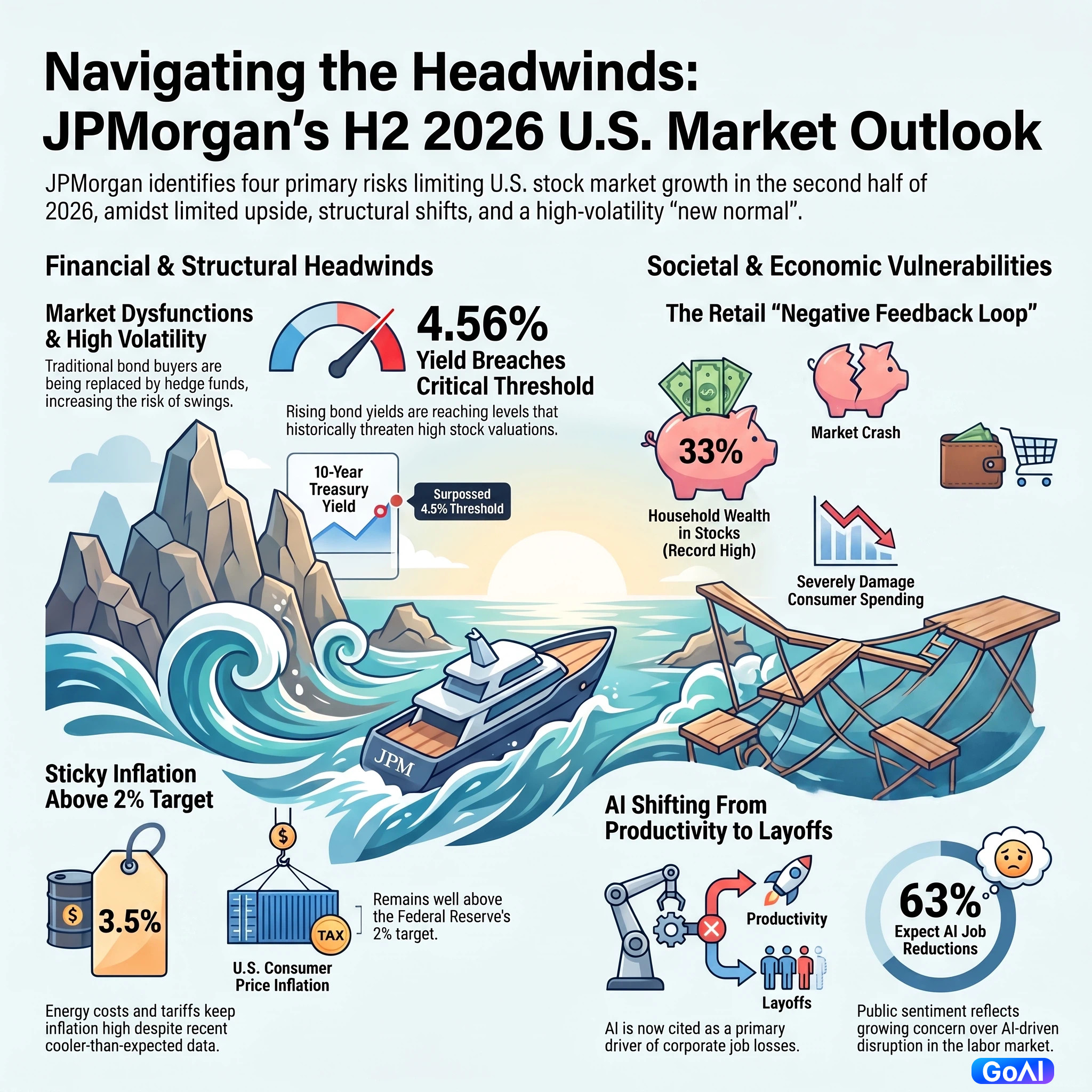
U.S. equities have endured a volatile ride since the start of the year, driven by geopolitical tensions, fears over AI disrupters, and ongoing sector rotation within the AI space.
Despite these headwinds, Wall Street delivered solid gains in the first half of the year, with the S&P 500 up nearly 9% year-to-date and rebounding more than 18% from its April lows.
However, JPMorgan warns that the market faces stern challenges in the second half under the threat of several underlying risks.
A research team led by JPMorgan Senior Researcher Zahin Ov noted in a report that the S&P 500 could see "weaker performance" relative to international equities over the remainder of 2026:
"We expect U.S. equities to move somewhat higher from current levels, but year-end returns are unlikely to match those seen in the first half of 2026."
Here are the primary factors the bank expects to shape markets through the rest of 2026:
"Market Dysfunctions" and Heightened Volatility
JPMorgan cited a June report from the Bank for International Settlements (BIS), which highlighted vulnerabilities in the financial system as traditional buyers of government bonds recede, replaced by hedge funds, foreign investors, and private players.
The BIS noted that risk has shifted away from traditional bank-sovereign linkages. With hedge funds now indirectly trading government debt across several core sovereign bond markets, the risk of market dysfunctions has intensified.
The bank added that markets could experience larger-than-usual swings:
"Structural, structurally higher volatility is the new baseline, with market structure changes leading to higher daily volatility and a need to adjust positions more rapidly."
Sticky Inflation and Higher Interest Rates
The second risk outlined by JPMorgan is persistent U.S. inflation alongside structurally higher interest rates, which could weigh on equities in the second half of the year.
While U.S. June inflation data came in cooler than expected, inflation has remained a major market catalyst throughout the year due to war in Iran driving energy costs higher and ongoing tariff pressures.
U.S. Consumer Price Inflation rose 3.5% year-over-year in June, remaining well above the Federal Reserve's 2% target. Meanwhile, the benchmark 10-year U.S. Treasury yield, which reflects long-term rate expectations and economic inflation, has climbed to roughly 4.56%, breaching the critical 4.5% threshold.
"At the same time, the spread between stock returns and bond yields—the equity risk premium—has fallen to its lowest level since the Global Financial Crisis," JPMorgan strategists wrote in their equity risk analysis. "This suggests that if bond yields rise further, they could become a problem for stock valuations."
Retail Investors Threaten Negative Feedback Loop
JPMorgan emphasized that the surge of retail investors entering U.S. equities has amplified the "wealth effect"—where rising stock prices encourage higher spending—but warned this trend also heightens the risk of a "negative feedback loop."
In short, a sharp market drawdown could deal a heavier blow to U.S. economic activity than in past bear markets.
U.S. equities currently account for roughly one-third of total U.S. household wealth, a record high.
"A major market correction could trigger a negative wealth effect far larger than historically observed," JPMorgan strategists noted. "Compared with historical norms, retail equity trading activity in 2025 and early 2026 has been at or near all-time highs."
Labor Market Turbulence
JPMorgan cautions that AI could further disrupt the U.S. job market, particularly as focus shifts from productivity gains toward job losses.
According to a recent report by Challenger, Gray & Christmas, AI was cited as a primary driver of corporate layoffs in the U.S. for four consecutive months. Meanwhile, a YouGov survey revealed that roughly 63% of Americans expect AI to continue reducing the overall number of jobs.
"The 'new normal' for the labor market remains unclear, with young college graduates disproportionately exposed to AI disruptions," the bank wrote in its report.