
To Hike or Not to Hike? Warsh Faces First Major Test of His Tenure This Week

On Tuesday, local time, the Federal Reserve will kick off its two-day July monetary policy meeting.
With U.S. economic data pointing to renewed inflationary pressures, the decision of whether to hold rates steady or deliver a surprise rate hike has become increasingly complex—and bound to spark intense debate.
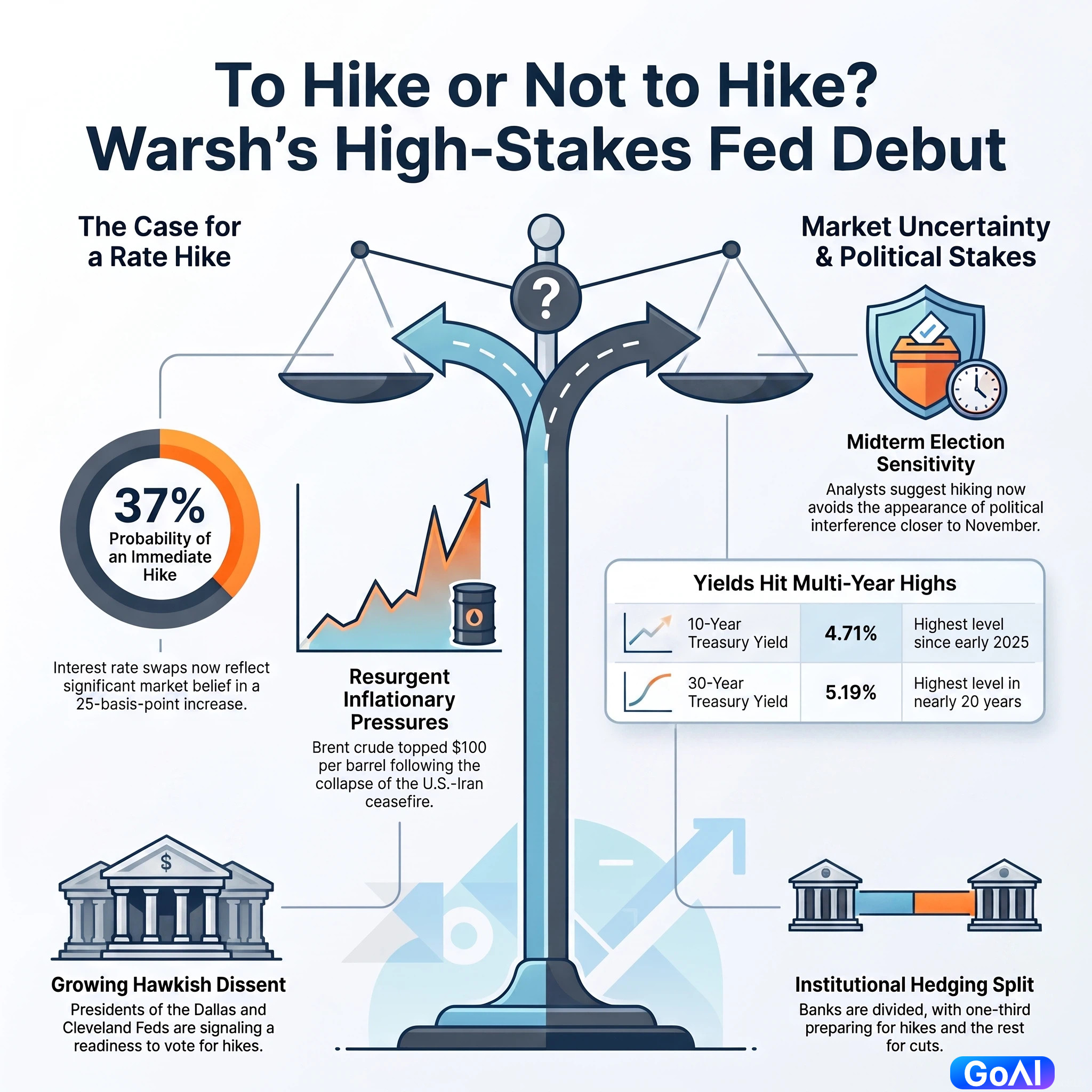
Rates traders currently assign a more than one-in-three probability to a Fed rate hike this week.
The shift comes as escalating tensions in the Middle East drive crude oil prices higher, stoking renewed fears over sticky inflation and rising Treasury yields.
Last week, as threats of escalation in the Iran conflict mounted, Brent crude futures briefly surged above $100 per barrel.
Driven higher by the energy rally, the benchmark 10-year Treasury yield jumped 13 basis points on the week to touch 4.71%—its highest level since early 2025—while the 30-year yield reached 5.19%, hovering near its highest level in nearly two decades.
This resurgence in oil prices hangs over the Fed's July 29 policy decision, forcing investors to weigh whether officials might deliver their first rate hike since 2023.
Fed Chair Kevin Warsh's decision to move away from the central bank's long-standing practice of issuing explicit forward guidance has left market participants—including prominent Fed watchers like Nick Timiraos—viewing this meeting as one of the most unpredictable policy decisions in recent history.
Data from the interest rate swaps market indicates roughly a 37% chance of a 25-basis-point rate hike this week, with traders fully pricing in a rate increase by September.
However, almost all economists surveyed by major media outlets continue to expect the Fed to hold interest rates unchanged this week.
The Growing Case for a Rate Hike
Even if the Fed ultimately leaves rates unchanged on Wednesday, the meeting is set to feature a growing chorus of hawkish dissent. Over recent weeks, an increasing number of policymakers have explicitly laid out the rationale for hiking rates either now or in the near future.
Dallas Fed President Lorie Logan called earlier this month for a modest rate hike, arguing that inflation is not returning to the Fed's 2% target on a sustained basis.
Cleveland Fed President Beth Hammack echoed similar concerns recently, noting that the Fed's dual mandate goals are "not in conflict" and that inflation currently poses a greater risk than unemployment.
Both officials are voting members on this week's FOMC decision—and are widely expected to dissent if the committee chooses to stand pat.
"It is clear from official communications that a core minority—including Logan and Hammack—is ready to act," said Claudia Sahm, Chief Economist at New Century Advisors LLC. "Meanwhile, a sizable majority of policymakers prefers to wait for clearer signs of disinflation before making a move."
A hawkish shift was already brewing at last month's meeting when officials held rates steady for a fourth consecutive session.
Minutes from that meeting revealed that most participants discussed scenarios where inflation remains elevated due to AI-driven demand, Middle East conflict, or trade tariffs. Nearly all members in that group noted that such conditions would likely necessitate further rate hikes.
Since that meeting, conditions have deteriorated on all three fronts: the Trump administration announced new tariffs on Canada and other trading partners, a fragile ceasefire between the U.S. and Iran collapsed, and the AI investment boom showed no signs of cooling.
Consequently, the Fed's top three inflation risks have intensified rather than abated.
Fed Chair Kevin Warsh reiterated the central bank's commitment to reining in inflation during his Congressional testimony earlier this month, pledging to utilize monetary tools to secure price stability.
However, his reluctance to specify how or when those tools would be deployed has left markets speculating heavily on the near-term path of interest rates.
Institutional Investors Prepare for Both Outcomes
As market uncertainty peaks, financial institutions are actively hedging against divergent policy paths.
"Among the banks we work with, roughly one-third are preparing for further rate hikes, while the rest are hedging against potential rate cuts," said Pradeep Bhatia, CEO of Derivative Path Inc., a derivatives service provider specializing in interest rate and FX risk management. "This sharp split shows that market participants have stopped trying to predict the Fed's exact cadence and are instead positioning for both scenarios simultaneously."
"The conflict in the Middle East is undeniably heating up, raising the probability of a substantial upward shock in crude prices from current levels," added Alex Payne, Senior Portfolio Manager at Vanguard. "Markets are adjusting to the reality that geopolitical risks could make inflation far more stubborn than previously priced."
Some institutions predicting a rate hike as early as this month also point to political considerations. Joseph Lavorgna, Chief Americas Economist at SMBC Nikko Securities America and a former Treasury official, noted that hiking rates this month would allow Warsh to establish inflation-fighting credibility early in his term, while minimizing political fallout ahead of the November midterm elections.
In September 2024—just weeks before the presidential election—the Powell-led Fed delivered an unexpected 50-basis-point rate cut. Trump subsequently criticized Powell, calling the move a "political decision" designed to assist his opponent, former Vice President Kamala Harris.
"If you wait until September or October on the eve of the midterms to deliver a first rate hike, imagine the political fallout. He might as well do it now," Lavorgna stated. He added that Warsh could frame an immediate hike as a proactive measure to anchor inflation expectations, which could ultimately help push down long-term market interest rates—a key priority for the president.
Conversely, a strong contingent of Wall Street analysts expects the Fed to remain on hold this week. Citi Economist Veronica Clark noted that a cooler June inflation print gives officials room to hold rates steady for now.
She added that if incoming data shows limited pass-through from energy prices to broader consumer metrics while unemployment ticks higher, policymakers may extend their pause or eventually shift toward rate cuts.
Regardless of the outcome, Chair Warsh's post-decision press conference will be scrutinized for clues on how the FOMC views the economic trajectory.
"The central question for the next few meetings is determining where the broader consensus lies within the FOMC regarding the actual necessity of a rate hike," concluded Matthew Luzzetti, Chief U.S. Economist at Deutsche Bank Securities.