
S. Korean Equity Rout Far from Over as Analysts Warn Leverage ETF Rules May Fail to Calm Volatility

From a parabolic surge to a sudden cascade, South Korean equities have seen a dramatic narrative shift over the past month, plunging domestic retail investors into deep distress.
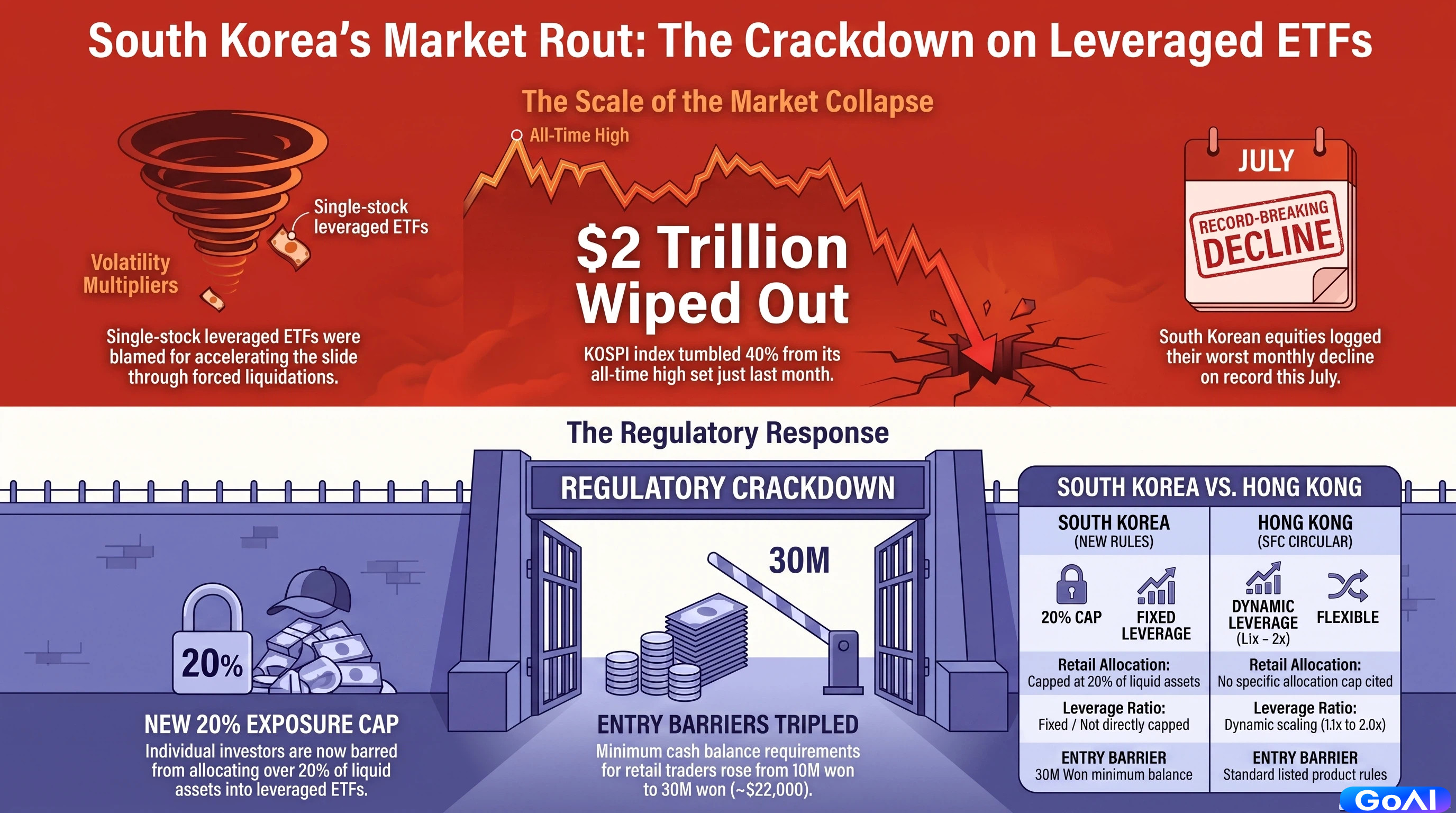
Throughout this sharp drawdown, single-stock leveraged ETFs have drawn heavy criticism for amplifying volatility and accelerating the broader market slide.
As once-crowded trades unwound, the KOSPI index has tumbled roughly 40% from its all-time highs set last month, wiping out nearly $2 trillion in market capitalization.
Highly leveraged retail traders who bought near the top have borne the brunt of the liquidation.
The market collapse has piled intense pressure on South Korean officials.
Having previously touted the stock rally, regulators are now facing angry retail investors who recently set up funeral wreaths outside the National Assembly building in protest.
With equities mired in a sharp downward trend marked by intraday whip-saws, financial regulators have intervened with a flurry of single-stock leveraged ETF regulations aimed at curbing volatility and protecting retail capital.
Leverage ETF Regulations May Fall Short of Calming Market Volatility
Market analysts warn that Seoul's regulatory clampdown on leveraged products may prove insufficient to soothe structural market volatility.
On Wednesday, following two consecutive days of circuit-breaker halts across domestic exchanges, the Governor of the Bank of Korea and top financial regulators convened an emergency meeting.
Authorities announced plans to cap retail position limits on single-stock leveraged ETFs while raising trading friction costs.
Under the new total exposure management framework, individual investors will be barred from allocating more than 20% of their total liquid financial assets into single-stock leveraged ETFs.
Regulators also announced the expansion of an "excessive bidding surcharge" to cash equities—a penalty mechanism previously restricted to futures markets aimed at curbing spoofing, where large orders are submitted without execution intent and subsequently canceled.
These measures follow earlier directives to freeze new listings of single-stock leveraged ETFs and raise minimum cash account balance requirements for retail traders opening or adding positions from 10 million won to 30 million won (roughly $22,000), effective July 31.
However, market participants point out that South Korean regulators stopped short of capping underlying fund leverage ratios directly—unlike recent policy moves by Hong Kong authorities.
As long as retail appetite for quick high-beta returns remains intact, dampening the structural impact of these products will prove challenging.
By contrast, the Securities and Futures Commission (SFC) in Hong Kong updated its Circular on Listed Structured Funds on July 24, introducing a flexible leverage architecture.
While maintaining maximum leverage caps at 2x (and -2x for inverse products), fund managers are now permitted to dynamically adjust daily leverage ratios down to a 1.1x (or -1.1x) floor based on market volatility.
Industry analysts note that dynamic leverage scaling mitigates passive rebalancing shocks during market downturns, helping absorb systemic liquidation risks.
"While these measures will help dampen volatility in S. Korean equities, they would be far more effective if paired with liquidity backstops like a stock market stabilization fund," said Kim Jin-wook, Chief Korea Economist at Citi.
The head of research at a Seoul-based brokerage noted that South Korea’s latest rules may prove ineffective, describing the retail allocation caps as rushed and poorly targeted. He added that Hong Kong's dynamic framework successfully reduces forced liquidations under stressed market conditions, thereby lowering broader volatility.
Furthermore, he emphasized that the new position limits will not apply retroactively to existing ETF holders via forced liquidation, nor will they restrict retail access to offshore leveraged products listed in New York or Hong Kong—leaving domestic markets exposed to ongoing volatility.
Following back-to-back limit-down sessions, South Korean equities found minor footing on Thursday but failed to stage a meaningful reversal. The flagship KOSPI Index closed down 1.23% at 5,593.56.
South Korean equities remain on track to log their worst monthly decline on record for July.
The sell-off is particularly striking given that memory giants Samsung Electronics and SK Hynix both delivered stellar quarterly prints this week, reporting a combined quarterly profit of roughly 150 trillion won (~$100 billion).