
U.S. July payrolls report arrives: Could soft data fuel Fed rate cut expectations?

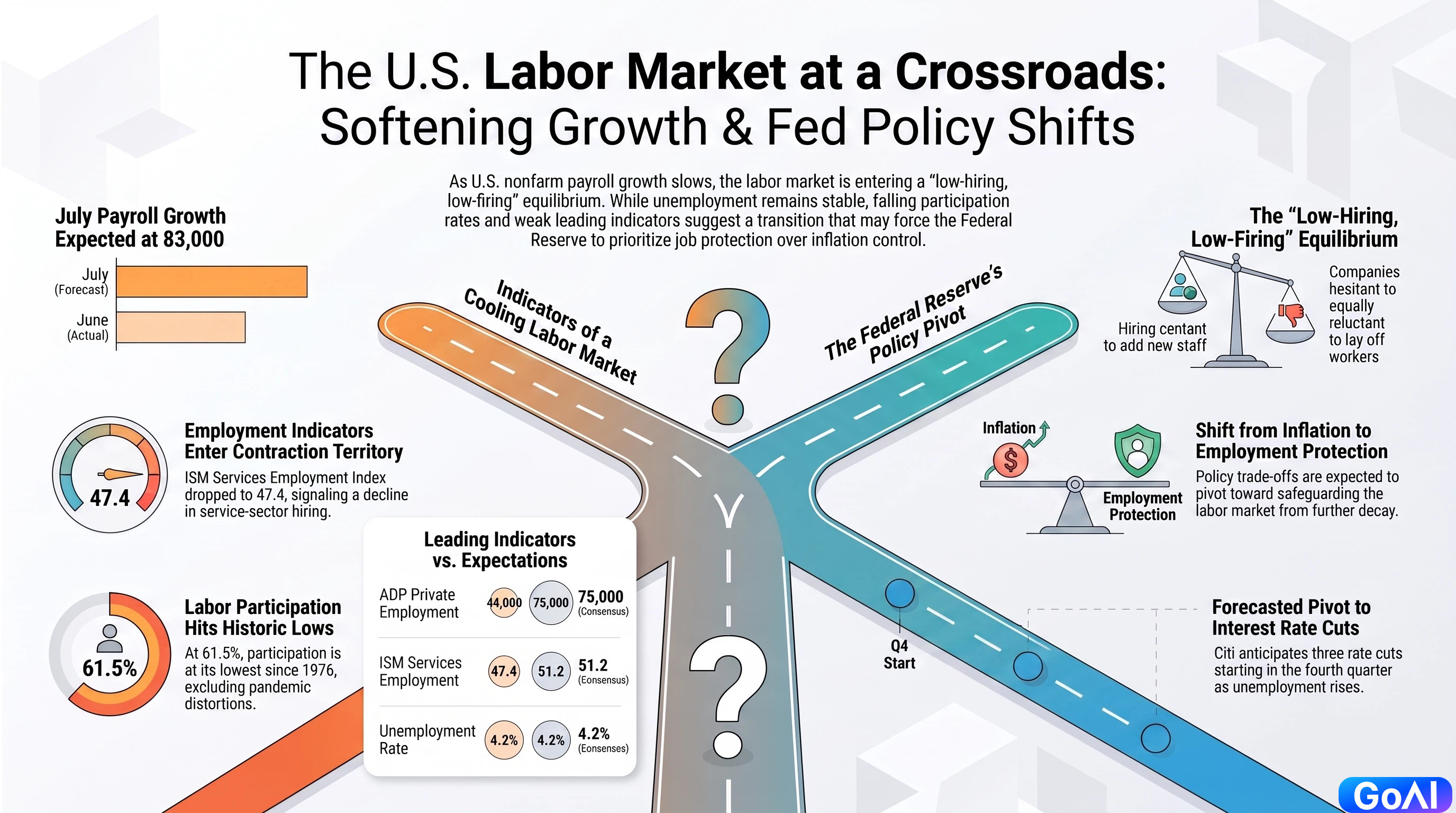
All eyes turn to the release of the U.S. nonfarm payrolls report this Friday. Economists and Federal Reserve officials will scrutinize the print to gauge the underlying health of the American economy.
June data released last month signaled that job growth was clearly losing momentum.
For July, consensus forecasts expect little meaningful acceleration, with payroll expansion and the unemployment rate likely holding relatively flat.
Against this backdrop, several Wall Street banks predict the Fed’s policy trade-offs could pivot over the coming months from curbing inflation to protecting employment.
U.S. July labor market projected to remain soft
Consensus expects July nonfarm payrolls to rise by just 83,000—a modest uptick from June’s 57,000—while holding the unemployment rate steady at 4.2%.
Average hourly earnings are projected to increase 0.3% month-over-month and 3.5% year-over-year, a pace theoretically aligned with the Fed's 2% inflation target.
By comparison, June payrolls added a below-consensus 57,000 jobs, while combined revisions for April and May shaved off a net 74,000 positions.
Although June’s unemployment rate ticked down to 4.2%, the decline was driven in part by a shrinking labor force rather than robust hiring demand.
Leading indicators released earlier this week also pointed to softness: ADP reported private sector job gains of just 44,000 against a 75,000 estimate, while the ISM Services Employment Index dropped into contraction territory at 47.4, down from 51.2.
As a result, major Wall Street firms maintain a cautious outlook.
Vanguard estimates July payroll growth could print as low as 18,000 based on 401(k) retirement plan data, highlighting summer labor market softness and warning that "this sluggishness risks extending into autumn."
Goldman Sachs noted that July prints have historically tended to miss initial forecasts alongside sizable downward prior-month revisions.
Wells Fargo observed that simultaneous decelerations in labor supply and demand are keeping the unemployment rate temporarily anchored.
A "low-hiring, low-firing" equilibrium
Beyond headline figures, key indicators—including the labor force participation rate, wage growth, and sector-level hiring distribution—will provide crucial signals regarding labor market resilience.
Market participants will pay close attention to labor force participation metrics, which contracted significantly in June.
The U.S. participation rate dropped to 61.5% in June, hitting its lowest mark since March 2021 during the early post-pandemic recovery phase. Excluding pandemic distortions, this represents the lowest participation reading since June 1976.
Particularly concerning was a sharp pullback among prime-age workers (ages 25–54), which fell to its lowest point since December 2023—marking one of the steepest single-month declines on record outside of April 2020.
Economists will use the July report to determine whether this contraction reflects seasonal noise and statistical anomalies or signals deeper structural strain in a market characterized by corporate caution: companies are hesitant to hire, yet equally reluctant to lay off staff.
Fed Governor Lisa Cook addressed this dynamic on Wednesday: "While hiring activity remains subdued, layoffs also remain low, keeping the unemployment rate stable. However, this 'low-hiring, low-firing' equilibrium weighs heavily on specific cohorts, particularly young entrants entering the labor market, which can measurably erode consumer confidence."
Cook added that while she retains broader confidence in the labor market, she would support further interest rate hikes if inflation proves sticky—a hawkish sentiment echoed by an increasing number of Fed officials.
Federal Reserve policy calculus set to shift
While monthly payroll volatility grabs headlines, Fed officials typically attach greater weight to the unemployment rate. However, the current low unemployment rate has been sustained largely by falling participation, with total employed workers declining by 833,000 in 2026.
Vanguard noted: "The lower participation rate stems directly from sluggish hiring demand, disproportionately impacting younger demographics.
We expect participation to normalize over the coming months; as workers re-enter the labor market and job creation lags applicant growth, the unemployment rate will inevitably push higher."
While Fed policymakers remain caught between confidence in current employment and lingering anxiety over inflation, not ruling out further rate increases in the near term, economists at institutions like Citi anticipate a shift in the central bank's policy trade-offs later this year.
Citi stands out with a non-consensus call, forecasting three interest rate cuts between now and January 2027.
"While labor market metrics can currently be characterized as 'holding steady,' we expect conditions to deteriorate over the coming months, pushing the unemployment rate above 4.5%," Citi economist Veronica Clark wrote in a research note.
"At that point, market focus will pivot decisively back to easing, with our base case calling for rate cuts to resume in the fourth quarter."
Heather Long, Chief Economist at Navy Federal Credit Union, summarized the balance:
"The Fed's core focus remains firmly on inflation. While that prioritization is understandable, policymakers must ensure the broader economy continues generating sufficient opportunities for young professionals launching their careers."