
Musk: SpaceX on Track to Generate $1 Trillion in Revenue by 2030

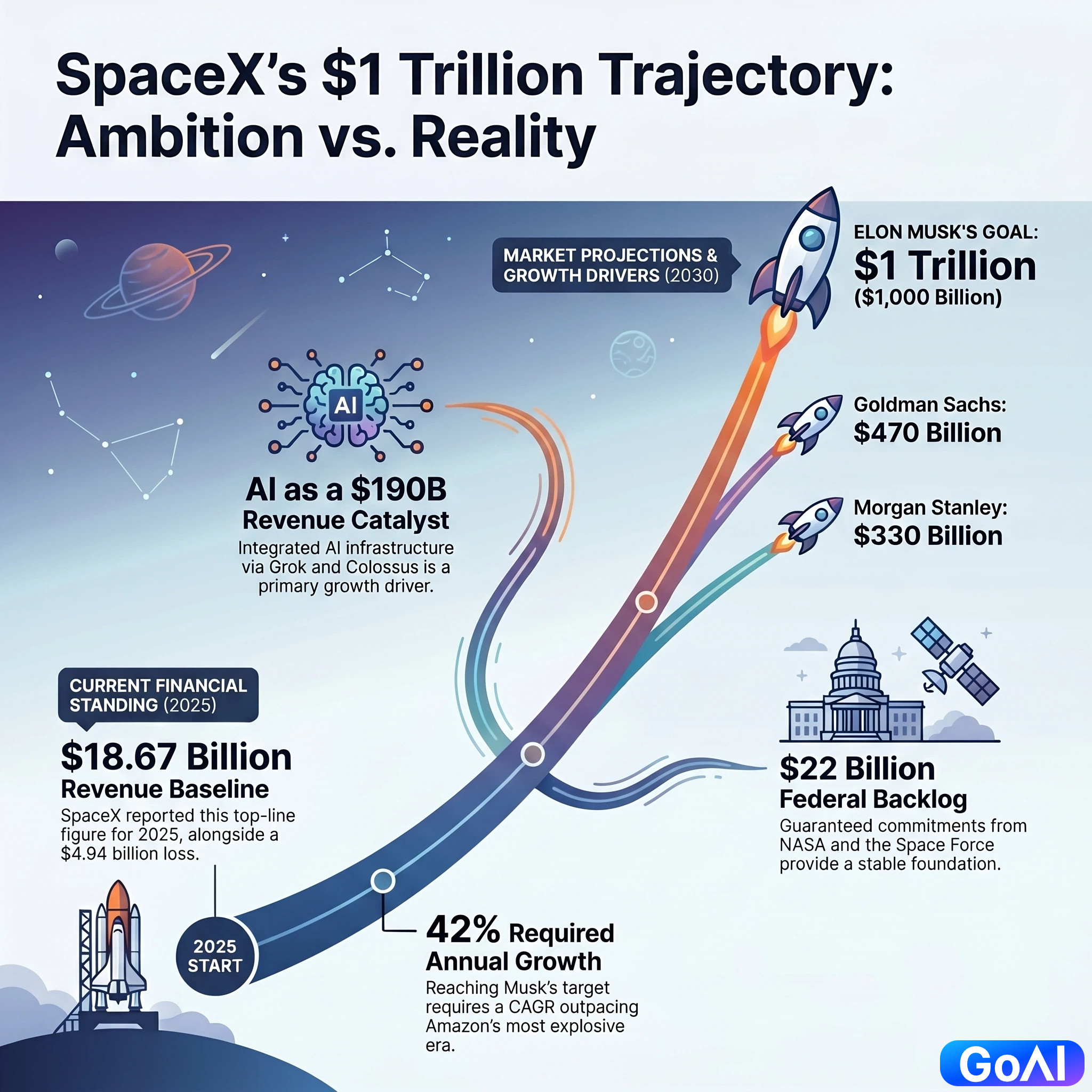
Elon Musk stated Sunday that his aerospace enterprise, SpaceX, could generate $1 trillion in annual revenue by 2030. The ambitious pronouncement comes just two days after the company’s blockbuster public debut, which saw its market capitalization breach the $2 trillion milestone.

"I would be surprised if SpaceX revenue is under $1 trillion by 2031," Musk posted Sunday on the social media platform X.
Last Friday, SpaceX completed a historic listing on the Nasdaq, cementing its position as the sixth-largest US corporation by market value and solidifying Musk’s status as the world’s preeminent centibillionaire.
During its maiden session, SpaceX equity touched an intraday high before paring gains to finish the day up 19.22% at $160.95 per share. Momentum carried into Monday's pre-market action, with the stock ticking up an additional 7.7% as of press time.
Despite its massive market capitalization, the company’s current top-line financials remain significantly below tech peers of comparable scale, such as Broadcom and Amazon.
In 2025, SpaceX saw its revenue surge to $18.67 billion, up from $14.02 billion the prior year, though the firm swung from a $791 million net profit to a net loss of $4.94 billion.
Consequently, several Wall Street analysts maintain a cautious stance regarding the company's precise growth trajectory.
Scaling from a $18.7 billion revenue baseline in 2025 to Musk's $1 trillion target would require a compound annual growth rate (CAGR) of approximately 42%—a clip that would outpace Amazon's most explosive expansionary phase.
According to a report published earlier this month, Goldman Sachs models SpaceX’s 2030 revenue at just over $470 billion.
Meanwhile, Morgan Stanley—one of the lead underwriters for the IPO—projects SpaceX will generate $160 billion in 2028 and $330 billion by 2030, before ballooning to $3.4 trillion by 2040, with adjusted EBITDA forecasted to exceed $2.7 trillion.
Morgan Stanley’s valuation model highlights artificial intelligence infrastructure as the primary top-line catalyst, projecting that SpaceX’s standalone AI division will generate $190 billion by 2030.
This vertical anchors the post-merger integration of the xAI Grok platform and the Colossus supercluster architecture.
Furthermore, a robust pipeline of government contracts offers a more tangible foundation for these long-term forecasts.
As previously reported, SpaceX maintains a backlog of at least $22 billion in federal commitments across NASA, the US Space Force, the National Reconnaissance Office (NRO), and the Space Development Agency (SDA).