
Is the Opportune Moment for US Equities Finally Arrived?

US equities typically command a core position in a standard global strategic allocation portfolio.
For international investors, however, the asset class currently presents a classic dilemma. On one hand, US large-caps offer a strong return on equity (ROE), manageable volatility, and distinct diversification benefits.
On the other hand, the market is riding a 17-year bull run that began in 2009, and stretched valuations in recent years have naturally given buyers pause.
Over the past two years, the structural drivers of the US market have shifted significantly, punctuated by recent corrections.
Looking ahead, has a compelling long-term entry point finally arrived? To evaluate the current balance of risk and reward, we break down the core macro drivers in this edition of the CIO Letter.
Valuation Overhangs Are Clearing
Over the last two years, US equities have underperformed other global markets. This relative underperformance was driven by a combination of global rate cuts, the migration of AI hardware profits toward external supply chains, and a broader re-rating of international assets.
Even so, US corporate earnings have maintained impressive momentum. The S&P 500 is projected to deliver a roughly 25% surge in earnings per share (EPS) for 2026.
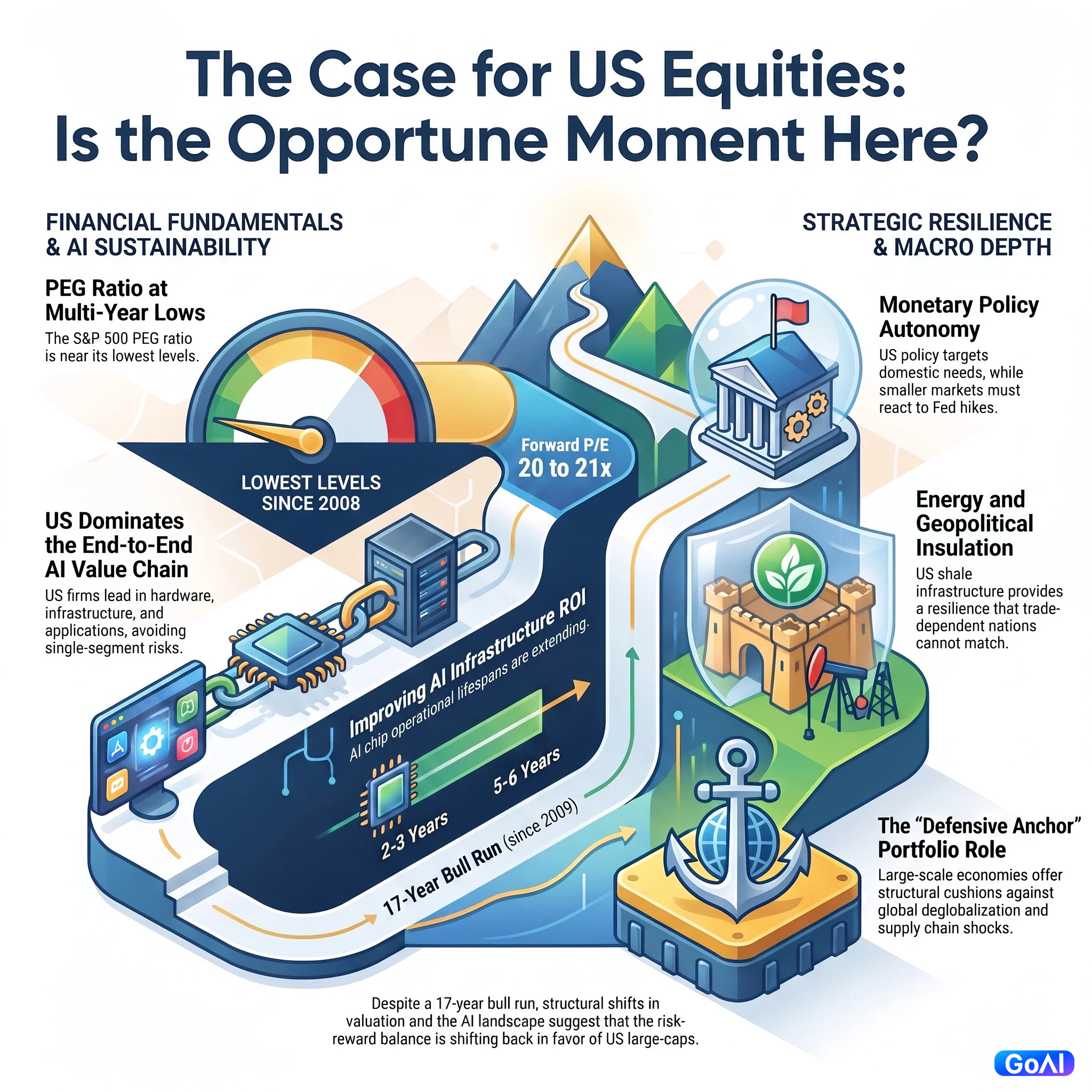
If these numbers hit the mark, the index’s forward price-to-earnings (P/E) multiple will pull back to a more palatable 20 to 21 times. While this still commands a premium over other markets, the valuation gap has closed significantly.
More importantly, these valuations are backed by concrete earnings power.
On a PEG ratio basis (P/E divided by earnings growth), the S&P 500 is trading near its lowest levels since the 2008 financial crisis. For long-term investors, if this earnings runway holds, current levels represent a solid buying opportunity.
A Balanced Play on the AI Revolution
The recent leg of the US earnings expansion has been overwhelmingly driven by artificial intelligence.
Assessing whether this rally is sustainable comes down to one question: can massive AI capital expenditures deliver real financial returns? Year to date, three clear trends suggest the answer is yes.
First, application demand is breaking out. The rise of AI agents has shifted the industry dynamic from "humans using AI" to "machines calling AI," which has dramatically accelerated token consumption.
With enterprise deployment still expanding, aggregate demand is nowhere near its peak.
Second, the return on investment (ROI) for compute infrastructure is improving.
The operational shelf life of AI chips—previously feared to be just 2 to 3 years—is stretching out to 5 to 6 years.
As leasing rates firm up, infrastructure returns have climbed.
This has drawn institutional money, such as pension and insurance funds, into AI project financing, expanding the capital pool well beyond big tech hyperscalers. The rapid financialization of compute is also lowering barriers to entry.
Third, the ecosystem provides a much more stable foundation.
As AI infrastructure spend accelerated, markets heavily weighted toward upstream hardware components outpaced the US over the past two years.
However, hardware manufacturing margins historically revert to the mean, and outsized upstream profits will inevitably attract new supply. Over the long haul, how profits are redistributed across the value chain remains highly uncertain.
In contrast, the US market stands out for its end-to-end value chain. It features dominant global leaders across the upstream, midstream, and downstream segments.
From a portfolio construction perspective, it avoids the hyper-cyclicality of single-segment markets. For investors looking for a balanced capture of the AI boom—and wanting to ensure the ultimate industry winners are in their portfolio—the US offers an ideal vehicle.
The Safe-Haven Appeal of Large-Scale Economies
Global markets are currently navigating a tricky mix of monetary policy uncertainty and geopolitical risk.
The policy shift under the new Federal Reserve leadership, paired with AI’s complicated impact on inflation, makes the interest rate path difficult to map.
Crucially, however, US monetary policy is tuned exclusively to its domestic economy. In contrast, many smaller emerging markets are forced to match US rate hikes, even when doing so hurts their local growth.
On the geopolitical front, deglobalization and supply chain vulnerabilities are fixtures of the macro landscape. Large economic superpowers inherently possess broader policy tools and deeper structural cushions.
The US, for instance, has successfully insulated itself from energy shocks through its domestic shale oil and gas infrastructure—a level of resilience smaller, trade-dependent nations cannot match.
In a fragmented, high-risk global environment, long-term asset allocation must adapt to this new geographic reality.
Strategic capital should prioritize large-scale economies that have genuine strategic depth and structural resilience, rather than smaller markets sitting on geopolitical fault lines.
Conclusion
The long-term case for accumulating US equities has come back into focus.
Valuations are being steadily absorbed by robust earnings growth, and the market’s comprehensive tech value chain provides a diversified play on the AI transition without the concentration risks of hardware-only plays.
Ultimately, as an asset class backed by massive economic depth and self-sufficiency, US equities remain an indispensable defensive anchor against global macroeconomic and geopolitical turbulence.