
Apple Reclaims the Crown: A Delayed but Necessary Market Course Correction?

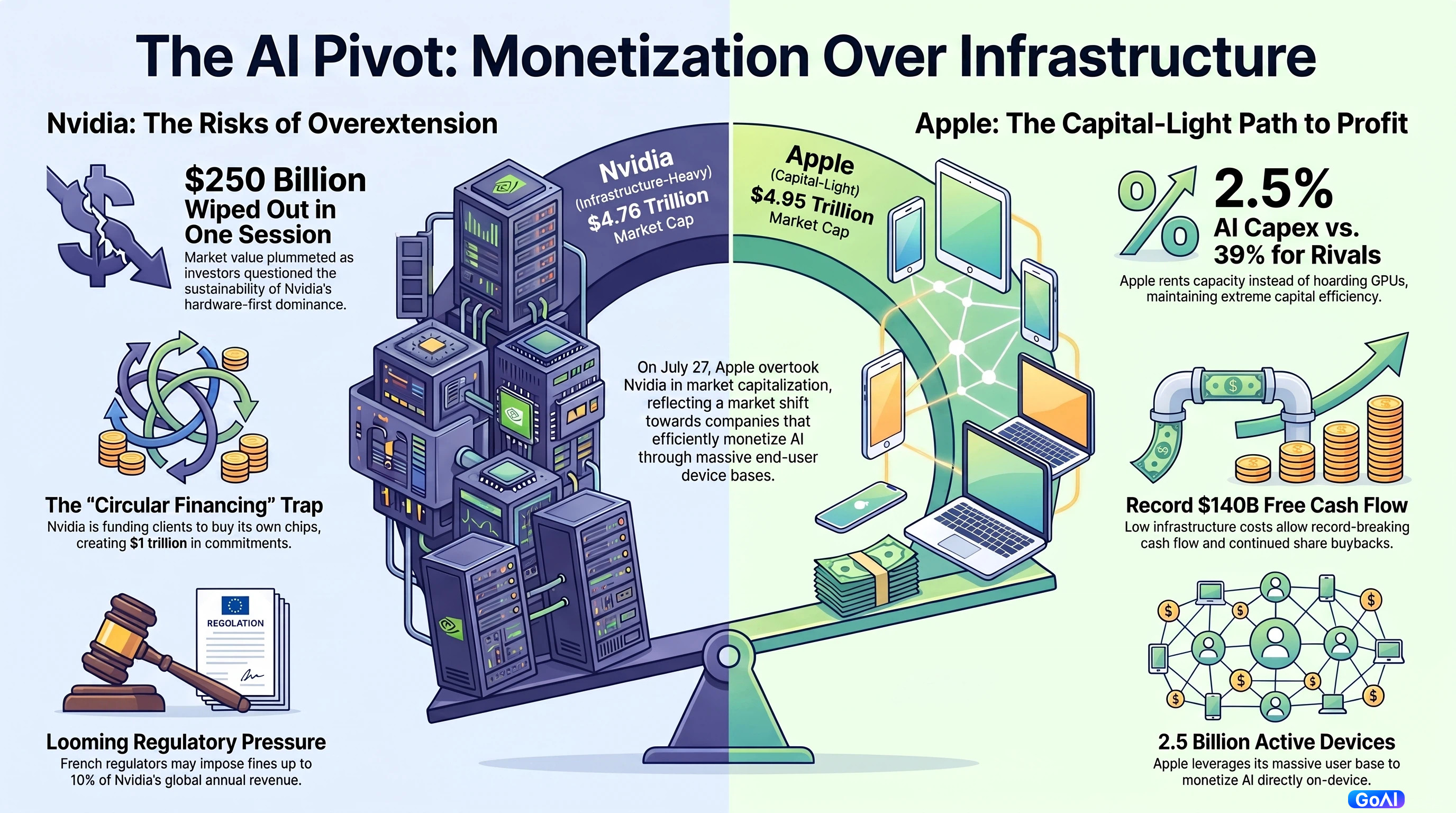
On July 27, Apple shares rose over 1% to reach a $4.95 trillion market cap, while Nvidia dropped nearly 5% to $4.76 trillion.
This gap between the two tech titans reflects a direct clash between two fundamentally different AI strategies.
Why Did Nvidia Fall? Overextended and Overleveraged
Reports over the weekend revealed that Nvidia is pushing $750 billion in AI infrastructure deals, alongside $250 billion in financial guarantees for an OpenAI data center project.
Wall Street bristled at this "circular financing" model—funding clients to buy its own chips—sending default protection costs spiking and wiping out $250 billion in market value in a single session.
Investors are now questioning where the actual profits are after hyperscalers poured hundreds of billions into compute capacity.
With top AI players holding over $1.5 trillion in unfulfilled financial commitments, traders are increasingly anxious about the ultimate solvency of the entire ecosystem.
Why Did Apple Rise? Choosing the Capital-Light Path
While competitors rushed to build out massive compute infrastructure, Apple chose a far leaner route by renting capacity rather than hoarding GPUs.
HSBC estimates Apple’s 2026 AI data center capex will account for just 2.5% of its total outlay, compared to 39% for the major cloud giants.
This capital efficiency is expected to drive Apple’s 2026 free cash flow to a record $140 billion, keeping dividend payouts and share buybacks fully intact.
Apple’s rally signals a long-overdue market course correction away from unsustainable upstream margins toward end-user monetization.
An upstream supplier boasting 70%+ gross margins while downstream software applications struggle for profitability violates basic market logic.
Without paying end users, upstream compute capacity remains a castle in the air, whereas Apple’s 2.5 billion active devices provide a proven, cash-generating foundation for on-device AI.
Antitrust risks also loom large over Nvidia as French regulators near the end of their investigation, which could carry fines up to 10% of global annual revenue. Wall Street may finally be repricing the policy risks associated with an absolute chip monopoly.
Summary
The battle for the top spot is far from over, as upcoming earnings prints and shifting compute demand could easily flip the rankings again.
However, Wall Street is clearly pivoting from "whoever has the most GPUs wins" to "whoever actually monetizes AI gets the premium."