
Great AI Rotation in U.S. Stocks? Wall Street Sets Sights on Next-Phase Winners

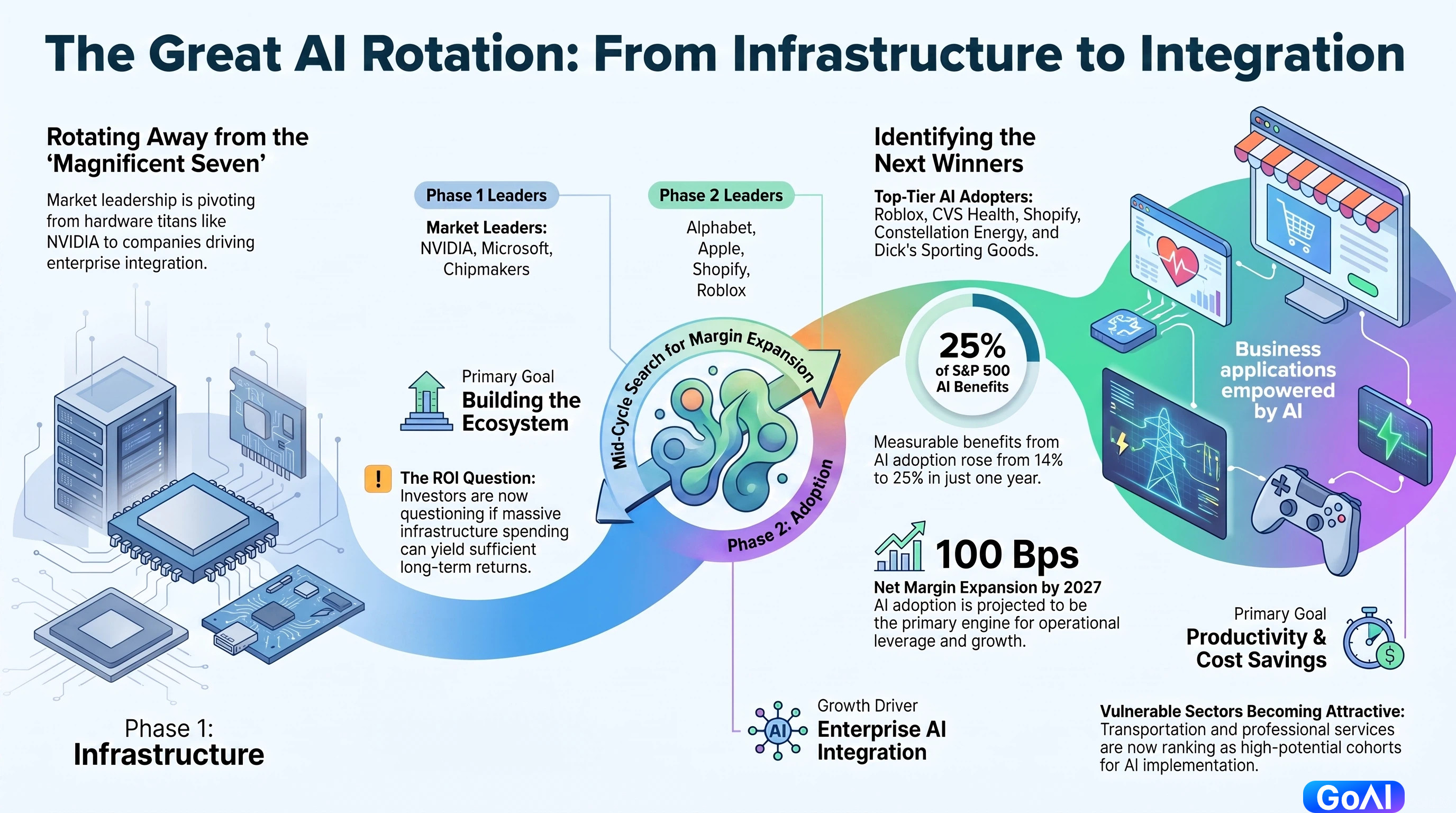
The U.S. equity bull market has broadened significantly this year, with market leadership rotating away from traditional mega-cap tech darlings toward previously overlooked sectors.
Within artificial intelligence, this shift has triggered sharp pullbacks among first-phase market leaders—including hardware titan NVIDIA and cloud hyperscalers like Microsoft.
In response, Wall Street is pivoting toward the next wave of potential beneficiaries: AI Adopters.
"Market momentum is shifting toward high-quality equities, a classic mid-cycle transition as the business expansion matures," wrote Mike Wilson, Chief U.S. Equity Strategist at Morgan Stanley.
"Margin expansion in this phase is likely to rely more heavily on enterprise AI integration rather than early-cycle operational leverage, reinforcing our bullish stance on quality assets."
The AI trade has experienced heightened volatility recently, with chipmakers and momentum high-flyers relinquishing gains.
Analysts at Piper Sandler described the price action as a "massive rotation" out of tech into defensive posturing, while Citi analysts noted that "the 'Magnificent Seven' playbook has grown stale."
According to Morgan Stanley, as the market enters this new phase, companies that successfully deploy AI to drive cost savings, enhance productivity, and unlock top-line growth will enjoy strong tailwinds.
"Our analysis reveals that 25% of S&P 500 constituents cited measurable benefits from AI adoption in their Q2 reporting, up from 14% a year ago," Wilson noted.
"We continue to view AI adoption as a primary engine for earnings growth and operational leverage, projecting it to deliver roughly 100 basis points of net margin expansion by 2027," he added.
Morgan Stanley also highlighted a curated list of top "AI Adopters."
Prominent names featured on the list include Alphabet, Roblox, Dick's Sporting Goods, CVS Health, Shopify, Apple, and Constellation Energy.
"The outlook for AI adoption is growing increasingly bright, with implementation benefits helping offset disruption concerns," the bank noted.
"This is particularly crucial as several industries often viewed as vulnerable—including transportation, software & services, and professional services—rank among the most attractive adoption cohorts."
Vanguard similarly observed bullish sentiment broadening beyond the "Magnificent Seven" and high-profile mega-caps.
The core market concern hinges on whether these tech giants can deliver adequate returns on their massive infrastructure investments before investor patience runs out.
"The prevailing consensus is that investors are increasingly questioning whether the astronomical capital outlays by AI hyperscalers—Alphabet, Amazon, Meta, Microsoft, and Oracle—can yield sufficient returns amid sky-high expectations and intensifying competition," said Shaan Raithatha, Senior Economist at Vanguard.
He added that while his team expects ongoing capital allocation into the broader AI ecosystem and key component suppliers, AI trade volatility is likely to persist, particularly as competitive pressure builds from Chinese market entrants.
"The next phase of AI expansion hinges on whether current capital investments translate into broad-based productivity gains across the global economy," Vanguard wrote.
"History shows that the societal benefits of general-purpose technologies eventually diffuse from early innovators to the broader macroeconomic landscape."