
JPMorgan Warns Global Food Crisis Could Erupt Next Year; Fertilizer Supply Chains Lack Buffers

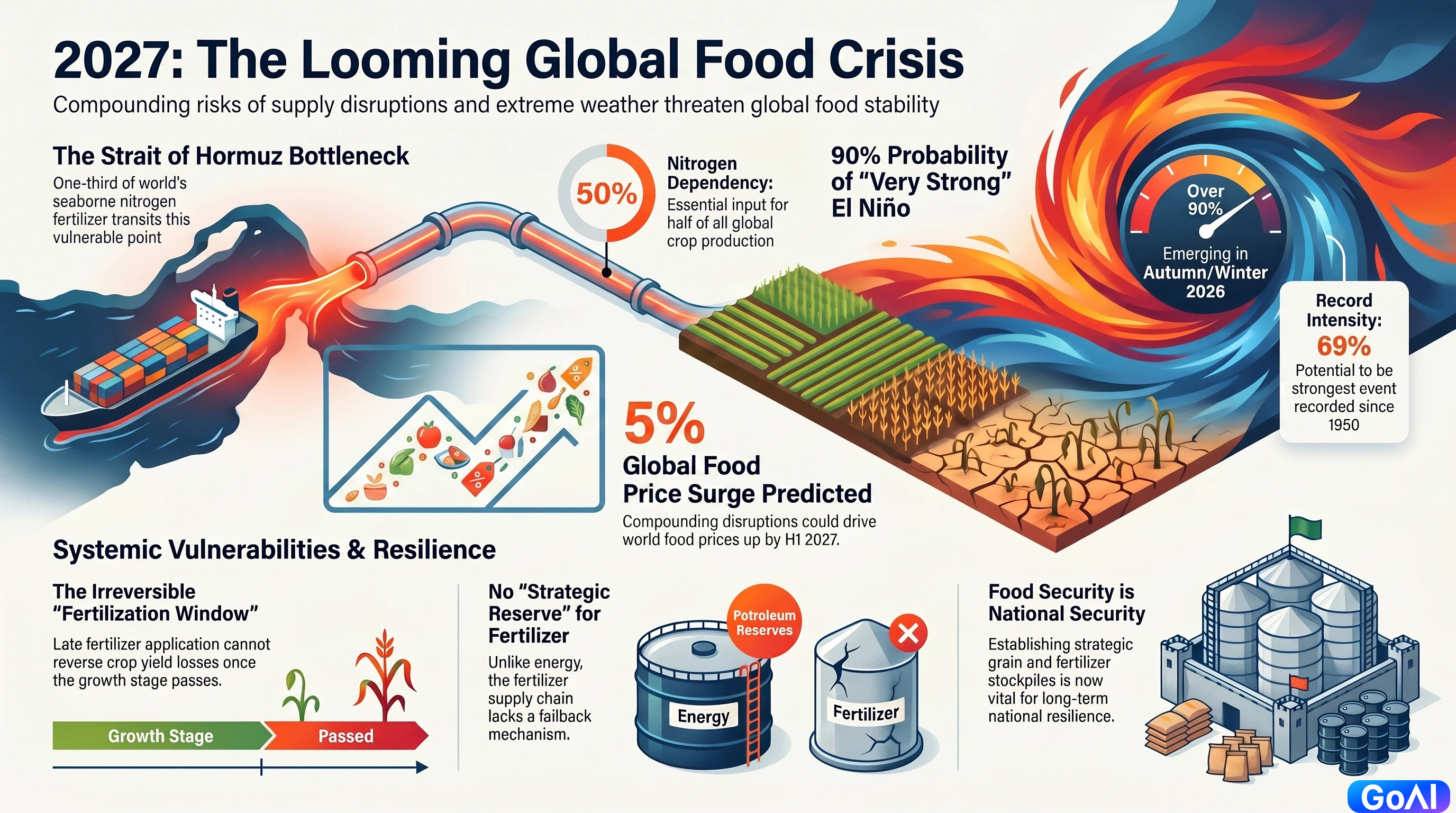
JPMorgan Chase has issued a fresh warning that compounding risks from global fertilizer disruptions and a super El Niño could drive world food prices up by 5% in the first half of 2027.
Unlike the energy sector, which can tap Strategic Petroleum Reserves to cushion supply shocks, the fertilizer supply chain possesses no comparable fallback mechanism.
If the critical fertilization window is missed, subsequent supply recoveries cannot reverse crop yield losses.
In a research report titled Food Security is National Security: Compounding Risks, JPMorgan noted that the current 3% food inflation rate in the U.S. is already straining household budgets.
While the U.S. does not face the highest direct food security risks, import dependencies will nevertheless transmit pricing pressures domestically.
Commodities heavily consumed in the U.S.—such as coffee, cocoa, and sugar—rely extensively on imports from primary producer nations that could face direct disruptions.
Fertilizer Shortages and Extreme Climate Risks Collide
JPMorgan highlighted dual compounding pressures confronting global food supply: fertilizer bottlenecks triggered by the Strait of Hormuz closure and the prospective emergence of an extremely strong El Niño.
Roughly one-third of the world's seaborne nitrogen fertilizer transits the Strait of Hormuz.
As nitrogen fertilizer is an essential input for approximately half of global crop production and must be applied during the early vegetative stages, supply disruptions could trigger lagged yield shocks extending over a full year.
Qu Dongyu, Director-General of the Food and Agriculture Organization (FAO), noted that agricultural crop cycles cannot be delayed and fertilizers must be applied at specific growth stages; if inputs fail to arrive on schedule, late applications cannot prevent yield declines.
Concurrently, the U.S. Climate Prediction Center projects an over 90% probability of a "very strong" El Niño emerging in the autumn and winter of 2026, with a 69% likelihood of it becoming the strongest El Niño event recorded since 1950.
El Niño drives sea surface temperatures in the east-central Pacific significantly above normal, disrupting global weather patterns and intensifying heatwaves and severe droughts across key agricultural regions.
JPMorgan expects Asia and Latin America to absorb the sharpest impacts.
Strategic Reserves Become Critical
While the U.S. is tapping its Strategic Petroleum Reserve to bridge energy shortfalls stemming from the Strait of Hormuz closure, China is leaning on national grain and fertilizer stockpiles to cushion supply disruptions, leaving it better positioned to weather potential food security shocks.
U.S. Agriculture Secretary Brooke Rollins stated that food security is fundamentally tied to national security, emphasizing that if the nation cannot feed itself, it cannot fully defend itself.
Sarah Kapnick, Global Head of Climate Advisory at JPMorgan, previously noted that climate change amplifies existing vulnerabilities across agriculture and food supply chains, with structural fault lines already surfacing.
The report concluded that while establishing strategic food and fertilizer reserves today may not fully avert potential 2027 shortfalls in time, it remains vital for bolstering long-term resilience against future climate-driven supply shocks.