
Global Bond Selloff Deepens on Fed Eve: 10-Year Treasury Yield Hits Highest Level Since 2007

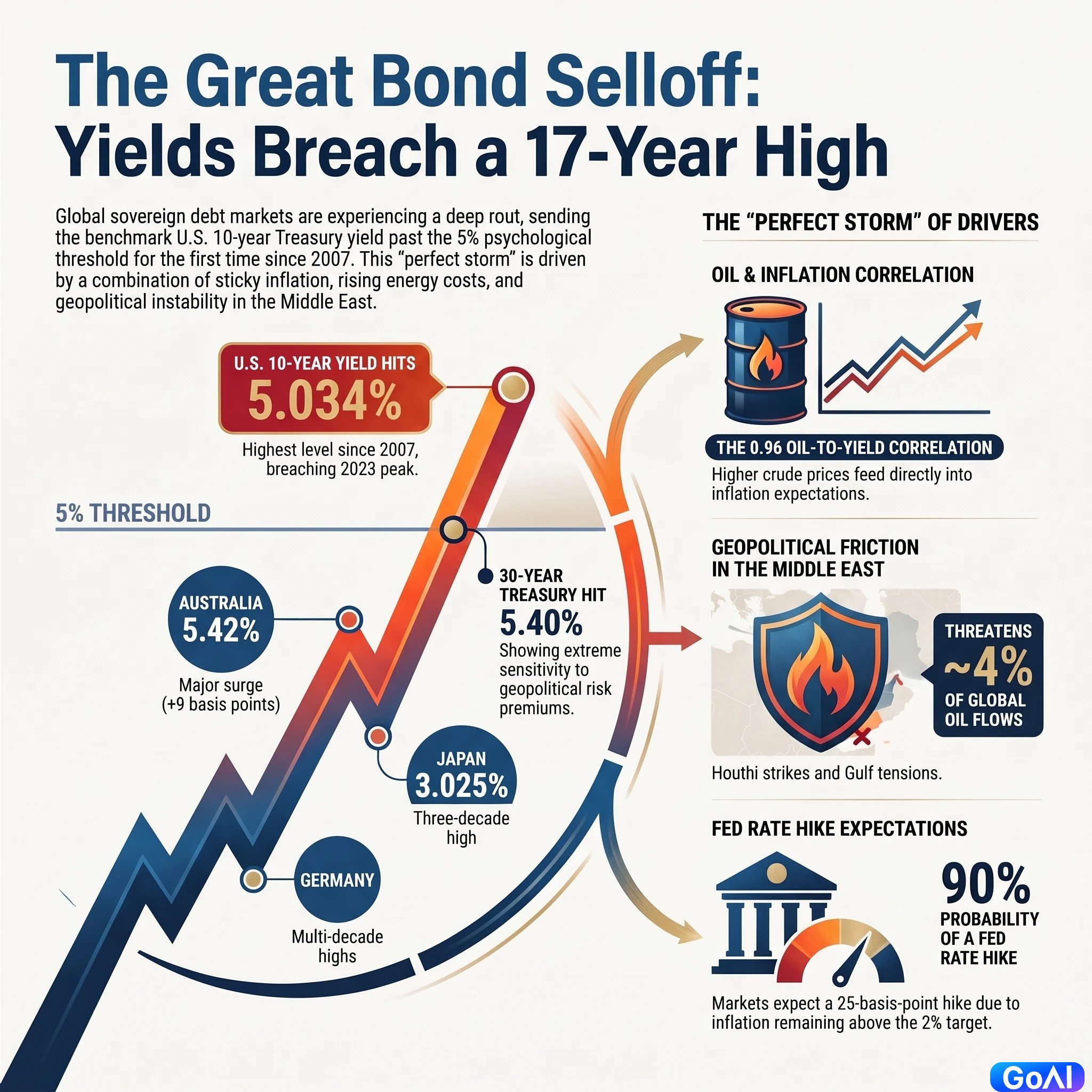
The rout across sovereign debt markets intensified on Tuesday on the eve of the Federal Reserve’s pivotal interest-rate decision, sending the benchmark 10-year U.S. Treasury yield to its highest mark since 2007.
The 10-year yield pushed past 5.02% to breach its 2023 peak, trading at 5.034% at publication time. The benchmark had briefly punctured the 5% psychological threshold on Monday before settling at 4.960%.
Longer-dated maturities, highly sensitive to geopolitical risk premiums, followed suit:
- The 30-year Treasury yield extended its climb to hit 5.40%, marking its highest level since June 2007.
- The policy-sensitive 2-year Treasury yield rose roughly 4 basis points to 4.68%.
The climb in the 10-year yield to near two-decade highs marks the latest milestone in a punishing sovereign bond retreat propelled by surging energy prices, heavy debt issuance, and stubborn inflationary pressures.
The move comes as the Fed convenes its two-day Federal Open Market Committee (FOMC) meeting. With August inflation prints holding well above the central bank’s 2% target, interest-rate futures tracked by the CME FedWatch Tool price in an implied probability of more than 90% for a 25-basis-point hike—the first tightening move since July 2023.
A fresh run-up in global crude benchmarks, spurred by heightened risks to Middle Eastern supply lines, provided the immediate catalyst for the leg higher in yields.
Geopolitical frictions flared as Yemen's Houthi movement launched fresh strikes against Saudi Arabia on Monday.
The escalation follows Riyadh’s attribution of earlier strikes on its East-West Pipeline to Iraqi-based, Iran-aligned militias—an outage the kingdom warned could disrupt roughly 4% of global oil flows.
Adding to the tension, Gulf states postponed scheduled talks with Tehran on Monday.
Both U.S. WTI and global benchmark Brent crude gained roughly 2% on Tuesday, building on Monday's 1% advance.
Domestically, the surge in the 10-year yield poses a political and economic headwind ahead of the midterm elections, as it directly sets borrowing baselines for consumer mortgages and corporate credit.
The spike runs counter to stated policy objectives from Treasury Secretary Scott Bessent, who previously cited lowering 10-year yields as an administration priority.
The bond market rout extended across major international debt hubs:
- Japan’s 10-year JGB yield crossed back above 3% to touch 3.025%, a three-decade high, ahead of Friday's Bank of Japan policy verdict, where markets broadly expect a 25-basis-point hike to 1.25%.
- Germany’s 10-year Bund yield climbed 6 basis points to 3.57%.
- France’s 10-year OAT yield jumped 5 basis points to 4.5531%, its highest level since September 2008.
- Australia’s 10-year yield surged 9 basis points to reach 5.42%.
- In the UK, long-dated gilt yields traded near multi-decade highs amid reports the Bank of England may soon pause active sales of its quantitative easing bond portfolio.
Wall Street Analysts Weigh In
"The 10-year U.S. Treasury yield is extraordinarily sensitive to inflation expectations," said Jonathan Liang, Chief Investment Officer of Fixed Income and FX at Standard Chartered. "With inflation metrics holding above the Fed's 2% target, this tight coupling is poised to persist."
BMO Capital Markets data shows the one-month rolling correlation between front-month WTI crude futures and the 10-year Treasury yield has surged to 0.96.
"Put simply, higher oil feeds directly into inflation expectations, and vice versa," noted Steve Sosnick, Chief Strategist at Interactive Brokers. "
While this relationship isn't always so direct, right now the geopolitical drivers and global inflation backdrop are so acute that they have dramatically amplified what is typically a moderate correlation. As long as oil remains firm, it will exert upward pressure on yields."
Commerzbank Research strategists added that the surge reflects an intersection of sticky inflation, elevated energy benchmarks, expansive sovereign deficit funding, and heavy corporate bond issuance related to artificial-intelligence infrastructure.
A sustained residency above 5% on the 10-year note threatens to further tighten broader financial conditions.
However, Mizuho Securities suggests the selloff could lose momentum as yields reach attractive carry levels.
"Expectations for a Fed rate hike are increasingly priced into the short end of the curve, pulling the 10-year higher in sympathy," said Hidehiro Joke, Senior Bond Strategist at Mizuho Securities in Tokyo.
"It appears unlikely the 10-year will march further toward 5.25% or 5.5%, as carry and roll-down should comfortably offset marginal financing costs." Joke added that as the passthrough effects of tariffs diminish, disinflation should reassert itself, limiting the Fed’s appetite to keep rates restrictive indefinitely.
Strategists also flag an asymmetrical risk: a Fed pause. Should the FOMC hold rates steady, or should Fed Chair Kevin Warsh signal that the tightening trajectory is shallower than money markets imply, fixed-income investors could demand an even larger term premium to guard against unchecked inflation risks.
"A decision to stand pat this week would severely impair the Fed’s inflation-fighting credibility," said Vail Hartman, U.S. Rates Strategist at BMO Capital Markets. "The market is not only vulnerable to an unexpected pause, but also to a 'dovish hike' if the dot plot or press conference conveys excessive patience."