
JPMorgan Flags Tactical Entry: Bitcoin Upside Potential Now Outstrips Gold

While ballooning U.S. sovereign debt and expectations of structural dollar debasement have led Wall Street to maintain a secular bull thesis for gold—even as bullion absorbs near-term headwinds from the Federal Reserve's rate-hike campaign—JPMorgan sees a more compelling immediate setup elsewhere.
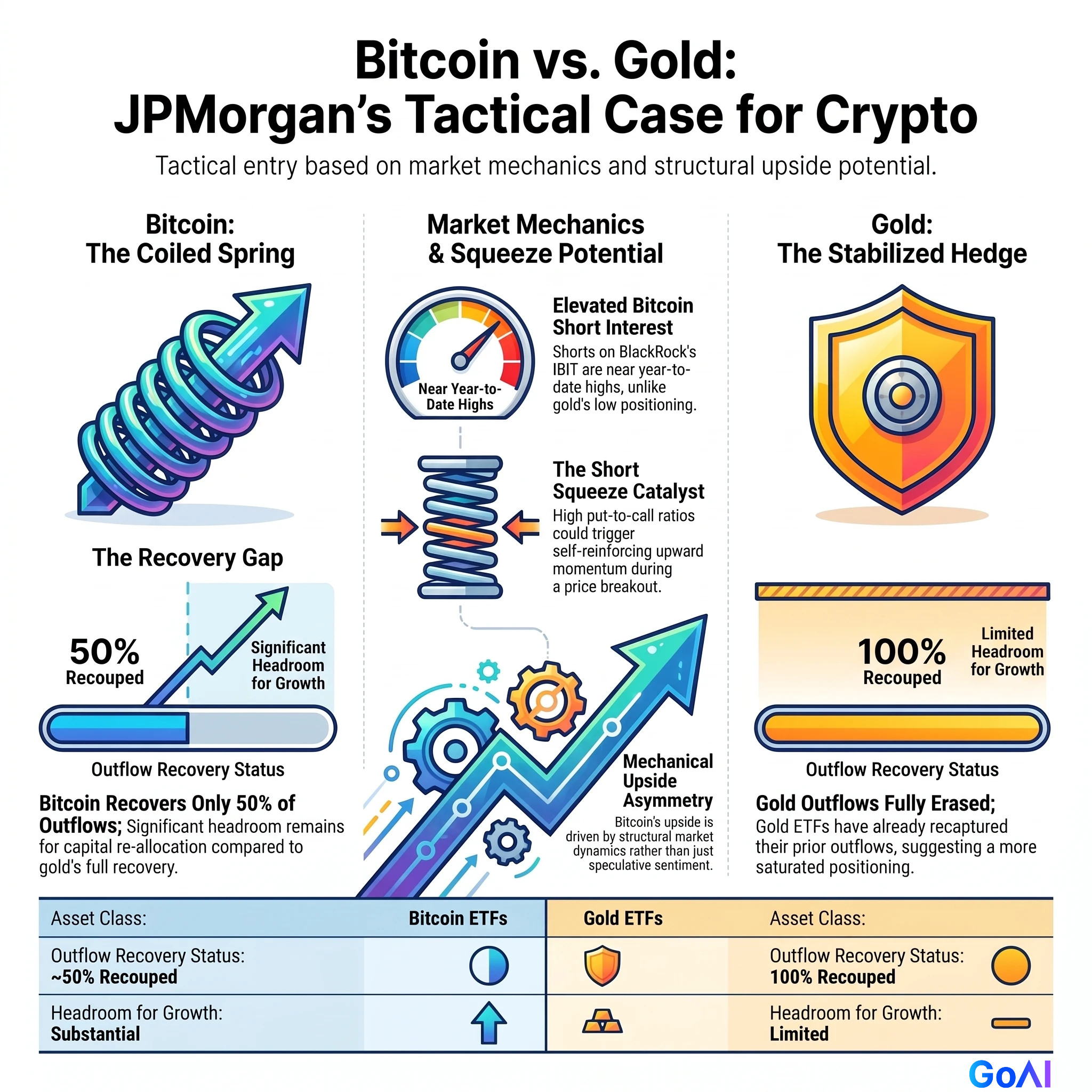
In a recent strategy note, JPMorgan strategists argue that Bitcoin currently offers greater upside potential than gold, driven not by speculative crypto sentiment, but by mechanical and structural market dynamics.
A team led by Nikolaos Panigirtzoglou highlights two primary drivers favoring Bitcoin over gold:
- Asymmetric Inflow Recovery: Total capital flows returning to spot Bitcoin ETFs remain substantially smaller than the flows recaptured by gold ETFs.
- Elevated Short Positioning: A heavy build-up of short interest in Bitcoin ETFs creates favorable preconditions for a short squeeze—a tailwind largely absent in physical gold vehicles.
Constructive on Bearish Positioning
Both gold and Bitcoin ETFs have logged significant inflows since late July, but the recovery trajectories have diverged sharply:
- Gold ETFs have fully erased their 2026 outflows to date.
- Bitcoin ETFs have recouped only about 50% of prior outflows, leaving substantial headroom for re-allocation.
Concurrently, short interest in BlackRock’s iShares Bitcoin Trust (IBIT) is hovering near year-to-date highs, signaling that institutional desks are actively shorting the vehicle or utilizing it aggressively as a portfolio hedge.
By contrast, short positioning in the SPDR Gold Shares ETF (GLD) sits comfortably below its historical baseline.
Furthermore, the put-to-call open interest ratio on Bitcoin ETFs remains elevated relative to gold counterparts.
JPMorgan strategists note that this positioning skew could fuel self-reinforcing upward momentum: should spot prices break higher, subsequent short covering and delta-hedging could trigger an accelerated short squeeze.
The bank did not publish updated price targets for either asset, noting that the framework is designed to exploit relative upside asymmetry rather than forecast absolute price levels.