
Historic First: U.S. Diesel Tops $6.50/Gallon, Threatening to Rekindle Broader Inflation

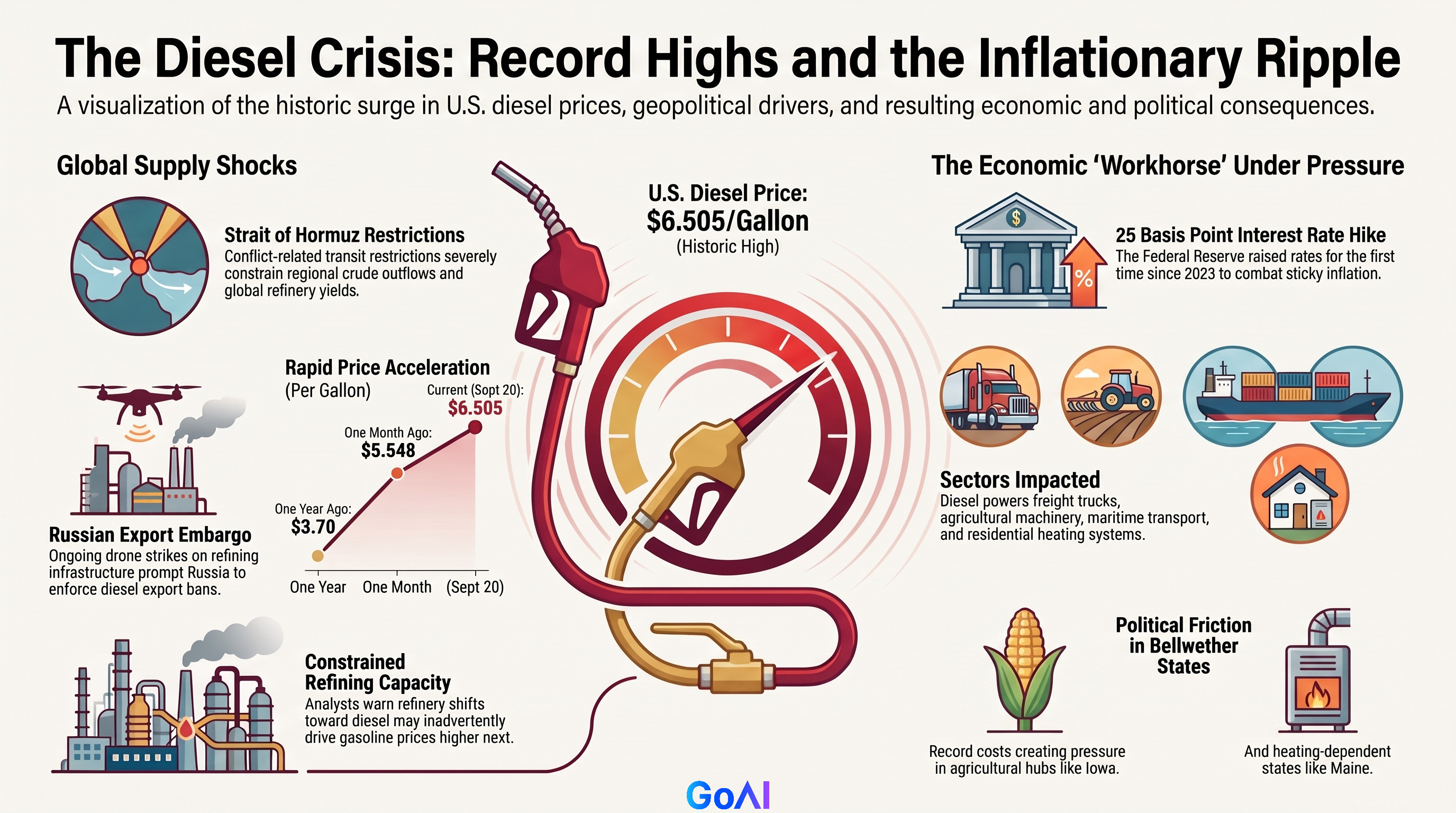
As energy markets absorb the ongoing fallout from the military conflict involving Iran, average U.S. retail diesel prices have topped $6.50 per gallon for the first time in history, threatening to exacerbate an already elevated inflationary environment.
According to data from the American Automobile Association (AAA), the national average price for diesel climbed to $6.505 per gallon as of September 20—up sharply from $6.204 a week earlier, $5.548 a month ago, and just $3.70 this time last year.
The rally has gathered pace throughout September, surging over 87 cents month-to-date in a near-unbroken daily advance.
Global diesel supplies face an acute squeeze as tanker transit through the Strait of Hormuz remains restricted.
While limited alternative routes have partially reopened, regional crude outflows have yet to return to pre-conflict levels, constraining refinery run rates and middle distillate yields globally.
Compounding the supply shock, Russia has enforced an export embargo on diesel, which policymakers may extend into October as recurring Ukrainian drone strikes continue to disrupt domestic refining infrastructure.
Over the weekend, the Moscow Refinery was targeted in one of the largest nighttime drone operations recorded this year.
The national average for diesel first breached the $6.00 mark just ten days ago. Analysts warn that record distillate prices threaten to transmit fresh price pressures across the entire supply chain.
While the vast majority of U.S. passenger vehicles run on gasoline, diesel serves as the industrial workhorse of the economy—powering heavy-duty freight trucks, agricultural machinery, backup generation, maritime transport, freight rail, and residential heating systems—touching virtually every tier of commerce.
With midterm elections approaching, record diesel costs present growing political friction for President Trump and the Republican Party in agricultural bellwethers such as Iowa, as well as heating-oil-dependent states across the Northeast including Maine.
At the policy level, escalating prices at the pump have fueled speculation that the Trump administration might weigh product export limits to shore up domestic stockpiles.
However, Interior Secretary Doug Burgum pushed back against that strategy last week, arguing that an embargo on crude or refined product exports would do little to relieve domestic fuel price pressures.
Sticky inflation backdrop prompted the Federal Reserve to lift the federal funds rate by 25 basis points last week—its first hike since 2023.
Over the weekend, Minneapolis Fed President Neel Kashkari reiterated that inflation remains uncomfortably high and warned that price pressures are increasingly permeating broader consumer and business baskets beyond the initial energy shock.
In a recent research note, Goldman Sachs cautioned that diesel prices will face persistent upward pressure amid constrained global refining capacity. The bank also noted that as refiners shift yields to maximize lucrative middle distillates, gasoline may ultimately hold "further upside risk" as motor fuel inventories tighten in turn.