
Rare Signal Flashes for US Equities: Probability of Entering a Bear Market Tops 67%

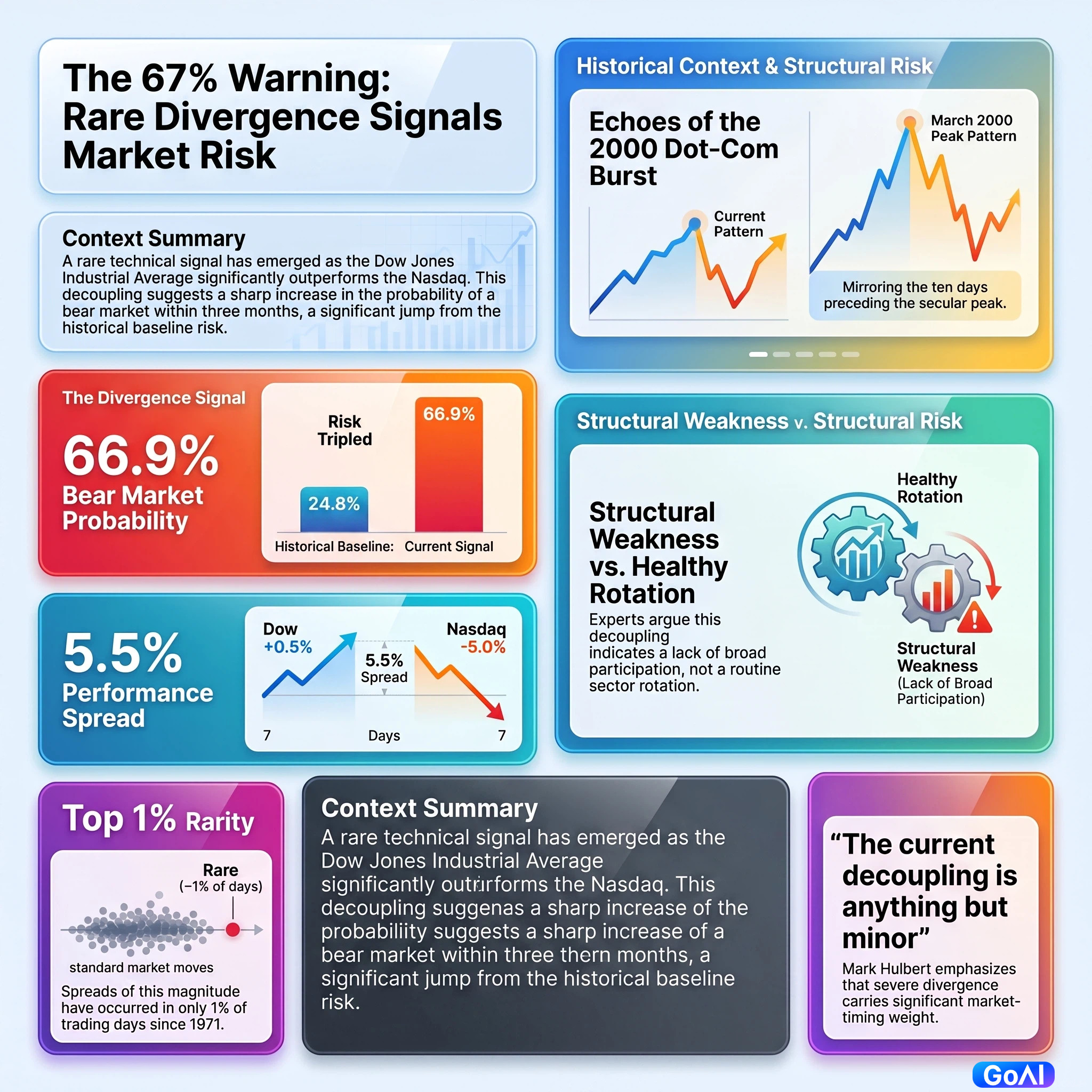
Behind the relentless rally in US equities lies a cluster of structural anxieties: stretched valuations, fears of an artificial intelligence bubble, and an emerging technical divergence. A rare signal has just flashed, with analytical models suggesting a 67% probability that the market is about to roll over into a bear market.
The severe performance gap between the Dow Jones Industrial Average (DJIA) and the technology-heavy Nasdaq Composite (COMP) indicates that the near-term risk of entering a bear market sits well above historical baselines.
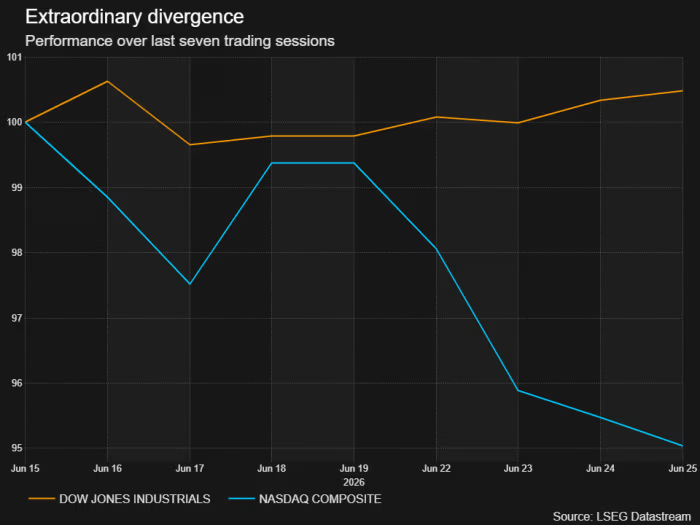
Data shows that during the seven trading sessions ended June 25, the Dow systematically outperformed the Nasdaq. Specifically, the Dow ticked up 0.5% while the Nasdaq shed 5.0%—creating a massive 7-day performance spread of 5.5 percentage points.
Remarkably, since the inception of the Nasdaq Composite in 1971, a 7-day spread of this magnitude has occurred in only about 1% of all trading days, with a significant cluster transpirring immediately prior to historical bull market peaks.
A prime historical proxy occurred in March 2000, just before the dot-com bubble burst. In the ten trading sessions leading up to that secular peak, seven days registered performance spreads matching or exceeding current levels. In the subsequent bear market, the Nasdaq Composite collapsed by nearly 80%.
To be sure, a divergence of this scale does not guarantee an immediate, deterministic shift into a bear market.
However, Mark Hulbert, a columnist for MarketWatch, pointed out that since 1971, whenever the Dow and Nasdaq have decoupled to this extent, the probability of the stock market entering a bear market within three months climbs to 66.9%.
"That is vastly higher than the baseline expectation for a bear market, which stands at just 24.8% for any random three-month window since 1971," he added.
Hulbert also noted that these statistical metrics suggest some Wall Street commentators may be misleading themselves—and their clients—by framing the Nasdaq’s recent slide as a healthy, routine sector rotation within an ongoing bull run.
"That thesis would carry more structural weight if the divergence between the blue-chip Dow and the tech-heavy Nasdaq were minor. Minor performance gaps are entirely normal and carry almost zero market-timing significance. But the current decoupling is anything but minor," he wrote.
Hulbert concluded that while this model does not guarantee an imminent bear market, investors must recognize that a genuinely healthy equity market requires broad, comprehensive participation—a characteristic entirely absent from the current tape.