
Up 858% in Six Months! SanDisk Target Price Ramped Again—Will the Top US Performer Keep Running?

On Tuesday, Bernstein hiked its price target for SanDisk by nearly 80%, from $1,700 to $3,000, bringing it close to Wall Street's street-high target of $3,250, while maintaining an "Outperform" rating on the stock.
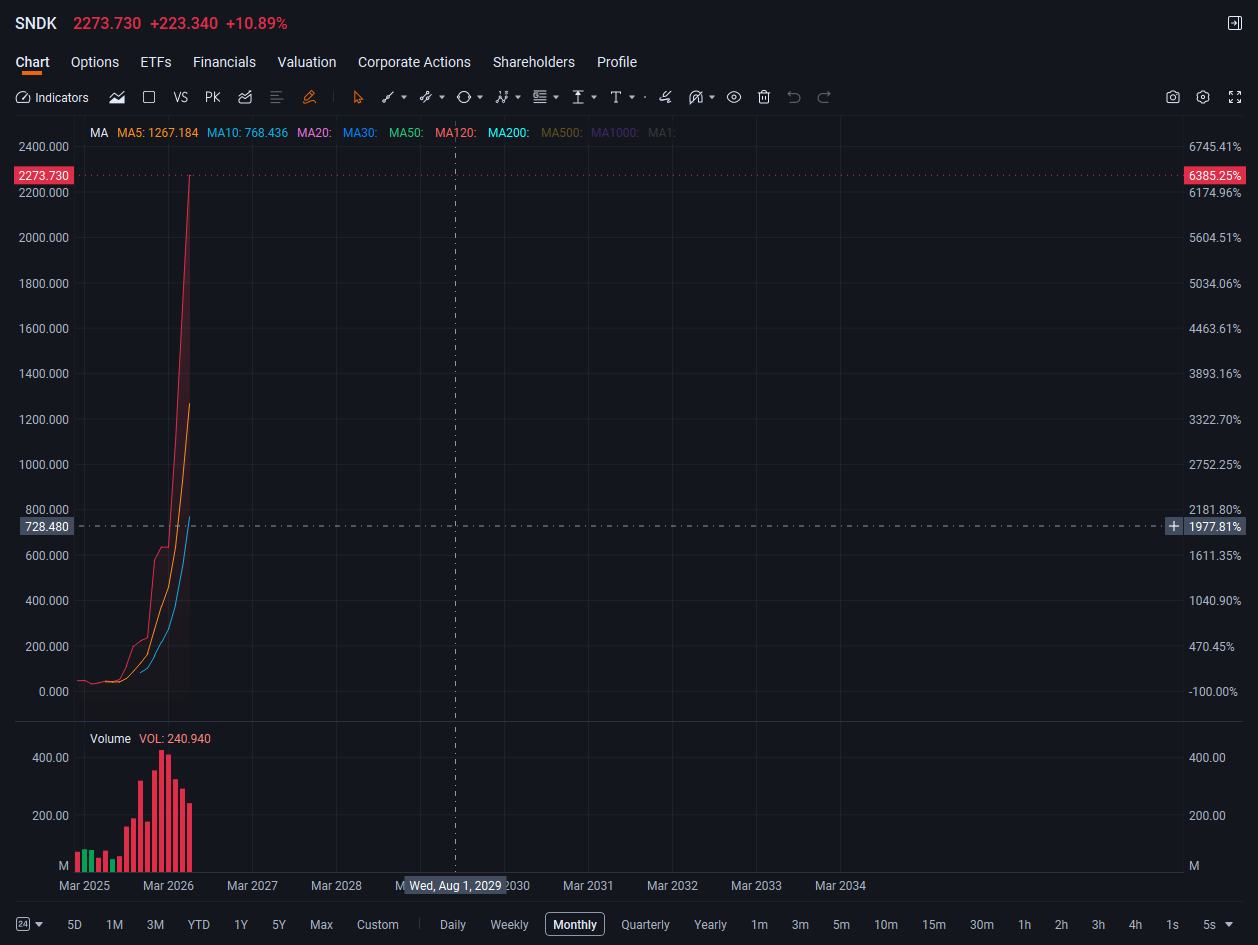
Based on Tuesday's closing price, this new target implies approximately 32% remaining upside for SanDisk.
The core catalyst behind Bernstein's aggressive price target revision is a fundamental shift in how memory chip manufacturers structure Long-Term Agreements (LTAs) with customers. Bernstein notes that this evolution structurally dampens the risk of extreme earnings volatility during industry downcycles.
Analyst Mark Newman noted that this new generation of memory LTAs differs significantly from legacy frameworks, which were historically "heavily biased toward customers."
The new contractual framework introduces three structural shifts:
-
Pricing Mechanisms: The adoption of fixed-price or collar-pricing structures, decoupling contracts from spot market volatility;
-
Upfront Financial Commitments: The integration of upfront financial guarantees to lock in buyers, forcing customers to deploy significant capital commitments beforehand and sharply raising the cost of default;
-
Contract Durations: An extension of contract tenors to three-to-five years, up from the historical one-to-two-year standard.
Bernstein estimates that under its recently signed LTAs, SanDisk has secured a floor price of roughly $0.29 per GB, lining up directly with the firm's projected average selling price (ASP) for the second quarter of 2026.
The lynchpin of Newman's thesis relies on a granular reading of how these upfront financial guarantees operate mechanically. He argues that the broader market misinterprets these commitments, erroneously viewing them as a static percentage of total contract value.
"In reality, this ratio is dynamic," he wrote. As revenue is systematically recognized over the life of the contract, the absolute dollar value of the guarantee covers a shrinking pool of remaining obligations. This implies that contract protection actually intensifies during the outer years of the lifecycle—precisely when an industry downturn is most likely to materialize.
Bernstein also stress-tested an extreme worst-case scenario where customers breach their LTAs the moment default becomes economically advantageous.
Under this framework, the firm estimates that if 60% of SanDisk’s shipment volume is insulated by LTAs, the company’s FY30 earnings per share (EPS) would still reach $214, even if memory pricing collapses 72% from its cyclical peak. Without LTA protection, EPS under the same grim scenario would drop to roughly $81.
Concurrently, Bernstein lifted its base-case EPS forecasts for SanDisk to $243 for FY27 and $272 for FY28. Under its bull-case model, those numbers climb to $350 and $400, respectively. The revisions reflect expectations for a stronger, more resilient pricing upcycle, paired with a structurally de-risked floor for the next inevitable downturn.
On Tuesday, SanDisk shares surged nearly 11% to close at $2,273.73.
Over the first half of 2026, SanDisk equity skyrocketed 858%, securing its crown as the single top-performing stock within the S&P 500.
Jefferies analyst Blayne Curtis similarly raised his SanDisk price target to $3,000 last Friday. He noted that structurally higher memory pricing, alongside SanDisk's expanding market share within the enterprise solid-state drive (eSSD) matrix, will continue to underpin the company's forward growth trajectory.
GoAI's advice
I have also conducted an independent analysis of SanDisk's share price using GoAI's Deep Dive feature.
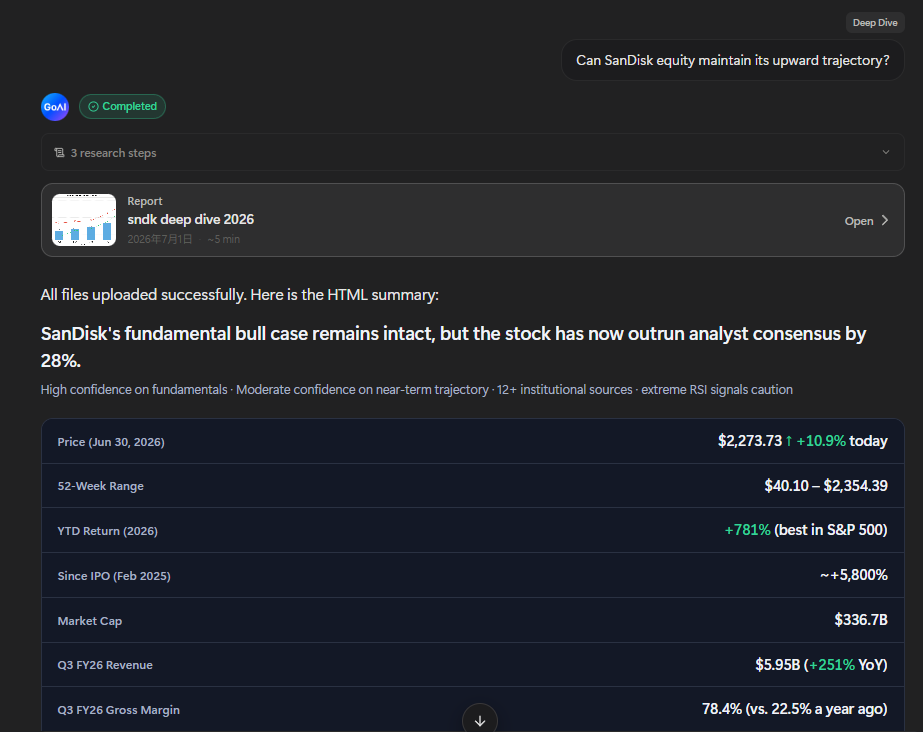
SanDisk Corporation (SNDK) has delivered one of the most extraordinary equity performances in modern semiconductor history.
Spun off from Western Digital in February 2025 at approximately $38.50 per share, the stock closed at $2,273.73 on June 30, 2026 — a ~5,800% total return in roughly 16 months. Year-to-date 2026 gains exceed 780%, making SNDK the best-performing stock in the S&P 500 this year.
The fundamental driver is genuine: a structural NAND flash supply shortage triggered by explosive AI data center demand, which has transformed SanDisk from a commodity memory vendor into an enterprise infrastructure powerhouse. Q3 FY2026 gross margins reached 78.4% — software-like levels on semiconductor hardware — a direct reflection of pricing power so strong that Citi forecasts average NAND prices rising 186% year-over-year in 2026.
However, at $2,273, the stock now trades above the consensus analyst price target of ~$1,773, the monthly RSI has touched 99 (a historical extreme), insiders are selling, and the South Korean government announced a massive Samsung/SK Hynix capacity expansion plan that could re-tilt supply by 2027–2028.
The question of whether this trajectory is sustainable depends critically on whether the current NAND cycle is structurally longer — or just another cyclical peak.
Verdict: Structurally bullish, but near-term risk-reward has inverted. The fundamental thesis is intact through at least Q4 FY2026 and into early FY2027, backed by $42 billion in contracted revenue. However, the stock has run beyond even the most bullish analyst consensus prices, and a 20–45% drawdown to the $1,250–$1,750 range would still represent a favorable re-entry within the same bull thesis.