
Samsung Q2 Operating Profit Forecasted to Surge 17-Fold, But AI Spending Outlook Signals Risks

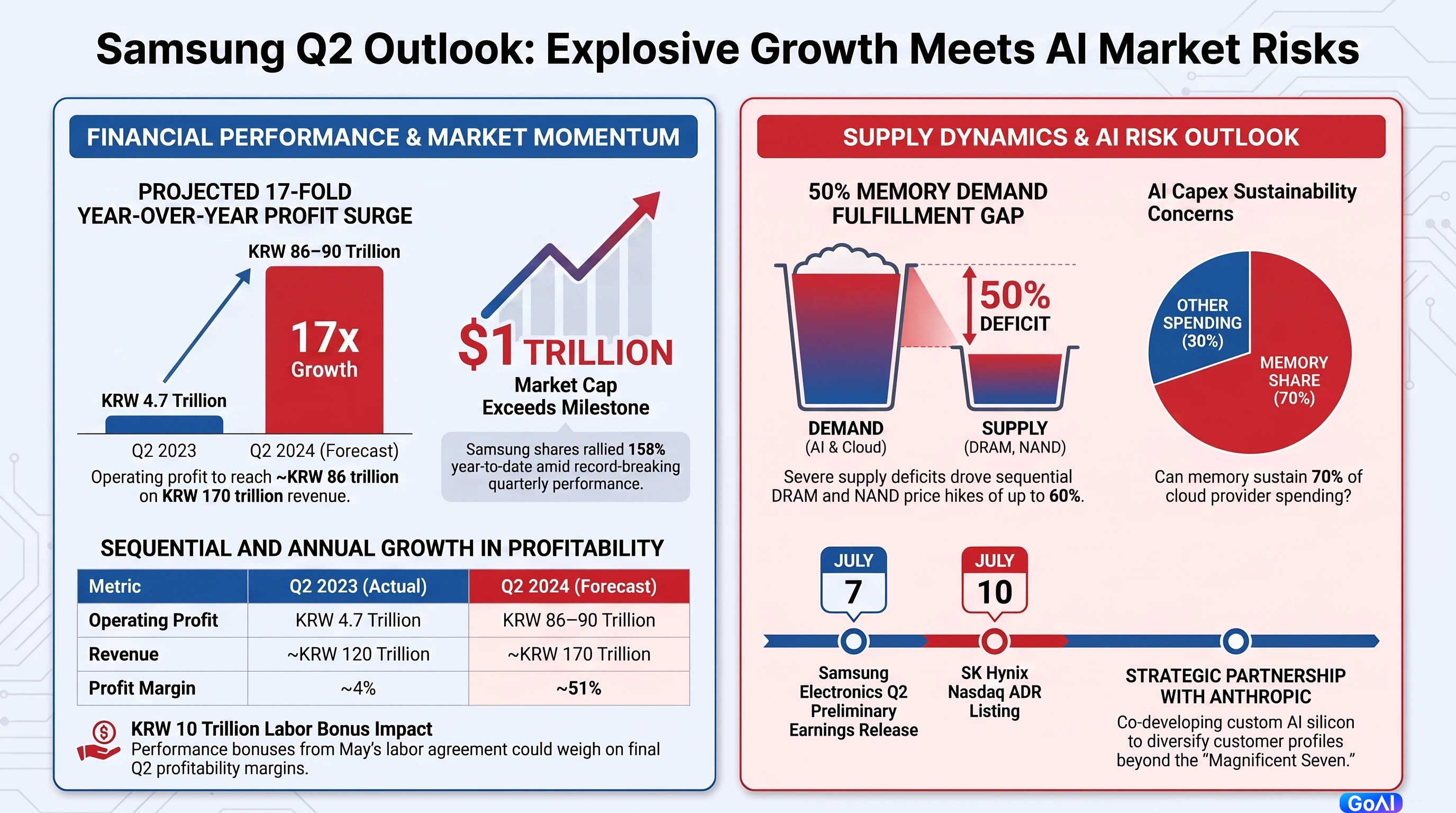
This week, two pivotal events are set to decide the near-term fate of South Korea’s twin market pillars, Samsung Electronics and SK Hynix.
Samsung Electronics will release its preliminary Q2 earnings results this Tuesday (July 7), followed just three days later by SK Hynix’s Nasdaq ADR listing on Friday (July 10).
The South Korean equity market has mirrored a rollercoaster lately, with intraday swings frequently touching 10%.
These two milestones—particularly Samsung’s preliminary print—will not only dictate the direction of the domestic market but will likely reverberate across global memory equities.
Samsung Positioned for Record Earnings
Wall Street broadly expects Samsung Electronics to deliver historic preliminary earnings for the second quarter.
According to analyst consensus compiled by LSEG, Samsung’s Q2 revenue is projected to hit approximately KRW 170 trillion ($111.2 billion), with operating profit hovering around KRW 86 trillion ($56.2 billion). Some brokerages are forecasting figures as high as KRW 90 trillion ($58.9 billion).
Should performance meet these targets, Q2 operating profit will effortlessly eclipse the KRW 57.2 trillion recorded in Q1, marking a staggering 17-fold surge compared to the KRW 4.7 trillion reported in the same period last year. This would represent Samsung’s third consecutive quarter of record-breaking operating profits.
Kim Dong-won, Head of Research at KB Securities, expects Q2 operating profit to expand 18-fold year-over-year to KRW 90 trillion, yielding an operating margin of 51%.
"Supply deficits are intensifying," Kim added. "Client demand fulfillment for memory sat at just 50% in June, while sequential price hikes for both DRAM and NAND flash are poised to reach up to 60% quarter-on-quarter."
Citi noted last week that average selling prices (ASPs) for DRAM and NAND rose 44% and 53% sequentially in Q2, respectively.
This structural shortage has powered massive equity rallies for memory producers. Year-to-date, shares of Samsung Electronics, SK Hynix, and Micron Technology have surged 158%, 273%, and 242%, respectively, driving the market capitalizations of all three companies past the $1 trillion milestone.
Nomura indicated in a report that underpinned by resilient demand from consumer memory, legacy computing, and AI data centers, commodity DRAM prices are projected to rise another 24% sequentially in Q3 (July–September), while NAND prices are expected to climb 25%.
May Labor Negotiations Loom Over Q2 Outlays
Some analysts point out that if the one-time performance bonus outlays agreed upon during May’s labor negotiations—estimated at up to KRW 10 trillion—are accounted for in Q2, Samsung's underlying operating profit would have breached the KRW 100 trillion ($65.4 billion) threshold for the first time.
Conversely, macro observers warn that if the provisioning for employee bonuses in Q2 exceeds current guidance, final earnings could fall short of consensus estimates.
In late May, Samsung averted a massive labor strike by finalizing a wage agreement that allocates 10.5% of the semiconductor division's operating profit toward special employee bonuses.
Some analysts estimate that cumulative bonus provisions could top KRW 40 trillion, making it a critical swing factor for Q2 profitability.
Are Greater Risks Ahead?
For global memory investors, the core question remains whether these robust earnings can directly translate into sustained equity gains. The answer hinges heavily on the future capital expenditure projections of tech megacaps.
While the market widely acknowledges the earnings recovery driven by explosive chip demand, global Big Tech platforms are beginning to signal potential headwinds.
J.P. Morgan noted in a recent brief that while investors agree memory supply-demand fundamentals remain exceptionally tight, many question whether memory’s share of cloud service provider (CSP) capex—estimated at 52% this year and projected to clear 70% next year—can continue expanding at this velocity.
Apple serves as a prime case study. Facing surging component costs, Apple lifted pricing across its Mac and iPad hardware lineups on June 25. The move sparked intense market anxieties regarding demand elasticity and the sustainability of memory chip margins, triggering a sharp pullback in semiconductor equities, including Samsung and SK Hynix.
According to J.P. Morgan, institutional investors are seeking concrete evidence that breakthroughs in AI services are translating into accelerated cloud software and AI revenue growth, which would justify memory's expanding share of AI infrastructure outlays.
Alternatively, demand visibility could strengthen significantly if Samsung and SK Hynix successfully diversify their customer profiles beyond the "Magnificent Seven."
A prime example is Samsung's potential partnership with Anthropic.
On July 2, reports emerged that Anthropic, the developer behind the "Claude" AI models, is in advanced discussions with Samsung Electronics' foundry division to co-develop and manufacture custom AI silicon. Following the news, Samsung shares jumped 8.22%, while SK Hynix surged 10.88% the following day.