
Shift Focus From Mega-Cap Tech: Investors Turn to Small- and Mid-Caps

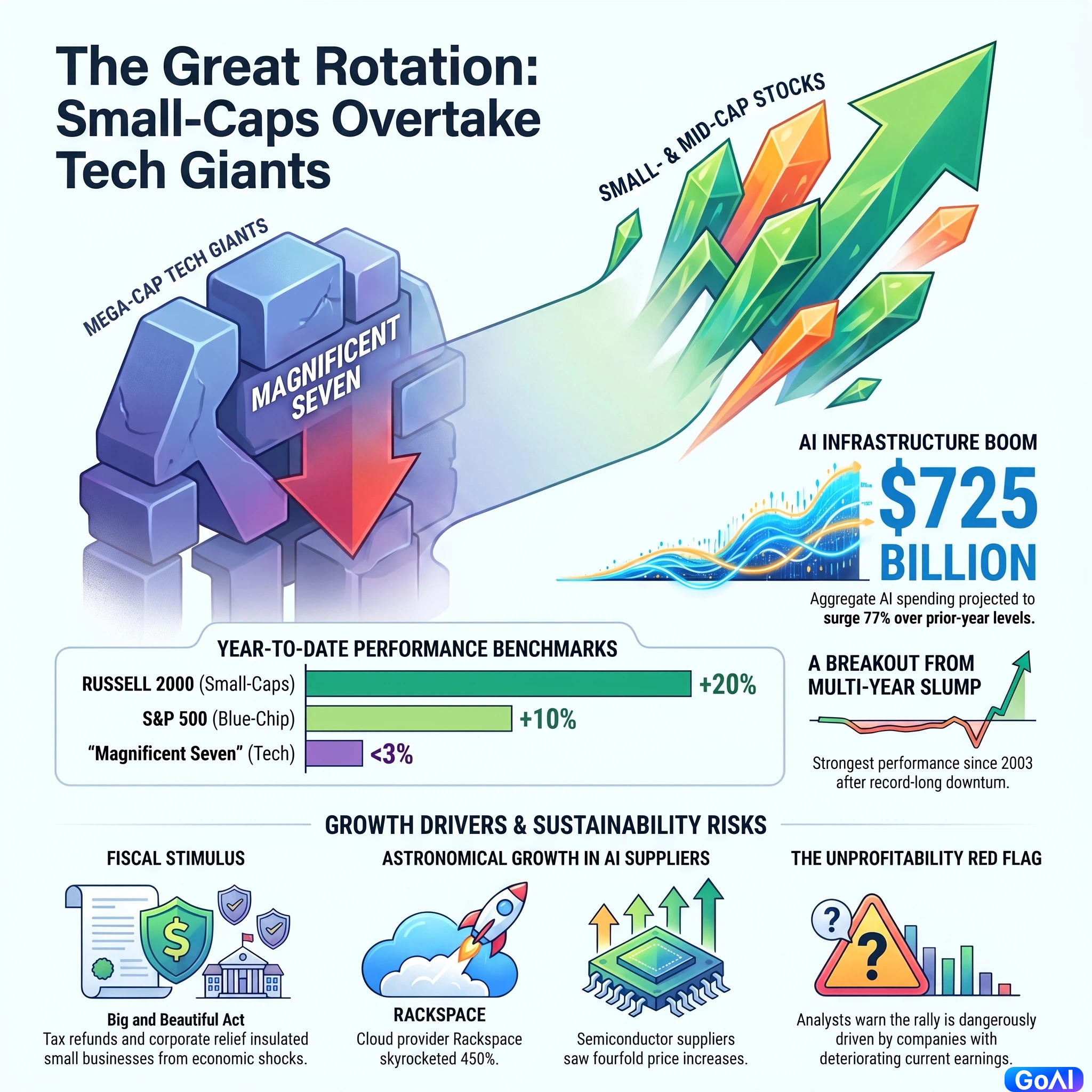
U.S. small- and mid-cap stocks are breaking out of a multi-year slump to post their best returns in over two decades, as investors rotate away from high-growth tech giants toward undervalued names poised to benefit from the artificial intelligence investment boom.
Year to date, the small-cap benchmark Russell 2000 Index has surged 20%, tracking toward its strongest performance since 2003, while the blue-chip S&P 500 has climbed 10% and the "Magnificent Seven" tech heavyweights managed a gain of less than 3%.
This rebound follows the longest prolonged slump on record for smaller equities.
The pivot comes as investors worry whether mega-cap tech can translate massive capital expenditures into bottom-line profits, prompting them to chase smaller firms capturing this infrastructure spend, boosted by a resilient U.S. economy and highly favorable fiscal policies.
"For years, investors waiting for a broader market rally were repeatedly disappointed as big tech dominated returns," noted Kriti Gupta, global investment strategist at J.P. Morgan Private Bank.
"But the baton is finally being passed, and investors no longer have to rely on a tiny handful of winners."
Manish Kabra, head of U.S. equity strategy at Société Générale, added that the U.S. AI "hyper-cycle" is acting as a major earnings catalyst, specifically lifting small- and mid-cap technology and industrial firms as aggressive data center spending ripples out to fuel broader economic growth.
Based on projections issued last quarter by tech titans like Amazon, Meta, Microsoft, and Alphabet, aggregate spending on AI infrastructure is expected to hit roughly $725 billion this year—a 77% surge over prior-year levels.
Concurrently, tax relief programs targeted at small businesses and households are helping the domestic economy insulate itself from energy price shocks triggered by conflicts in the Middle East.
Kabra noted that the "Big and Beautiful Act"—signed into law by President Trump last summer—delivered substantial tax refunds to American citizens this spring, while smaller enterprises simultaneously captured corporate income tax relief alongside highly lucrative adjustments to capital depreciation rules.
"This legislation, along with the consumer purchasing power saved by tax refunds, rescued the American consumer," Kabra noted. "Without this bill, we would not be seeing double-digit returns across every single small- and mid-cap sector."
Sustainability Questioned
From a performance standpoint, the small- and mid-cap stars of the year are concentrated in technology and industrial infrastructure nodes feeding directly into AI hardware pipelines.
For instance, component suppliers to semiconductor manufacturing giants, such as Ichor Holdings and Ultra Clean Holdings, have seen their stock prices surge more than fourfold this year, while cloud computing provider Rackspace Technology skyrocketed by 450%.
Dane Smith, head of North American investment strategy and research at State Street Global Advisors, remains optimistic about U.S. small-caps due to their strong fundamentals and relative cheapness compared to the broader market.
"The sky-high valuation multiples and severe concentration risks of large-caps have troubled investors this year," Smith said. "Small-caps offer a much-needed relief valve for those exact structural risks."
Despite the broadening enthusiasm, several prominent Wall Street analysts warn that the underlying mechanics of this small-cap rally look dangerously fragile.
Critics point out that beneath the stellar headline gains lies a basket of companies with rapidly deteriorating current earnings, trading strictly on distant promises of future profitability, which once again highlights investor over-optimism and a stock market bubble.
Max Kettner, chief multi-asset strategist at HSBC, cautioned that the Russell 2000's upward trajectory is being driven overwhelmingly by its unprofitable components.
"This isn't an underlying economic success story; it is driven by investors aggressively bidding up unprofitable tech companies to astronomical levels," Kettner remarked. "Is this style of trading sustainable? Absolutely not."