
ASML Beats, So Why Did Chip Stocks Fall?

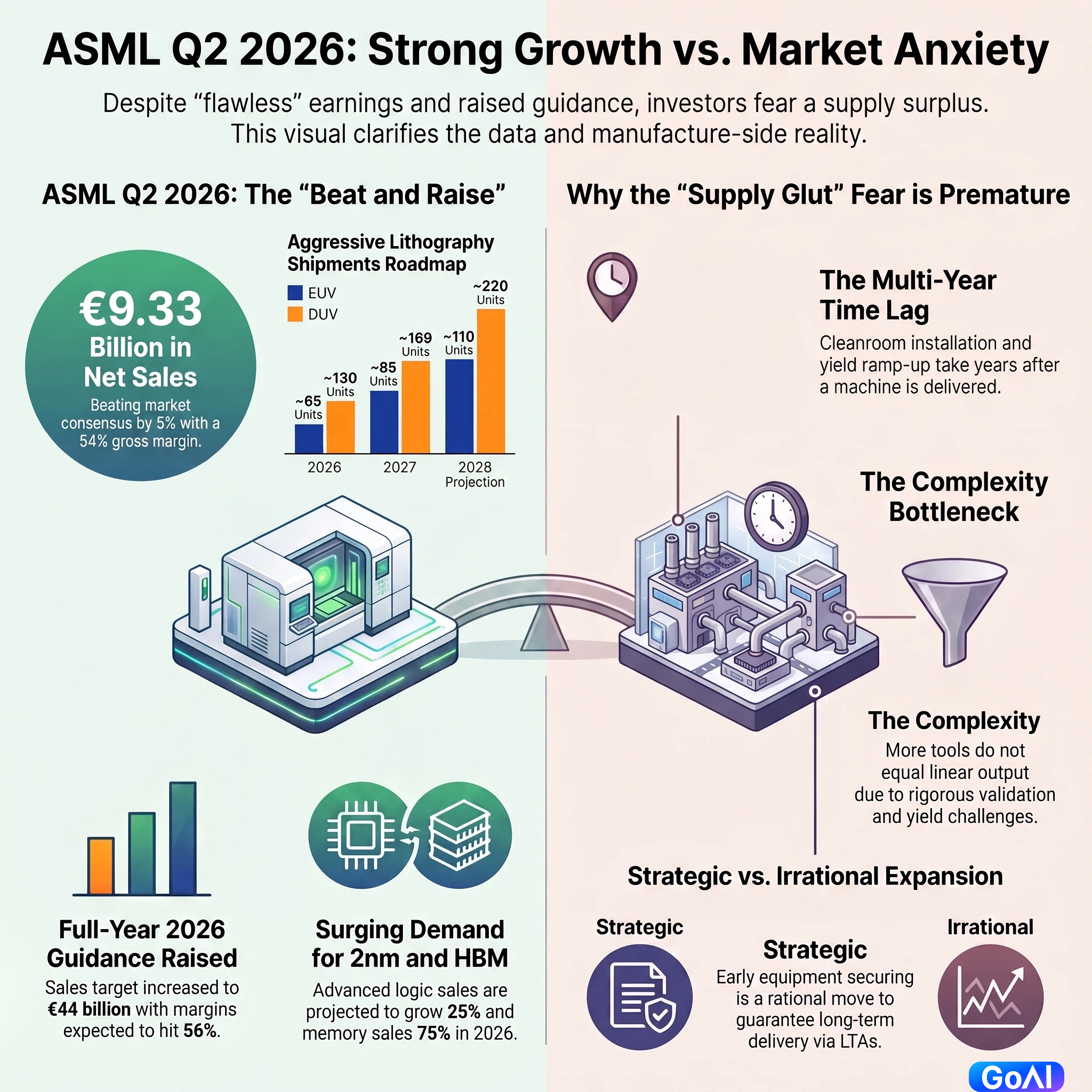
Why did the semiconductor sector lose its footing today despite ASML’s blowout earnings?
The knee-jerk reaction in the market stems from a common anxiety: if the demand for lithography machines is this strong, does it mean that memory and logic chipmakers will aggressively expand capacity, resolving the current supply deficit and capping prices?
Is the structural "price hike" thesis for semiconductors unraveling?
While this bearish outlook has taken hold of short-term sentiment, the stellar earnings report is actually solid evidence that the chip cycle’s upward trajectory remains fundamentally intact.
ASML Q2 2026 Earnings: A Clear "Beat and Raise"
ASML turned in a flawless Q2 2026 performance, beating expectations across the board and raising future guidance:
-
Net Sales: €9.33 billion (beating consensus by 5%).
-
EPS: €7.59 (beating consensus by 10%).
-
Gross Margin: 54% (3% above guidance).
-
Full-Year Guidance: The mid-point for 2026 sales was raised by ~16% to €44.0 billion, with the gross margin target bumped up to 56%.
Equipment Delivery Projections
-
Extreme Ultraviolet (EUV): Pacing ~65 advanced EUV shipments in 2026, rising 30% to 85 units in 2027. ASML is currently evaluating a further 30% increase to ~110 units by 2028.
-
Deep Ultraviolet (DUV): Tracking ~130 units in 2026, rising to ~169 in 2027. If the second wave of capacity expansion materializes, shipments could hit ~220 units by 2028.
This robust demand for lithography systems is driven entirely by aggressive expansions in advanced logic and memory nodes.
-
Advanced Logic: Management disclosed that customers are scaling up 5nm, 4nm, and 3nm capacities to meet demand for AI accelerators and co-processors, while actively preparing for 2nm volume production and mapping out 1.4nm nodes. ASML expects sales in the advanced logic foundry segment to grow by over 25% in 2026.
-
Memory: Tight supply dynamics for DDR5 and HBM are forcing customers to expand wafer fab capacities and migrate to advanced DRAM nodes. Because shrinking nodes require more EUV and immersion DUV steps, demand is driven by both absolute volume expansion and technological complexity. Consequently, ASML forecasts memory-related sales to surge by over 75% in 2026.
During the earnings call, CFO Roger Dassen noted that customer demand signals are exceptionally strong, prompting the company to actively model the 110-unit EUV capacity target for 2028.
Furthermore, The Information reported that ASML plans to raise equipment prices, including a 10% price hike on DUV systems.
The Market's Valuation for ASML
ASML's visible supply roadmap offers high earnings predictability. JPMorgan estimates that if these capacity targets translate to shipments, ASML's 2028 EPS could exceed €65.
Applying its five-year mid-point multiple of 33x, this implies a share price of over €2,140.
Goldman Sachs maintained its "Buy" rating and €2,000 price target, citing a highly visible demand runway—a sentiment echoed by Barclays and Morgan Stanley.
Why the Market Is Overreacting on Memory & Logic
While ASML's outlook is incredibly clear, it has inadvertently created a headwind for downstream chipmakers and memory producers.
The market is worried that a massive wave of lithography deliveries translates directly into a deluge of downstream wafer supply, which would inevitably kill the current pricing momentum.
This perspective, however, oversimplifies the physics of semiconductor manufacturing. Two main factors prevent immediate supply gluts:
1. The Time Lag
Ordering a lithography machine is not the same as turning on a factory. From placing an order to shipment, delivery, cleanroom installation, qualification, and finally yield ramp-up, the process takes years.
2. The Complexity Gap
For advanced HBM and cutting-edge logic, final usable capacity is governed by multiple bottleneck steps.
Even with more EUV systems on-site, producing qualified HBM silicon that can successfully pass rigorous validation (such as Nvidia's qualification process) is a highly complex task. The relationship between tool purchases and final output is far from linear.
In a supply-constrained environment governed by long-term agreements (LTAs), securing critical equipment early is the only rational way for chipmakers to guarantee they can deliver to downstream clients on time.
It buys them the runway required for debugging and yield optimization, ultimately boosting long-term profitability.
The Outlook: A Healthy Sector Rotation
In the near term, the semiconductor landscape is dividing into distinct phases:
-
Upstream Equipment & Materials: Will continue to enjoy high earnings visibility and near-term premium valuations.
-
Advanced Logic: Entering the latter stages of its price-hike narrative.
-
Memory: Transitioning from a pure "price-hike" phase to a "capacity-expansion" phase, which naturally introduces elevated volatility.
While semiconductor positioning is currently crowded and retail participation is high—leading to amplified swings—the underlying structural trends remain robust.
Once the market digests this near-term volatility, and as mega-cap tech earnings begin to land, the semiconductor index is well-positioned to retest its previous highs.
The semiconductor upcycle will eventually end, but it is not ending now. Keep a long-term horizon, and remain patient.